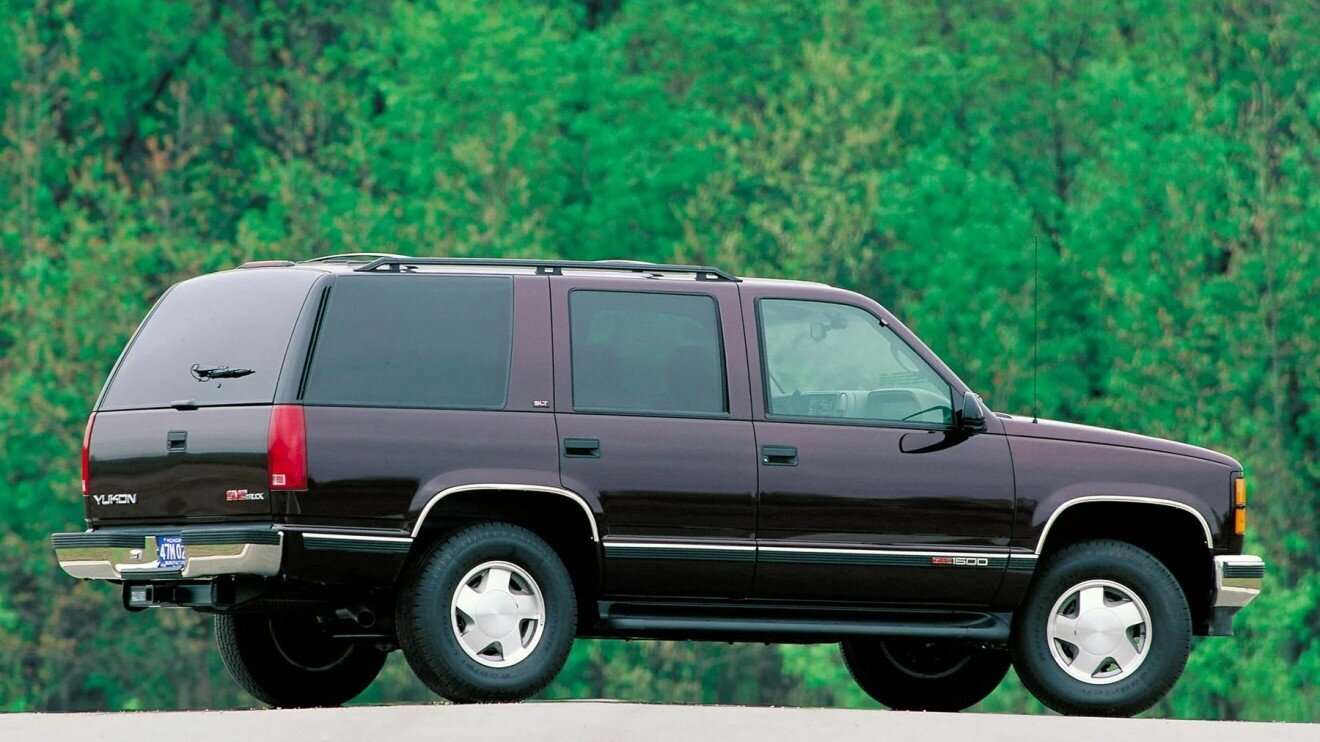
The GMC Yukon is a full-size SUV from the American automaker General Motors, sold under the GMC brand since 1991. In the 1996 context of the novel, this refers to the first generation of the model (GMT400), produced from 1992 to 2000.
Origin and positioning
The GMC Yukon emerged from a rebranding of the full-size GMC Jimmy SUV. In 1991, General Motors decided to rename its flagship SUV, giving it a name honoring the Canadian territory of Yukon – a symbol of harsh northern wilderness and off-road terrain. The name was meant to underscore the vehicle’s off-road capability and its ability to handle the toughest operating conditions.
Alongside the GMC Yukon, GM produced a twin under the Chevrolet badge, which was called the Blazer until 1994 and then renamed Tahoe. Both vehicles were a shortened version of the popular Chevrolet Suburban, retaining its off-road capability and roomy cabin.
Technical specifications of the first generation
The first-generation GMC Yukon was built on the GMT400 platform – the same one used for the full-size Chevrolet C/K pickups. This gave the vehicle a sturdy body-on-frame construction and excellent off-road capability. The two-door version had a 111.5-inch (2,832 mm) wheelbase, while the four-door version had a 117.5-inch (2,984 mm) wheelbase.
The standard engine was a 5.7-liter Chevrolet 350 Small Block gasoline V8, producing roughly 200–250 horsepower depending on the year and trim. Starting in 1994, a turbodiesel 6.5-liter Detroit Diesel V8 became available, offered exclusively on two-door four-wheel-drive versions.
Transmission options included a four-speed 4L60E or 4L80E automatic, as well as a five-speed manual, which was offered only on two-door four-wheel-drive models and was discontinued after 1995.
Trim levels and equipment by 1996
In 1996 the GMC Yukon was offered in several trims: base, SLE, and the top-tier SLT. The base version included a minimal set of options, while the SLT came with a leather interior, power seats, and other comfort features.
Of particular note is the Yukon GT, introduced in 1992–1994, which featured monochromatic body paint, special bumpers and grille, and bucket seats with a center console. This variant was marketed as a sportier version of the SUV.
By 1996 the vehicle had received an updated Vortec 5700 engine with improved power and fuel economy. Two-door rear-wheel-drive versions, electronic four-wheel-drive control, and daytime running lights had also become available.
Status and perception in the mid-1990s
In 1996 the GMC Yukon (like its twin the Chevrolet Tahoe) was a symbol of American automotive manufacturing and an embodiment of the "big car for a big country" concept. These SUVs were extremely popular among affluent Americans, especially in the southern states, where the climate allowed for comfortable use of vehicles with powerful engines.
Owning such a vehicle in mid-1990s Russia was a mark of exceptional financial standing. A new Yukon cost around $25,000–30,000 in the US, but shipping it to Russia, customs clearance, and maintenance multiplied that cost several times over. In practice it was a vehicle for a very narrow circle of people – successful businessmen, high-ranking officials, and figures from the criminal underworld.
Operating quirks in Russian conditions
Running a GMC Yukon in mid-1990s Russia came with plenty of difficulties. The main problem was the lack of official dealer service and the trouble getting spare parts. Repairs on such vehicles could only be handled at specialized shops, often of a rather makeshift character.
Fuel was also a problem – American engines were designed for high-octane gasoline, and the quality available in Russian reality left much to be desired. This led to accelerated engine wear and the need for frequent maintenance.
Nevertheless, the Yukon had a number of advantages for Russian conditions: high ground clearance, four-wheel drive, and a sturdy build made it suitable for use on bad roads. Its roomy cabin and imposing size created the necessary image of status.
Cultural significance and symbolism
In the context of the novel, the 1996 GMC Yukon symbolizes several important aspects of the era. First, it demonstrates the owner’s financial capacity – a vehicle affordable only to the very wealthy. Second, it connects to American culture and values, which at the time were seen by many Russians as a model of success and prosperity.
Mentioning the Yukon alongside a Lamborghini underscores the character’s status and his ability to afford expensive foreign cars. At the same time, choosing an American SUV rather than a premium European car may point to a practical streak in his character – the Yukon was better suited to Russian road conditions than most European luxury cars.
Technical reliability and reputation
The first-generation GMC Yukon earned a reputation as a fairly reliable vehicle, especially where the powertrain was concerned. The Chevrolet 350 Small Block engine was well understood and relatively simple to service, an important advantage given the limited service infrastructure in Russia.
The vehicle did have its weak points, though: the electrical system, suspension components, and transmission needed regular attention. Fuel consumption ran around 15–20 liters per 100 kilometers in city driving – not a serious issue given relatively cheap gasoline in the US, but an extra expense in Russia.
Place in the automotive hierarchy
In the American automotive hierarchy of the mid-1990s, the GMC Yukon occupied a position between mass-market cars and true luxury brands. It was considerably pricier than ordinary sedans and wagons, but didn’t reach the level of brands like Cadillac or Lincoln. That made it attractive to a middle class chasing status without being ready to pay for premium brands.
In the Russian context, this ranking shifted – any American vehicle of this size and class automatically became a symbol of high status, regardless of its positioning back home.