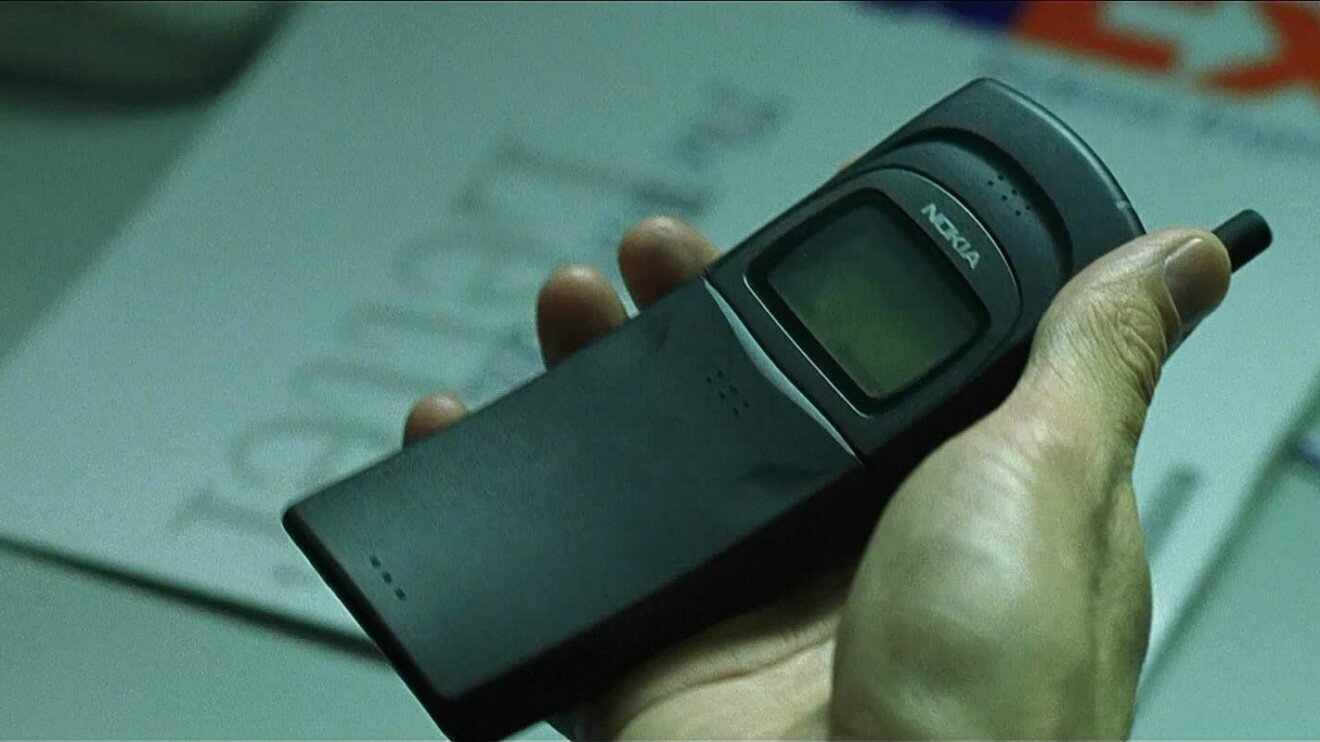
The Nokia 8110 was a mobile phone that became a genuine symbol of technological progress in the second half of the 1990s and a cult object thanks to the film «The Matrix.»
Development and technical specifications
The Nokia 8110 was announced on September 9, 1996 as the first entry in Nokia’s high-end 8000 series. The phone went on sale in 1997 and immediately drew attention for its revolutionary design – it was the first mobile phone with a slider form factor.
Its distinguishing feature was a sliding protective cover that, when closed, shielded the keypad from accidental presses while carried in a pocket. In use, the cover slid downward, bringing the microphone closer to the user’s mouth for better call quality. Opening the cover automatically answered an incoming call – an innovative solution for its time.
Technically the Nokia 8110 was a fairly advanced device. It weighed just 152 grams, making it one of the lightest phones on the market. Despite its compact size, the battery gave better standby time than its predecessor, the Nokia 2110. The model was Nokia’s first GSM phone to use an ARM processor, and the company’s first phone with a monochrome graphical LCD screen.
The "Banana" nickname and design
The distinctive curved shape of the body, especially noticeable when open, earned the phone the popular nickname "banana." That curvature wasn’t accidental – it provided an ergonomic placement of the microphone and speaker relative to the user’s face, improving call quality.
The Nokia 8110’s design was aimed at the business segment of the market. The phone was positioned as a status accessory for the business professional, combining compactness, light weight, and reliability.
Variants and the line’s development
In March 1997 an improved model, the Nokia 8110i, was introduced, becoming the first phone with SSMS (Smart SMS) technology. This system allowed the phone to be updated over the air (OTA) using an intelligent menu structure. Users could enter simple information, which was sent via a structured text message to an MT receiver capable of interpreting the data and sending a structured reply back to the phone.
The Nokia 8110i was also the first mobile phone to support receiving ringtones via SMS – a feature that became part of the smart-messaging protocol. Visually the 8110i was almost identical to the base 8110 model, except for the color of the Nokia logo – white on the earlier model.
The 8110 family also included the Nokia 8146 and Nokia 8148, single-band versions for GSM 1800 networks. In 1998 the Nokia 8110 and 8110i were replaced by the Nokia 8810, while the 8146 and 8148 were succeeded in 1999 by the Nokia 7110.
Cultural impact: "The Matrix" and worldwide fame
The Nokia 8110’s real worldwide fame came from the science-fiction action film The Matrix (1999). For the film, the phone was specially modified: a spring mechanism was installed, letting the cover pop open automatically at the press of a button on the side of the case. This modification created a striking visual effect – Keanu Reeves’ character (Neo) would dramatically flip the phone open with one press.
It’s worth noting that the production version of the Nokia 8110 did not have an automatic opening mechanism – the cover had to be slid open by hand. The automatic slider only appeared later, on the Nokia 7110, which is often confused with the "Matrix" phone because of that feature.
After The Matrix came out, demand for the Nokia 8110 surged. A limited run of phones with special film-related markings was released and sold out instantly among fans of the movie.
Market positioning in 1998
By 1998 – the year the novel is set – the Nokia 8110 had already established itself as one of the most prestigious mobile phones on the market. In Russia, mobile communications were only just beginning to develop; GSM-900 networks launched in Moscow in 1994, and by 1998 coverage was gradually expanding to other major cities.
The price of the Nokia 8110 during that period was quite high – the phone was positioned at the premium end of the market. Its owners were mainly successful businessmen, high-ranking officials, and members of the "New Russians" – a social stratum that displayed its status through expensive imported goods.
Owning a Nokia 8110 in 1998 was a clear marker of high social status and financial well-being. The phone stood out not only against simpler models, but also against competitors from Motorola, Ericsson, and other manufacturers, thanks to its unusual design and technical capabilities.
The slider’s technical breakthrough
The Nokia 8110’s slider mechanism was a genuine breakthrough in mobile-device design. Before it, phones had either a monoblock design or a flip cover (as in some Motorola models). The sliding protective cover solved several problems at once:
- Keypad protection from accidental presses when carried in a pocket or bag
- Call ergonomics – the extended cover brought the microphone closer to the mouth
- Automatic answer of incoming calls when the cover was opened
- Compactness – the phone took up minimal space when closed
The slider mechanism was a fairly sophisticated piece of engineering for its time, requiring precise part fitting and a reliable rail design.
Legacy and influence on the industry
The Nokia 8110 laid the groundwork for an entire direction in mobile phone design. The slider form factor was developed further in the Nokia 7110, and later in numerous phones from other manufacturers. The concept of a protective sliding cover was used in mobile devices right up through the smartphone era.
In 2018, for the 20th anniversary of The Matrix, Nokia unveiled a modern reincarnation of the legendary model – the Nokia 8110 4G, running the KaiOS operating system and powered by a Qualcomm 205 chipset. The new version kept the recognizable design of the original but got a modern feature set and 4G network support.
The Nokia 8110 "Banana," then, remains not just a technical artifact of the 1990s, but a symbol of the era when mobile communications came into their own – and, thanks to cinema, an object that acquired a cult status reaching far beyond telecommunications technology.