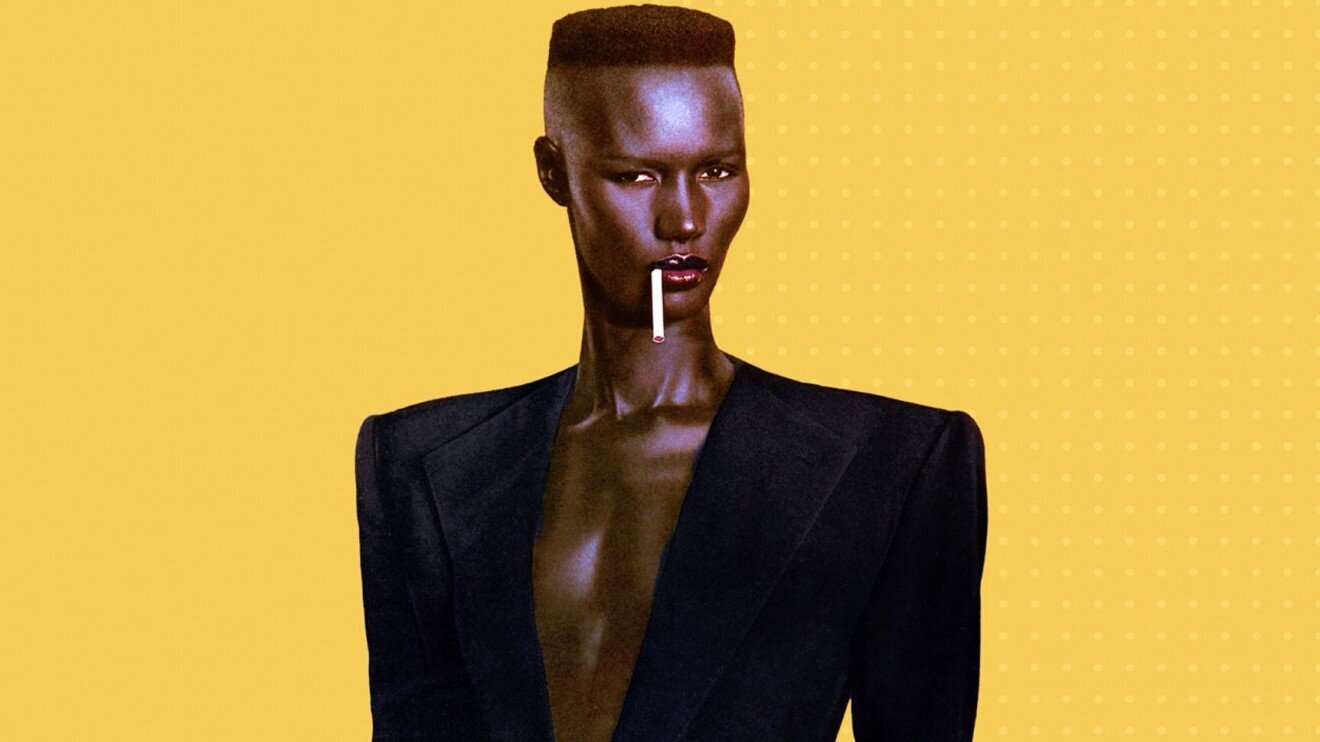
Appearance and image
By the mid-1990s Grace Jones had already spent more than a decade and a half as one of the most recognizable and provocative figures in world pop culture. Her androgynous look and extravagant style made her a genuine icon whose influence reached far beyond the music industry.
Jones possessed a truly unique appearance: 179 cm tall, chiseled cheekbones, an arrow-straight neck, a perfectly sculpted jawline, and striking features combined into a look impossible to mistake for anyone else’s. Her dark beauty was set off by geometrically precise hairstyles – her famous close-cropped, razor-edged cut became her signature.
«Grace was very open. We worked together to build this fearsome character. I mean, she was naturally fearsome to begin with – with her body, her very straight neck, her prominent cheekbones and sharply defined jaw.»
Jones’s style was revolutionary for its time. She wore men’s Armani suits and geometrically precise outfits that accentuated her androgyny. Square shoulders, sharp angles, minimalist shapes – all of it created a look critics called «neo-Cubist.» Her manner of dress challenged traditional notions of femininity and masculinity.
Modeling career
Jones’s road to fame began in the world of high fashion. Moving to Paris in 1970, she quickly became an in-demand model. The Paris fashion scene proved ready to embrace her unusual, androgynous, daring look. Legendary designers such as Yves Saint Laurent, Claude Montana, and Kenzo Takada booked her for their runway shows.
Jones appeared on the covers of the most prestigious fashion magazines – Elle, Vogue, Stern. She worked with the era’s most outstanding photographers: Helmut Newton, Guy Bourdin, Hans Feurer. Her collaboration with Azzedine Alaïa was especially fruitful – she was frequently photographed modeling his collections.
Modeling career
- 1970s: Working in Paris
- Designers: Yves Saint Laurent, Kenzo, Claude Montana
- Magazines: Vogue, Elle, Stern
- Photographers: Helmut Newton, Guy Bourdin
Style traits
- Androgyny
- Geometry
- Minimalism
- Avant-garde sensibility
Music career and Studio 54
In 1977 Jones signed with Island Records and threw herself into the world of music. Her debut album, «Portfolio,» marked the start of a music career that would span decades. She first became a fixture of the New York disco scene, centered on the legendary club Studio 54.
Jones’s live performances were highly sexualized and provocative, earning her the nickname «queen of the gay discotheques.» Her shows were performances in which music merged with theatricality and provocation. In the early 1980s she shifted toward a new-wave style incorporating elements of reggae, funk, post-punk, and pop.
| Album | Year | Style | Notes |
|---|---|---|---|
| Portfolio | 1977 | Disco | Debut album, included covers of Broadway hits |
| Warm Leatherette | 1980 | New Wave | A shift to a new sound, featured a cover of The Normal |
| Nightclubbing | 1981 | New Wave/Post-punk | Considered her best album, topped NME’s list |
| Slave to the Rhythm | 1985 | Pop/Electronic | A concept album featuring interviews with Jones herself |
Collaboration with Jean-Paul Goude
One of the most important chapters in shaping Grace Jones’s image was her collaboration with French photographer and graphic designer Jean-Paul Goude, which began in 1981. Goude became not just her creative partner but her lover (their relationship lasted until 1984).
Goude designed her album covers, directed her music videos, choreographed her live shows, and helped develop her visual image. His work with Jones defined the visual landscape of the 1970s and 1980s. Goude saw Jones as his muse, calling her «beautiful and grotesque at the same time.»
The «French correction» technique
Goude used a technique he called «French correction» – cutting up photographs and reassembling them into a collage to elongate limbs or exaggerate the size of the head. The best-known example is the cover of the album «Island Life,» showing Jones in an anatomically impossible pose.
Goude’s work centered on artistic depictions of race, ethnicity, and world culture, with a «fascination with the far-off and the exotic.» Many of his images of Black women are considered controversial and exploitative, since Jones was presented as «a white man’s interpretation of African femininity.»
Film career
By the mid-1990s Grace Jones was also known as an actress who had appeared in several memorable roles. Her film debut came in 1984 in «Conan the Destroyer,» in which she played the Zulu warrior Zula. The role earned her a Saturn Award nomination for Best Supporting Actress.
In 1985 Jones appeared in the James Bond film «A View to a Kill,» playing May Day, henchwoman to the chief antagonist Max Zorin. The role became one of the franchise’s most memorable female parts and brought the actress another Saturn Award nomination.
Conan the Destroyer (1984)
The role of Zula the warrior, opposite Arnold Schwarzenegger. Saturn Award nomination.
A View to a Kill (1985)
May Day in the James Bond film. One of the franchise’s most memorable villainess roles.
Vamp (1986)
The role of Katrina, an ancient Egyptian vampire queen. Saturn Award for Best Supporting Actress.
In 1992 Jones appeared in the comedy «Boomerang» with Eddie Murphy, playing Helen Strange. For the film’s soundtrack she also recorded the song «7 Day Weekend.»
Influence on culture and fashion
By 1996 Grace Jones’s influence on pop culture was undeniable. Her androgynous appearance, square shoulders, and angular, shoulder-padded clothing influenced the cross-dressing movement of the 1980s. To this day she’s known for her singular image at least as much as for her music.
Jones became a source of inspiration for a host of artists: Annie Lennox, Lorde, Rihanna, Janelle Monáe, Nile Rodgers – all of them, to varying degrees, borrowed elements of her style and approach to performance. Critics have noted that «everyone from Madonna to Björk, from Beyoncé to Lady Gaga, has lifted more than a page from her playbook.»
Legacy in the 1990s
Throughout the 1990s Grace Jones remained a cult figure, a symbol of androgyny and avant-garde style. Her image became a textbook example of how gender stereotypes can be challenged through fashion and art. A mention of her name in the context of a 1996 novel points the reader toward the ideal of a strong, independent, provocative woman.
Personal life and philosophy
Jones’s childhood was spent in Jamaica in a strict Pentecostal family. Her father was a local politician and an apostolic-church minister. She herself described her childhood as «crushed by the Bible,» and has since refused to set foot in Jamaican churches because of that traumatic early experience.
Her relationship with Jean-Paul Goude produced a son, Paulo (1979). In 1996 she was married to Atila Altaunbay. Earlier she had a relationship with Swedish actor Dolph Lundgren, who worked as her bodyguard – it was Jones who helped him land the role of a KGB officer in «A View to a Kill.»
Musical style
Jones’s music has been described as «strange, vivid, and progressive.» She wove disco, new wave, post-punk, art pop, industrial, reggae, and gospel into a dense sound entirely her own, held together by a melodic, powerful voice.
Jones has a contralto – a fairly rare voice type. She sings in two modes: either a monotone recitative, as in «Private Life,» «Walking in the Rain,» and «The Apple Stretching,» or in an almost soprano register, as in «La Vie en Rose,» «Slave to the Rhythm,» and «Victor Should Have Been a Jazz Musician.»
Achievements and recognition
- No. 82 on VH1’s list of the «100 Greatest Women of Rock and Roll» (1999)
- Q Idol Award (2008)
- No. 40 on Billboard’s ranking of the greatest club artists of all time (2016)
- Grammy nomination for Best Video Album («A One Man Show,» 1983)
The 1996 context
In the context of a novel set in 1996, invoking Grace Jones as a benchmark of beauty and style is quite telling. By that point she was already an established icon, whose image was associated with luxury, provocation, and unconventional beauty. The comparison to her underscored the exoticism and unusualness of the character – a tall, dark-skinned woman with a bold, unforgettable look.
Throughout the 1990s Jones’s image continued to shape fashion and pop culture. Her androgynous style, the geometric lines of her clothing, her extravagant hairstyles remained current and inspired a new generation of artists and designers. Invoking her name in a work of literature from that period drew on a whole complex of cultural codes – from high fashion to the musical avant-garde.
For a Russian reader of the 1990s, the name Grace Jones was familiar through her roles in Hollywood films, especially the Bond franchise, as well as through the music channels that had begun broadcasting Western pop culture. Her image symbolized Western freedom of self-expression, which held particular resonance in the post-Soviet space.
«Grace Jones wasn’t just a singer or an actress – she was a phenomenon, an embodiment of rebellion against convention, a symbol of the right to be oneself in defiance of every stereotype. Her image in a black swimsuit on the deck of a luxury yacht is the quintessence of 1990s glamour, a time when the world was opening up to new possibilities and new ideals of beauty.»
By 1996, then, Grace Jones remained not merely a celebrity but a cultural phenomenon whose image continued to shape ideas about style, beauty, and creative freedom. Her influence stretched from high-fashion runways to movie screens, from dance floors to the pages of fashion magazines, making her one of the most recognizable and influential figures of her time.