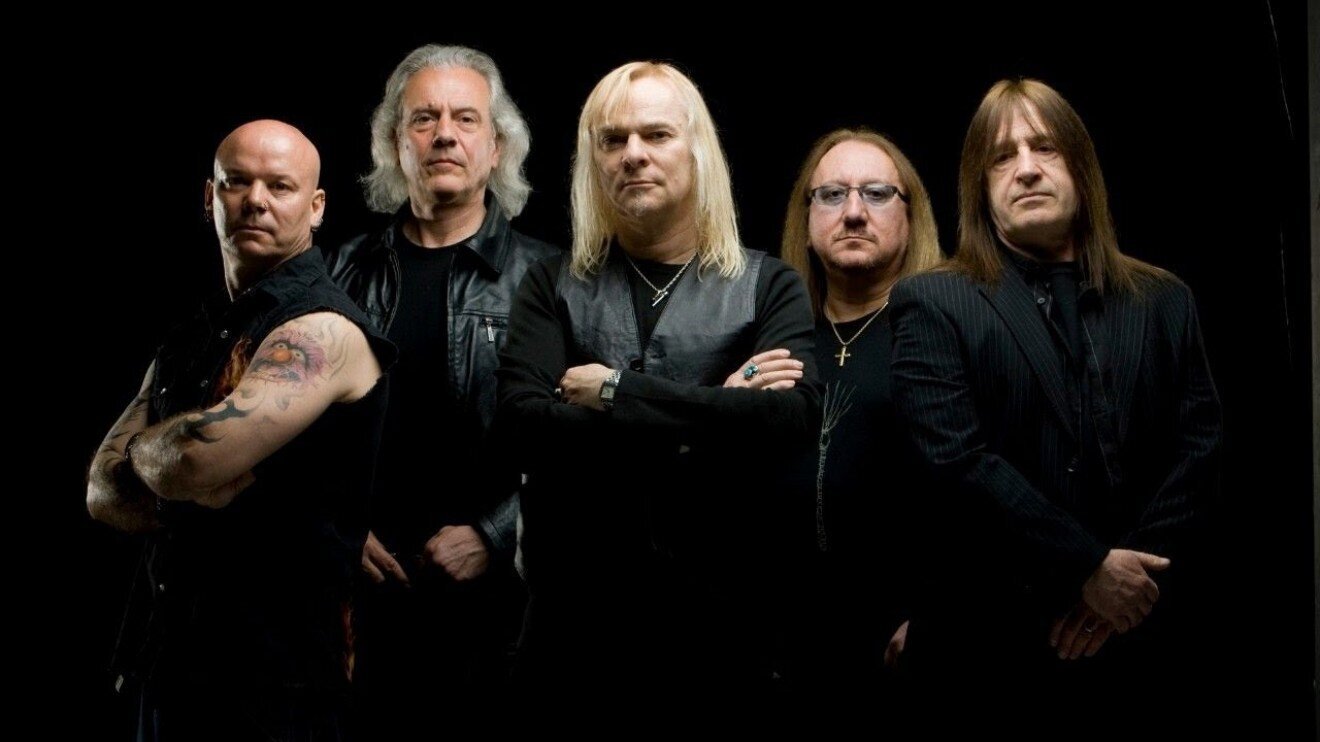
How musicians forgotten at home became stars of post-Soviet Russia
In the late 1990s, a remarkable cultural phenomenon unfolded across the Russian provinces: the British rock band Uriah Heep, all but forgotten in its home country, toured provincial cities to triumphant, thousands-strong crowds, becoming genuine stars for Russian music fans.
Who Uriah Heep were
Uriah Heep is a British rock band formed in London in 1969. The band took its name from a character in Charles Dickens’s novel David Copperfield. In the early 1970s the band was one of the leading forces in British hard rock, alongside Deep Purple and Black Sabbath.
The golden years (1971–1973)
The band’s peak came with the albums Look at Yourself, Demons and Wizards, and The Magician’s Birthday, now regarded as hard-rock classics. The band’s trademark was elaborate backing-vocal harmonies and David Byron’s dramatic lead vocals.
The classic lineup included Mick Box (guitar), David Byron (vocals), Ken Hensley (keyboards), Gary Thain (bass), and Lee Kerslake (drums). The only member to remain with the band continuously since its founding is guitarist Mick Box.
Decline in Britain
By the late 1970s the band’s popularity at home had collapsed. Vocalist David Byron’s struggles with alcohol, constant lineup changes, and shifting musical trends left Uriah Heep all but invisible on the British scene. In 1985 Byron died of a heart attack, a chronic alcoholic by that point.
«It was very strange, because in England we were almost forgotten – a lot of people had mentally buried us already.»
Breaking through the Iron Curtain
An unexpected turn in the band’s fortunes came in the mid-1980s. In 1987, at the height of perestroika, Uriah Heep became one of the first Western rock bands to perform in the USSR. That December they played ten shows at Moscow’s Olimpiysky sports complex for 185,000 spectators.
Triumph in the USSR
The shows were performed alongside the popular Soviet band Zemlyane. Bernie Shaw, the band’s vocalist since 1986, recalled the reception as «something close to Beatlemania.» Mick Box said the musicians «genuinely felt like ambassadors of the West.»
The Moscow shows produced the album Live in Moscow, and the band’s success in the USSR opened doors to other Eastern Bloc countries – Czechoslovakia, East Germany, Bulgaria, Poland.
Russian tours of the 1990s
After the collapse of the USSR, Uriah Heep toured Russia regularly, playing not just the capitals but provincial cities as well. The band played to a crowd of 100,000 in St. Petersburg, and toured Ukraine and Kazakhstan.
In the Russian provinces of the late 1990s, a Uriah Heep concert was a genuine event. Local authorities often arranged shows by the legendary British band as a way to demonstrate their own cultural significance and their ties to the Western world.
The paradox of their popularity
While the band was regarded in Britain as a relic of the 1970s, in Russia Uriah Heep had thousands of devoted fans spanning several generations. Their concerts drew both people who remembered the band from pirated Soviet-era recordings and young listeners discovering classic rock for the first time.
The lineup in the 1990s
By the late 1990s the band’s lineup was:
- Mick Box – guitar (since 1969)
- Bernie Shaw – vocals (since 1986)
- Phil Lanzon – keyboards (since 1986)
- Trevor Bolder – bass (1976–1981, and since 1983)
- Lee Kerslake – drums (1971–1980, and since 1982)
Albums of the 1990s
The band released several studio albums in the 1990s:
- Different World (1991) – received mixed reviews
- Sea of Light (1995) – a return to their 1970s sound
- Sonic Origami (1998) – showcased the band’s lyrical, symphonic side
Despite their heavy touring schedule, distribution problems often meant the albums weren’t even available in stores in the countries where the band was performing.
Key facts
- Formed: 1969
- Origin: London, England
- Genre: Hard rock, progressive rock
- Albums sold: Over 40 million
- Peak fame: 1971–1973
The band’s hits
- • «Gypsy»
- • «Lady in Black»
- • «July Morning»
- • «Look at Yourself»
- • «Easy Livin’»
- • «The Wizard»
- • «Stealin’»
Influence
Uriah Heep had a significant influence on the development of heavy metal. Many bands of the NWOBHM movement (Iron Maiden, Saxon, Def Leppard) have cited them as a key influence.
A cultural phenomenon
The story of Uriah Heep in 1990s Russia is a striking example of how music can find new life in an unexpected place. A band regarded as a museum piece at home found a second youth in post-Soviet Russia. Their concerts became events not just for rock fans but for local officials, who saw hosting Western stars as a way to demonstrate their own importance.
The phenomenon of Uriah Heep’s Russian popularity can be explained by several factors: a hunger for Western rock music, built up over years of isolation; the quality of the band’s performances, which retained their professionalism despite years of neglect back home; and the particular mood of the 1990s, when anything Western was seen as a symbol of freedom and progress.
Interesting fact: Bernie Shaw noted that the more the band played in Russia, the more they drew a younger audience, tied to the worldwide revival of interest in classic rock.
By the late 1990s, then, Uriah Heep represented a unique phenomenon: a British rock band with a history stretching back nearly thirty years, which found its principal audience not at home, but in a distant Russia, where its music continued to live and grow, drawing in new generations of listeners.