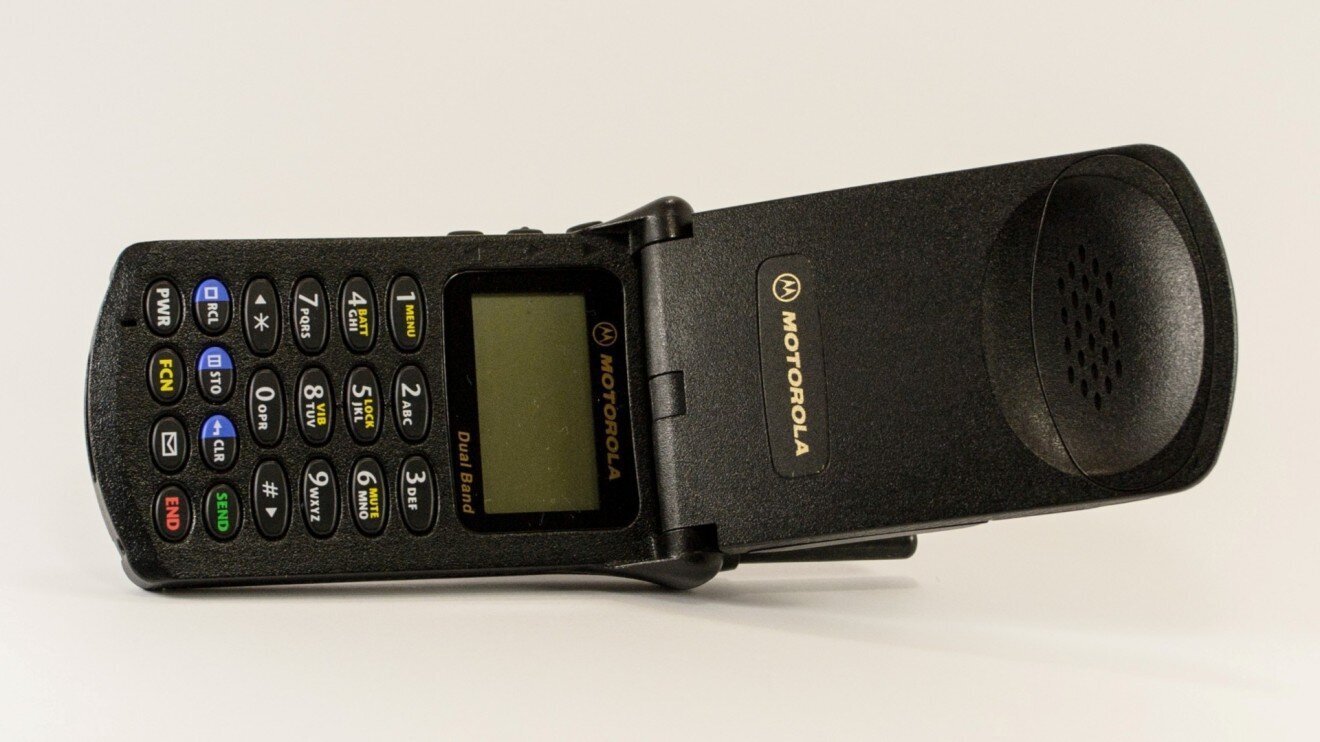
The Motorola StarTAC is a series of flip phones designed and released by Motorola starting in 1996. It was the first truly popular flip phone, setting new standards for compactness and elegance in mobile communications.
Development and market launch
The StarTAC trademark application was filed by Motorola in September 1995. The phone was officially unveiled in North America on January 3, 1996. At launch it was the smallest mobile phone available, running on the analog AMPS network.
Its initial price was $1,000 (roughly $2,010 in 2025 dollars, adjusted for inflation). Because of the high cost, most phones were sold under contract rather than directly from the manufacturer. During the initial launch, magazine ads included a full-size cardboard cutout of the phone that could be torn out of the page to demonstrate the device’s miniature size.
Revolutionary design
The StarTAC built on the design of Motorola’s earlier MicroTAC, a semi-flip phone first released in 1989. Unlike the MicroTAC, where the flip section folded down from the keypad, the StarTAC’s flip folded up from the display.
Although the StarTAC is often called the world’s first flip phone, that’s not strictly accurate – Japan’s NEC had already developed and released a similar phone back in 1991. Even so, the StarTAC is considered the first example of a luxury or fashion-forward mobile phone.
At the time, the term «flip» in mobile phones referred to folding keypad covers, as on the MicroTAC, and the term «clamshell» wasn’t yet in use. Instead, Motorola called and marketed the StarTAC a «wearable» mobile phone, emphasizing that it could be clipped to a belt or worn on a lanyard around the neck.
Technical specifications and features
Size and weight
The StarTAC’s dimensions were extremely compact for its time. At just 3.1 ounces (88 grams) in its lightest configuration, the StarTAC was significantly lighter than other handsets. For comparison, the Ericsson GH337 and Nokia 2110, previously considered relatively «light,» weighed 7.1 ounces (200 g) and 8.3 ounces (235 g) respectively. Even Motorola’s own original 1989 MicroTAC, the lightest and smallest of its own era, weighed 12.3 ounces (349 g).
Key features
- SMS messaging: the ability to receive text messages, though only later digital models could send them
- Lithium-ion battery: optional at the time, when most phones were limited to less capacious NiMH batteries
- Vibrate alert: an alternative to a ringtone (the VibraCall feature)
- LED display: in keeping with Motorola tradition, most of the early analog StarTAC generations used LED displays
Model lineup
Analog models
StarTAC 3000 – the base model, released in 1996, without side volume controls, a smart button, or contacts for an auxiliary battery. The only StarTAC with a segmented LED display.
StarTAC 6000 and 6500 – announced September 30, 1996. A mid-tier model with a single-line alphanumeric LED display and a smart button. It weighed 3.6 ounces (100 g). The StarTAC 6500 was identical to the 6000e but added vibration.
StarTAC 8500 and 8600 – the original model, launched in 1996, with a two-line LED display. The StarTAC 8600 was the first StarTAC with an answering machine and voice recorder (with a 4-minute recording capacity), plus caller ID.
Digital models (TDMA and CDMA)
In July 1998 Motorola announced its first CdmaOne and TDMA StarTACs: the ST7760 (dual-mode CDMA 800/AMPS), the ST7762 (CDMA 1900), and the ST7790 (dual-mode TDMA/AMPS).
On September 22, 1999, improved models were introduced: the StarTAC ST7860 and StarTAC ST7867W, which added an integrated WAP micro-browser and improved address-book features.
GSM models
The first digital, GSM StarTAC was announced in October 1996. At 98.5 grams it became the lightest (and the first under 100 grams) GSM phone of its time. The GSM StarTAC models were compatible with Motorola CELLect PC cards, letting the phone’s GSM connection be used for email, fax, or internet access from a laptop or PDA.
The StarTAC 70 series included the 70, 74, 75, and 75+ models. These had a two-line alphanumeric LCD display but no vibration. The StarTAC 70 was also sold in a multicolor edition known as the StarTAC Rainbow.
The StarTAC 80/85 series looked externally identical to the 70 series but had higher-resolution displays capable of showing simple graphics, such as logos.
The StarTAC 130 was announced at CeBIT 1998 as a GSM 900 phone weighing 87 grams. Motorola called it the smallest and lightest GSM phone. The switch from a full-size SIM card to a mini-SIM helped shrink its length and thickness.
Special models and accessories
Clip-On Organizer
In 1999 Motorola released the StarTAC Clip-On Organizer – a separate device functioning as an electronic address book that attached to an existing StarTAC unit. Some called the StarTAC-and-organizer combination a «smartphone.»
StarTAC D
The StarTAC D was announced at CeBIT 1999 as a GSM 900 model letting users make mobile payments. The rear slot, normally meant for a full-size SIM card, instead accepted an EMV debit or credit card. The StarTAC D became the world’s first dual-SIM mobile phone.
Litigation
In March 1997 Qualcomm announced the Qualcomm Q flip phone, resembling the Motorola StarTAC’s design. Motorola sought an injunction to block sales of the Q in April 1997, but the block was soon lifted. Motorola then sued Qualcomm for patent infringement. In August 1999 a US judge ruled that the Qualcomm Q did not infringe Motorola’s patents by using a flip design resembling the StarTAC.
Influence on the industry and legacy
In 2005 PC World magazine named the StarTAC the 6th greatest gadget of the past 50 years, on a list of fifty devices.
In South Korea, the StarTAC series achieved «cult» status. This prompted the local company Samsung Electronics to develop its own flip phone, released in 1998. Samsung would go on to become a leading maker of flip phones, alongside Motorola, in the early twenty-first century.
The Motorola RAZR V3 is considered the StarTAC’s spiritual successor.
Modern use and collecting
Thanks to the StarTAC’s popularity, it has developed a cult following among enthusiasts and vintage mobile-phone collectors. Despite its age, many models can still be used in regions where cellular carriers continue to operate a compatible network. This is mostly limited to GSM models running on 2G networks.
In October 2010 the French firm Lekki, which restored iconic vintage products from the 1990s, released a line of refurbished StarTACs in new, colorful cases priced at €220 apiece.
Revivals
StarTAC 2004
Motorola revived the StarTAC in a reimagined modern form, announced in 2004 for the South Korean market. Named the StarTAC 2004, it was a CDMA model made exclusively for SK Telecom, with a color TFT LCD display at 128×160 resolution, 64-channel polyphonic sound, and mobile-banking capability.
StarTAC III
Motorola released another StarTAC revival, the StarTAC III (model MS900), announced February 27, 2007 for the South Korean market. This model had a 2-inch QVGA display, 128 MB of built-in memory, MP3 audio support, and GPS navigation.
Significance for status and positioning
By the late 1990s the StarTAC had become a symbol of status and technological sophistication. Owning this phone, especially alongside other prestigious mobile devices, was a way of demonstrating membership in the upper tier of the business and IT world. Its compactness, elegant design, and relatively high price made the StarTAC a coveted accessory for top managers and successful entrepreneurs.