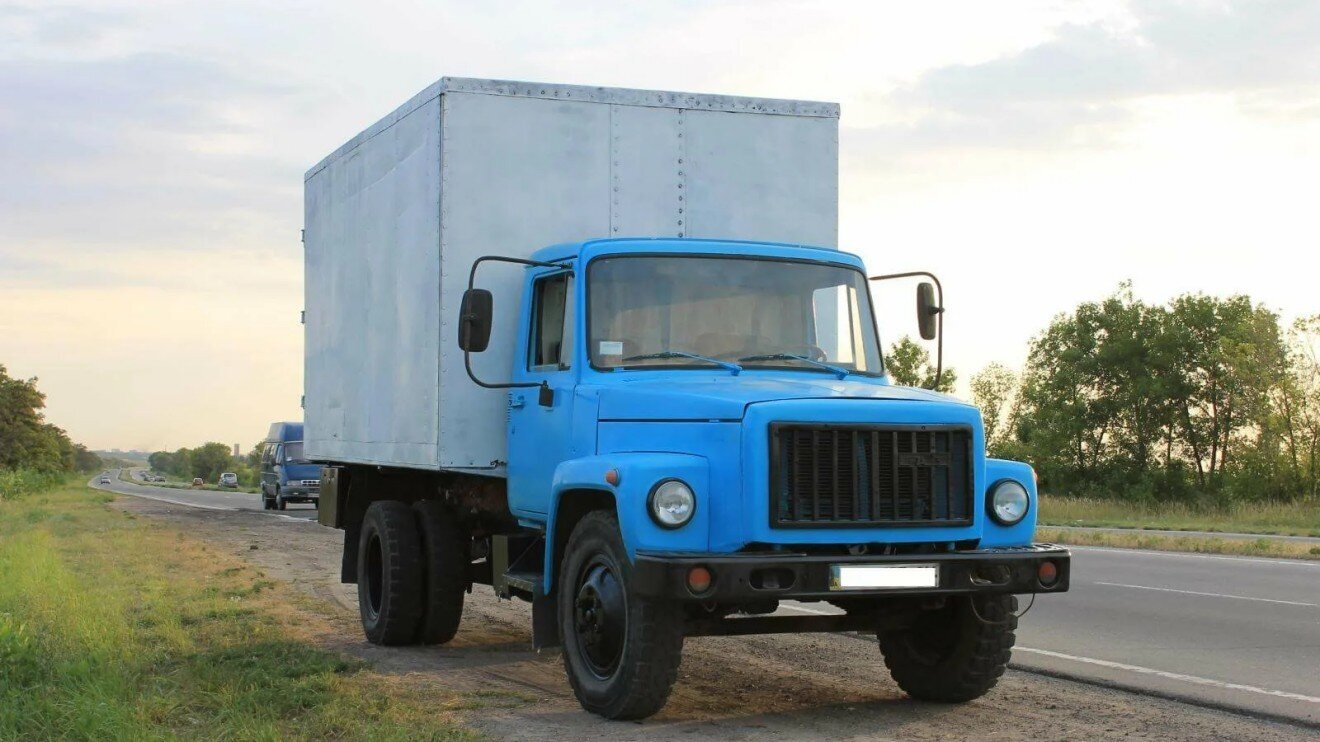
The GAZ-3307 is a medium-duty flatbed truck with a 4.5-ton payload capacity, built at the Gorky Automobile Plant starting in 1989. The vehicle belongs to the fourth generation of GAZ-brand trucks and succeeded the GAZ-52/53 family, which had dominated the Soviet truck fleet since the late 1950s.
Technical Specifications
The GAZ-3307’s design was a compromise. The truck got a new two-seat all-metal cab with improved ergonomics, but kept its predecessor’s powerplant — the eight-cylinder V-configuration carbureted ZMZ-511 engine, 4.25 liters, 125 horsepower. The engine tolerated low fuel quality well and ran on low-octane A-76 gasoline.
The GAZ-3307’s cab had originally been designed for the planned diesel truck GAZ-4301. It gave the driver considerably better working conditions than the outdated GAZ-53 cab: more interior space, an effective ventilation and heating system, better soundproofing. For the first time on a GAZ truck, the steering came with power assist.
The chassis kept a proven layout: dependent leaf-spring suspension, a rear drive axle with a final drive, and air-assisted brakes. The 4×2 wheel configuration meant the truck was built for paved roads.
Development History
Development of a new generation of medium-duty trucks began in the first half of the 1960s. The original plan called for modernizing the existing GAZ-53A. In 1963, a prototype, the GAZ-54, was built, and testing continued for several years. In 1972, an updated prototype, the GAZ-53-11, appeared.
A fundamental shift came in the mid-1970s. The USSR began importing heavy Magirus-Deutz trucks from the West German conglomerate Klöckner-Humboldt-Deutz, fitted with air-cooled diesel engines. These powerplants proved highly reliable in harsh climate conditions. The 25th Congress of the CPSU, in February–March 1976, resolved to begin mass dieselization of the country’s truck fleet.
A technical proposal for the new truck, designated GAZ-4301, was reviewed by the Ministry of the Automotive Industry’s scientific-technical council on February 9, 1978. The project was led by engineer Alexander Mikhailovich Butusov, with Valery Dmitriyevich Zapoynov as lead designer and Stanislav Vitalyevich Volkov as stylist. The first prototypes were built in 1979, a second batch in 1981.
The 26th Congress of the CPSU, in the spring of 1981, approved the truck-dieselization program. The new truck was slated to get a six-cylinder inline, air-cooled GAZ-542 diesel, built under license from the German firm Deutz.
Production Reality
Building and equipping diesel production at the Gorky plant dragged on. The economic conditions of the late 1980s made it hard to quickly ramp up production of the new powerplant. GAZ-542 diesel production wouldn’t begin until January 22, 1993.
The plant needed a replacement for the aging GAZ-53. A stopgap solution was adopted: create a simplified model pairing the new cab with the proven gasoline engine. That’s how the GAZ-3307 came about — in effect an updated GAZ-53 with the GAZ-4301’s cab. On December 26, 1986, the plant completed testing of the new model.
Series production of the GAZ-3307 began in 1989. The truck was billed as a stopgap measure until diesel variants could be rolled out, but the stopgap became permanent.
Operating Characteristics
The GAZ-3307 inherited its predecessor’s main strengths and weaknesses. The carbureted eight-cylinder engine was simple in design and easy to repair, but thirsty — around 25–30 liters per 100 kilometers, depending on conditions and load.
Its tolerance for low-quality fuel was an advantage amid unstable fuel supplies. The engine ran on widely available low-octane A-76 gasoline in the early 1990s. The design tolerated considerable wear and continued operation through mechanical faults that would demand immediate repair on more modern vehicles.
A 4.5-ton payload capacity allowed for substantial cargo volumes. The standard-size flatbed made the truck versatile. Vans, tanker bodies, and specialized cargo boxes of every kind were mounted on the GAZ-3307 chassis.
Air-assisted brakes provided reliable stopping power for a loaded truck. Power steering reduced the physical strain on the driver during maneuvering, especially at low speed and while parking.
The GAZ-3307 in 1993 Commerce
In 1993, the GAZ-3307 was one of the few available options for medium-payload commercial hauling. Specialized small-payload commercial vehicles were practically nonexistent in the Soviet and early Russian auto industry.
The Gazelle — a family of light commercial vehicles with a 1.5-ton payload — wouldn’t appear until 1994. Until then, goods delivery relied on trucks originally designed for other purposes. The GAZ-3307, the ZiL-130, and their predecessors, the GAZ-53 and GAZ-52, made up the backbone of small and medium-business transport fleets.
These trucks suited delivery trade poorly. Their large size made maneuvering and parking in city conditions difficult. The open flatbed required extra protection for cargo from weather and prying eyes — usually handled with canvas tarps. High side rails made loading and unloading awkward.
The lack of an insulated cargo box limited the ability to haul perishable goods. The cab held only the driver and one passenger, creating problems whenever a crew of loaders needed transporting.
High fuel consumption drove up operating costs. Under average load and city driving, the GAZ-3307 burned 28–32 liters of gasoline per 100 kilometers. By comparison, the future diesel-powered Gazelle would use around 10–12 liters per 100 kilometers.
Maintenance
The GAZ-3307 needed regular servicing. The carbureted engine required periodic adjustment, spark-plug changes, and carburetor cleaning. The points-and-distributor ignition system needed tuning and contact replacement.
The oil filter needed replacing every 10,000 kilometers. The air filter needed cleaning or replacement depending on operating conditions, with shorter intervals in dusty environments.
The chassis needed regular greasing at numerous points. The leaf springs needed periodic checks of their U-bolts. The brake system needed monitoring of lining condition, clearance adjustment, and checks for air-system leaks.
Spare-parts availability in 1993 varied. Major components shared with the GAZ-53 were relatively easy to find. Parts specific to the new cab could be harder to source. A growing market in counterfeit and low-quality parts added further risk.
Alternatives
In the medium-duty segment, the main rival was the ZiL-130, with a 5-ton payload. It had a more powerful engine (150 horsepower versus the GAZ-3307’s 125) and greater capacity, but burned even more fuel — around 31–36 liters per 100 kilometers.
The GAZ-52 and GAZ-53, though formally discontinued by 1993, remained in wide use. These trucks were the most affordable option on the secondary market.
Imported Japanese and European trucks existed only in minimal numbers. High cost, difficulty sourcing parts and service, and customs procedures limited their spread.
Diesel Variants
In late 1994, a diesel variant appeared — the GAZ-3309, with a four-cylinder, air-cooled GAZ-5441 turbodiesel producing 116 horsepower. The truck kept the same cab and chassis as the GAZ-3307, differing outwardly only in an air-intake pipe on the left side of the cab.
The diesel engine delivered significant fuel savings — consumption dropped to 16–20 liters per 100 kilometers. Torque and towing characteristics improved. But GAZ-3309 production was suspended until the end of 2001 due to technical and economic difficulties.
When production resumed, the plant switched to Belarusian MMZ D-245.7 diesels, made at the Minsk Motor Plant. These four-cylinder, water-cooled turbodiesels, 4.75 liters, delivered around 122 horsepower and were also fitted to the ZiL-5301 «Bychok.»
Economics of Ownership
A new GAZ-3307 in 1993 cost several million rubles in denominated terms. For comparison, the average salary ran to a few tens of thousands of rubles a month. Buying a new truck required substantial capital or financing, available only to a limited circle of people and organizations.
Used early-production GAZ-3307s and the earlier GAZ-53 offered a more affordable option. Prices varied widely depending on condition, model year, and equipment.
Operating costs included fuel, oil, spare parts, maintenance, insurance, and taxes. At 28–32 liters per 100 kilometers and a monthly mileage of 1,000 kilometers, fuel use ran to 280–320 liters. At an A-76 gasoline price of around 100 rubles a liter in mid-1993, fuel costs alone reached 28,000–32,000 rubles a month.
Depreciation and unplanned repairs added substantial sums. Replacing an engine, gearbox, or rear axle cost hundreds of thousands of rubles. Body repair after an accident demanded significant time and money.
Logistics and Organization
Operating a truck required a driver with the right license category. A shortage of qualified drivers amid the growing private sector made staffing difficult. A truck driver’s wages were a substantial line item in operating costs.
Storing the vehicle was its own headache. Without a private garage or a guarded lot, the risks of theft and vandalism rose. Renting a garage or a spot in a guarded lot added to costs.
Registering the truck to a legal entity or a sole proprietor meant navigating registration procedures, obtaining the right documents, and arranging insurance. The lack of a clear regulatory framework, and constantly shifting requirements, added further complications.
Its Use in the Alcohol Trade
Using a GAZ-3307 for delivery sales of alcoholic goods, as in the situation described, created its own specific headaches. The open flatbed needed a tarp to protect the cargo from weather and prying eyes. With no lockable cargo box, theft risk rose during stops.
Loading and unloading crates of bottles over the truck’s high side rails took real physical effort. With no hydraulic lift gate, everything had to be done by hand. Unloading a full truck took several people and a good chunk of time.
Delivering goods to buyers at various points around the city meant numerous stops, maneuvering, and parking. The truck’s size made navigating narrow streets and courtyards difficult. The lack of power steering on early variants added to the driver’s physical burden.
The need to have an expeditor or guard accompany the cargo, given the cab’s limited seating, created organizational headaches. Carrying cash after selling the goods raised the risks further.
Continued Production
The GAZ-3307 was produced until January 2020, making it one of the longest-lived Soviet and Russian trucks. Production was interrupted in 1996–97, resumed, and later scaled down to small-batch runs for special orders.
From 2006–2008, vehicles began carrying engines certified to Euro 2 emissions standards, and Euro 3 from 2008–2012. Large-scale production of carbureted variants ended in 2009, with small-batch output kept up for government agencies.
Starting in 2014, the plant began producing a new medium-duty truck, the «Gazon Next,» replacing the aging family. The GAZ-3309 and its variants were discontinued in January 2020, closing out a thirty-year history for the fourth generation of GAZ trucks.
Conclusion
The GAZ-3307 is a characteristic example of Soviet and early Russian truck manufacturing. The vehicle paired an outdated technical base with elements of modern design. This compromise kept production going amid economic crisis, but locked in a lag behind world standards.
In 1993, the GAZ-3307 remained one of the few available options for commercial hauling. The absence of specialized small-payload commercial vehicles forced businesses to use trucks poorly suited to delivery trade. That situation would only change with the arrival of the Gazelle and other specialized models in the mid-1990s.