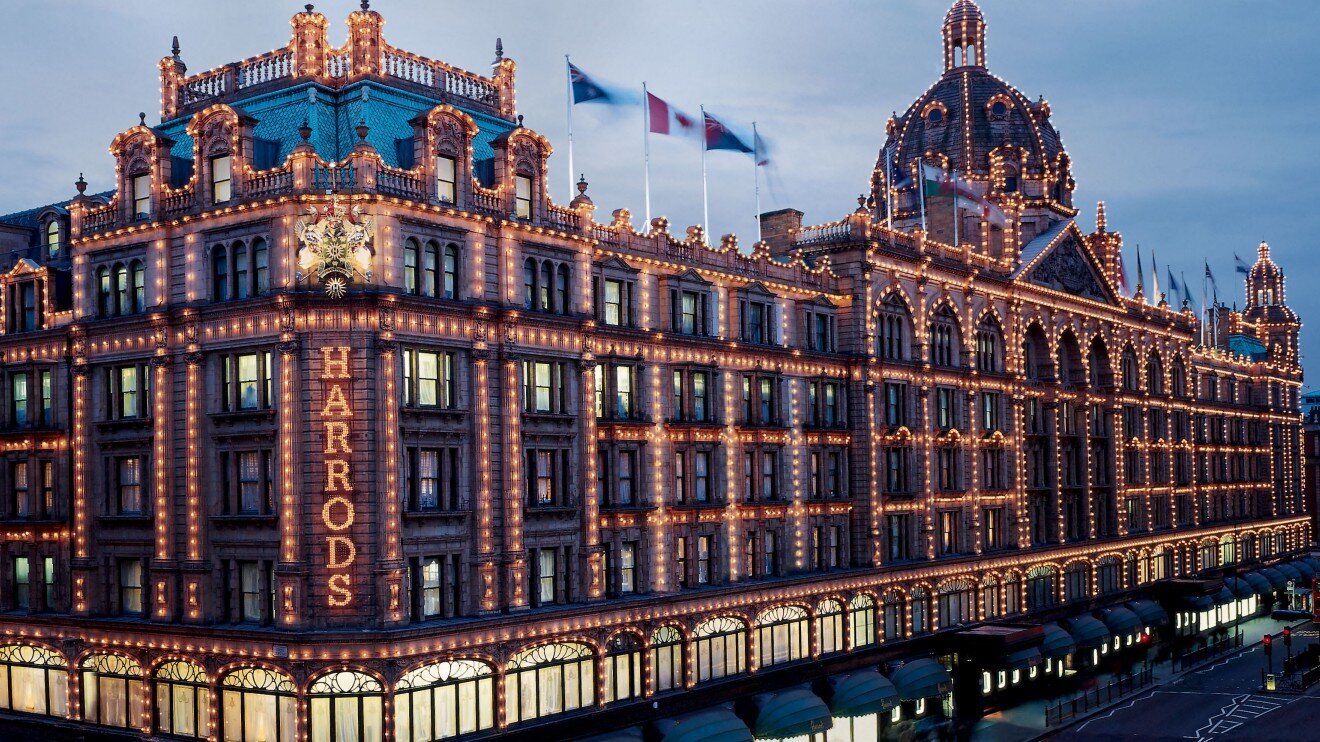
Omnia Omnibus Ubique — "All Things for All People, Everywhere"
A Temple of Luxury in the Heart of London
Harrods is more than a department store — it’s a symbol of British luxury and elegance, located on the prestigious Brompton Road in Knightsbridge. The seven-story building, spanning more than 100,000 square meters, is the largest department store in Europe and one of the biggest in the world. It draws around 15 million visitors a year, making Harrods one of London’s chief tourist attractions.
Origins
Harrods’s story began in 1849, when Charles Henry Harrod opened a small shop in Brompton, banking on the crowds expected for the Great Exhibition of 1851 at nearby Hyde Park. Starting with a single room staffed by two assistants and an errand boy, his son Charles Digby Harrod grew the family business into a thriving retail enterprise.
By 1881 the shop employed a hundred people, but in December 1883 the building burned to the ground. Remarkably, Charles Harrod managed to fulfill every Christmas order and even turned a record profit that year. A new building went up quickly on the same site, and the store began offering credit to its best customers.
Famous Customers
Harrods’s regular customers included figures like Oscar Wilde, Lillie Langtry, Ellen Terry, Charlie Chaplin, Noël Coward, Laurence Olivier and Vivien Leigh, Sigmund Freud, A. A. Milne, and many members of the British royal family. Beatrix Potter shopped there from age 17, and it was at Harrods that her book The Tale of Peter Rabbit was sold alongside the world’s first licensed toy tie-in.
In 1921, A. A. Milne bought an 18-inch Alpha Farnell teddy bear at Harrods for his son Christopher Robin, who first named it Edward, then Winnie — giving rise to the prototype of the famous Winnie-the-Pooh.
Architectural Splendor
The current Harrods building was designed by architect C. W. Stephens for Charles Digby Harrod and opened in 1905. It covers 2 hectares and houses more than 330 departments. The building is a Grade II listed structure.
Especially notable are its Food Halls, with their lavish decor, including an Egyptian-themed room and other thematically decorated departments. The interiors feature marble, stained glass, and ornamental details that create an atmosphere of luxury and refinement.
The Food Halls
Harrods’s famous Food Halls are a temple of gastronomy, showcasing delicacies from around the world — the rarest teas, coffees, cheeses, wines, and other fine goods. The halls are decorated in a range of styles, from Egyptian to Victorian.
The Jewelry Departments
Harrods’s jewelry departments carry pieces from the world’s leading brands, including exclusive collections, ranging from classic designs to avant-garde work by contemporary designers.
The Christmas Department
Harrods’s seasonal Christmas department is a genuine winter wonderland, offering holiday decorations, gifts, and the store’s famous teddy bears year-round.
Innovation and Firsts
Harrods has always been a pioneer in retail innovation. On November 16, 1898, it installed England’s first escalator — a "moving staircase" built as a leather conveyor belt with mahogany-and-frosted-glass handrails. Nervous customers were offered brandy at the top to steady their nerves after the "ordeal."
The store was a founding member of the International Association of Department Stores in 1928, and its then-managing director, Frank Chitham, served as the association’s president in 1930.
Services
Harrods offers far more than merchandise. The store runs 23 restaurants, offering everything from traditional English tea to fine dining. Customers can access "By Appointment" personal shopping, watch repair, bespoke tailoring, a pharmacy, a spa, and a hair salon.
Specialty services include private-event planning, grocery delivery, a wine consultant, custom picnic hampers and gift baskets, bespoke cakes, and perfumery.
An International Clientele
On peak days, Harrods sees up to 300,000 shoppers, with the highest share of non-English-speaking customers of any department store in London. The store employs more than 5,000 staff from over 50 countries.
That makes Harrods a genuinely international meeting place, where cultures and traditions from around the world intersect.
Royal Privileges
From 1910, Harrods held Royal Warrants from various members of the British royal family, confirming its status as an official supplier to the royal court. These included warrants from Queen Elizabeth II (groceries and household goods), Prince Philip (clothing), Prince Charles (clothing and saddlery), and the Queen Mother (china and glassware).
These warrants not only reinforced the store’s prestige but guaranteed the highest standard of goods and service.
Exotic Sales and Stories
Harrods is known not just for its luxury goods but for its unusual sales. In 1923, it sold a lemur named Mah-Jongg to the Courtauld family, who kept him for 15 years. In 1969, John Rendall and Anthony Bourke bought a lion cub named Christian at Harrods; once grown, he was released into the wild in Kenya.
In 2009, Harrods Bank began selling gold bars and coins "off the shelf" — from 1 gram to 12.5 kilograms — along with storage and buyback services.
Dress Code and Tradition
Since 1989, Harrods has enforced a dress code for visitors. Cycling shorts, beachwear, athletic vests, flip-flops, bare feet, exposed midriffs, and dirty clothing are all banned. Celebrities turned away for violating the dress code have included Kylie Minogue, Jason Donovan, a scout troop, and even the football club Shakhtar Donetsk, who arrived in tracksuits.
Ownership and Management
Harrods’s ownership has passed through several stages. The company went public in 1889, was acquired by House of Fraser in 1959, and was bought by the Fayed brothers in 1985 for £615 million. In 2010, the store was sold to Qatar Holding, Qatar’s sovereign wealth fund, for £1.5 billion.
A Place in Culture
Harrods has appeared repeatedly in fiction and film. Agatha Christie, who visited the store as a child, wrote admiringly of its Christmas window displays in 1926. Mr. Bean (Rowan Atkinson) bought his Christmas decorations at Harrods in the 1992 episode "Merry Christmas, Mr. Bean."
The store has become a symbol of British elegance and luxury, a place where tradition meets modernity and history intertwines with innovation. For many visitors, Harrods isn’t merely a place to shop, but a cultural experience — an immersion in a world of refinement and sophistication.
Harrods Today
Harrods remains a symbol of luxury and quality, drawing millions of visitors from around the world. Its motto, "Omnia Omnibus Ubique" — "All Things for All People, Everywhere" — still captures the store’s philosophy: offering the very best goods and services to the most discerning clientele.