Origins
The flagship Selfridges store was founded by the American entrepreneur Harry Gordon Selfridge in 1909. Selfridge had made his fortune working at Chicago’s famous Marshall Field’s department store, but on arriving in London in 1906, he was disappointed by the state of British retail.
Noticing that London’s major stores weren’t using the advanced American sales methods he knew, Selfridge decided to invest £400,000 in building his own department store. He chose what was then an unfashionable stretch of western Oxford Street, gradually buying up the Georgian buildings in the block bounded by Somerset, Wigmore, Orchard, and Duke Streets.
Architecture and Construction
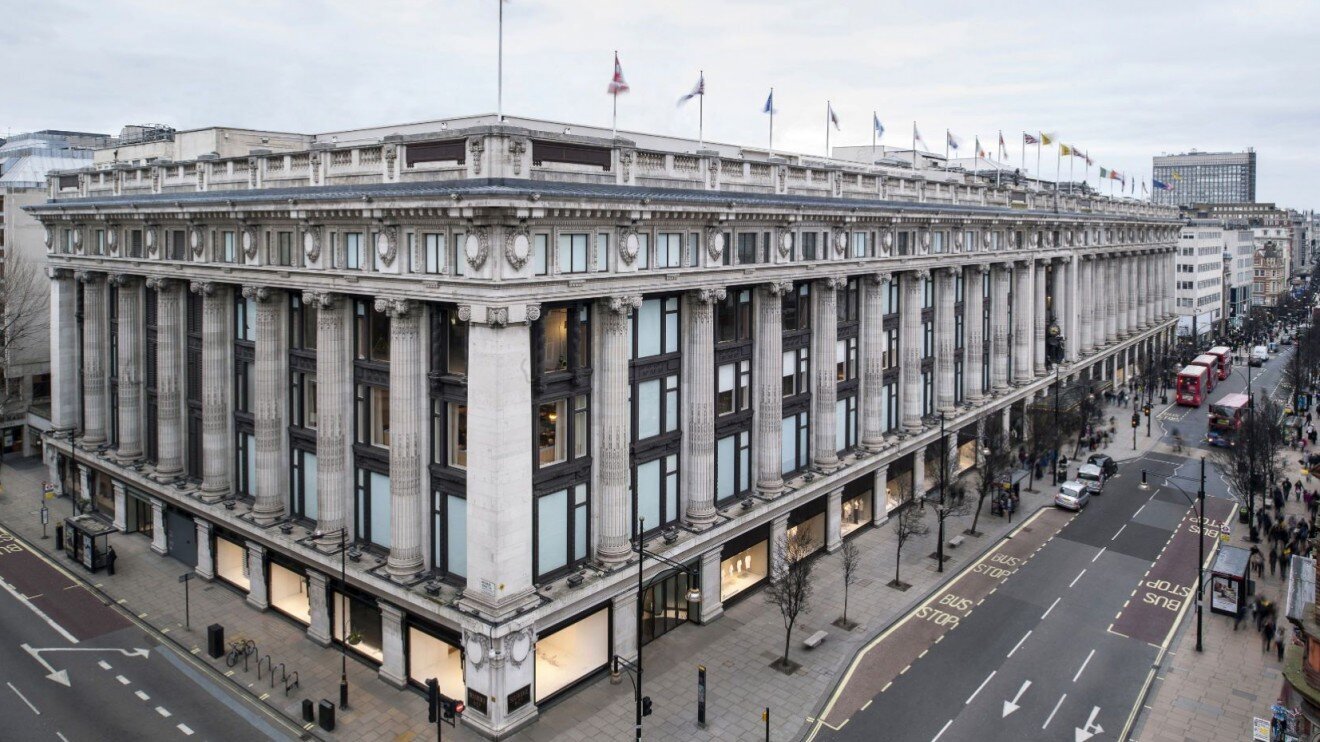
The building was designed by the eminent American architect Daniel Burnham, who also created Marshall Field’s in Chicago, Filene’s in Boston, and other famous department stores. Burnham combined the classical Beaux-Arts style with modern construction technology.
Technical Specifications
- Floor area: 540,000 sq ft (50,000 m²)
- Floors: 5 above ground + 3 basement levels
- Construction: steel frame
- Original number of departments: 100
Architectural Features
- Ionic columns concealing steel supports
- A polychrome sculpture above the entrance by Gilbert Bayes
- Enormous 19×12-foot windows
- A facade more glass than stone
The building was one of the first in Britain to use a steel frame. The Swedish engineer Sven Bylander designed the structure and successfully pushed for changes to London’s building code, leading to the passage of the "Steel Frame Act" in 1909.
A Retail Revolution
Selfridge opened his store on March 15, 1909, hiring 1,400 staff and setting new standards for retail. His philosophy was a radical departure from the traditional British approach:
Selfridge’s Innovations
Store Concept
- Shopping for pleasure, not just necessity
- Merchandise displayed openly for customers to browse
- Unobtrusive but professional service
- The phone number "1" for all of London
Customer Amenities
- Elegant restaurants at moderate prices
- A library and reading rooms
- Dedicated rooms for foreign shoppers
- A first-aid room and a quiet room
The Roof Terraces
A particular attraction were the rooftop terraces, home to:
- Gardens with views over London
- Cafes and restaurants
- A mini golf course
- A women’s rifle club
The roof was a popular spot for a stroll after shopping and for fashion shows.
The War Years
During World War II, Selfridges played an important role in the Allied war effort. From 1942, the store’s deep basements (60 meters underground) housed an American military command post:
A Secret History
Selfridges’s basement housed one of the few secure teleprinter communication links of the war. Fifty soldiers of the U.S. Army’s 805th Signal Service worked there, operating the SIGSALY encryption system, connected directly to the Pentagon.
The first conference call took place on July 15, 1943. Prime Minister Churchill used the system to communicate with the U.S. president; lines were later extended to 10 Downing Street and the War Cabinet.
The store was seriously damaged during the bombing of London:
- September 17–18, 1940 — the famous display windows were shattered and the lifts knocked out
- April 17, 1941 — the Palm Court restaurant was destroyed
- December 6, 1944 — a V-2 rocket strike killed 8 American servicemen and 10 civilians
The Famous Window Displays
27 Oxford Street Windows
Selfridges’s window displays became a symbol of the store and a London landmark in their own right, drawing tourists, designers, and fashion fans from around the world.
Historical Significance
- Harry Selfridge created a "signature" window that celebrities would autograph
- That window was destroyed in the first air raid and never rebuilt
- 20% of the store’s profits are tied to its windows
Today
- The windows are photographed by London photographer Andrew Meredith
- They’re featured in Vogue, Harper’s Bazaar, and the New York Times
- Bold art installations sometimes stop traffic on Oxford Street
Standing and Recognition
By the end of the 20th century, Selfridges had established itself as one of the world’s leading department stores:
2nd
largest department store in the UK, after Harrods
250,000
people pass through the main entrance every week
The largest
beauty department in the UK
Ownership
The store’s ownership history reflects the shifting landscape of British retail:
| 1909–1941 | Harry Gordon Selfridge — founder |
| 1951–1965 | The Lewis’s group (Liverpool) |
| 1965–2003 | Sears Group (Charles Clore) |
| Since 2003 | The Weston family (Canada) — £598 million |
Architectural Legacy
The Selfridges building is a unique example of a transitional moment in architecture — classical in appearance, revolutionary in construction. Its steel frame, hidden behind an elegant Beaux-Arts facade, made it one of the last great classical buildings in Britain.
Cultural Influence
Selfridges changed not just retail but London’s social culture. The store became a place where women could stroll freely and unaccompanied, a place to meet and be entertained. The concept of "shopping for pleasure" spread around the world.
Today, Selfridges remains more than a store — it’s a cultural institution, a symbol of the London way of life, and proof that commerce can become an art form.