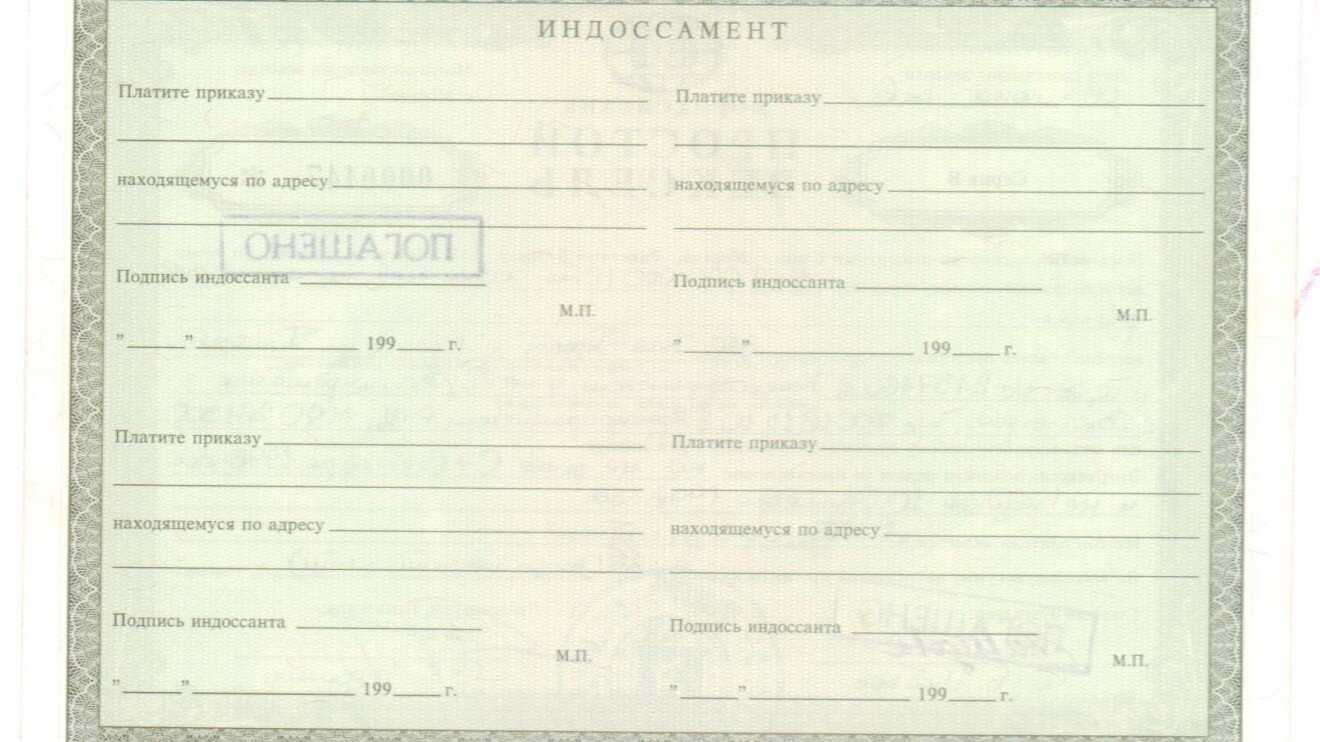
The scheme described in the text is a classic example of mid-1990s financial fraud, from a period when Russia’s economy was still forming its market institutions, without a developed legal framework or effective government oversight.
How the Fraud Worked
The fraudsters used promissory notes carrying deliberately invalid endorsements. The scheme ran like this:
Stage 1: The perpetrators issued notes in the name of a supposedly existing LLC, «VatraInvestment,» creating the appearance of a solid financial institution.
Stage 2: When the note was handed over to a new holder, the endorsement (transfer signature) deliberately misstated the organization’s name — instead of the actual OJSC «VatrOInvestЪ,» it read the non-existent LLC «VatraInvestment.»
Stage 3: When the note came due, holders would go to Vatrobank to collect — only to be refused, on the grounds that the endorsement was invalid.
Schemes like this were especially common between 1995 and 1998, when promissory notes were widely used by Russian enterprises to settle payments amid an acute cash shortage.
What an Endorsement Is
An endorsement (from the Latin in, «on,» and dorsum, «back») is a transfer signature on the back of a security, certifying the transfer of rights under the document to a new holder. Russian also uses the older term «giro.»
The endorsement is the key mechanism of promissory-note circulation. Without a properly executed endorsement, a note can’t be transferred to another party — and loses its negotiability, its main advantage over an ordinary IOU.
Basic Requirements for a Valid Endorsement
Unconditionality: an endorsement can’t carry any conditions or caveats. It’s either fully valid or entirely invalid.
The endorser’s signature: the party transferring the note must sign the transfer inscription.
Completeness of transfer: an endorsement can’t be partial — all rights under the note transfer as a whole.
Accuracy of details: any error in the organization’s or individual’s name renders the endorsement invalid.
Types of Endorsement
Special (order) endorsement — names the specific party to whom the note is transferred.
Blank endorsement — carries only the transferring party’s signature, with no named recipient, turning the note into a bearer instrument.
Procuration endorsement — transfers not ownership but authority to act on the owner’s behalf (for instance, to collect payment).
Legal Consequences
In the case described, misstating the organization’s name in the endorsement («VatraInvestЪ» instead of «VatraInvestment») rendered the transfer inscription legally void. Which meant:
• Rights under the note formally never passed to the new holder
• The bank was fully entitled to refuse payment
• The victims were left without legal recourse
Such schemes thrived in an environment of low financial literacy and an underdeveloped banking oversight system. Many entrepreneurs of the era lacked sufficient knowledge of promissory-note law, making them easy prey for fraudsters.
Schemes like this were only fully stamped out by the late 1990s, as banking oversight strengthened and financial-market participants grew more legally literate.