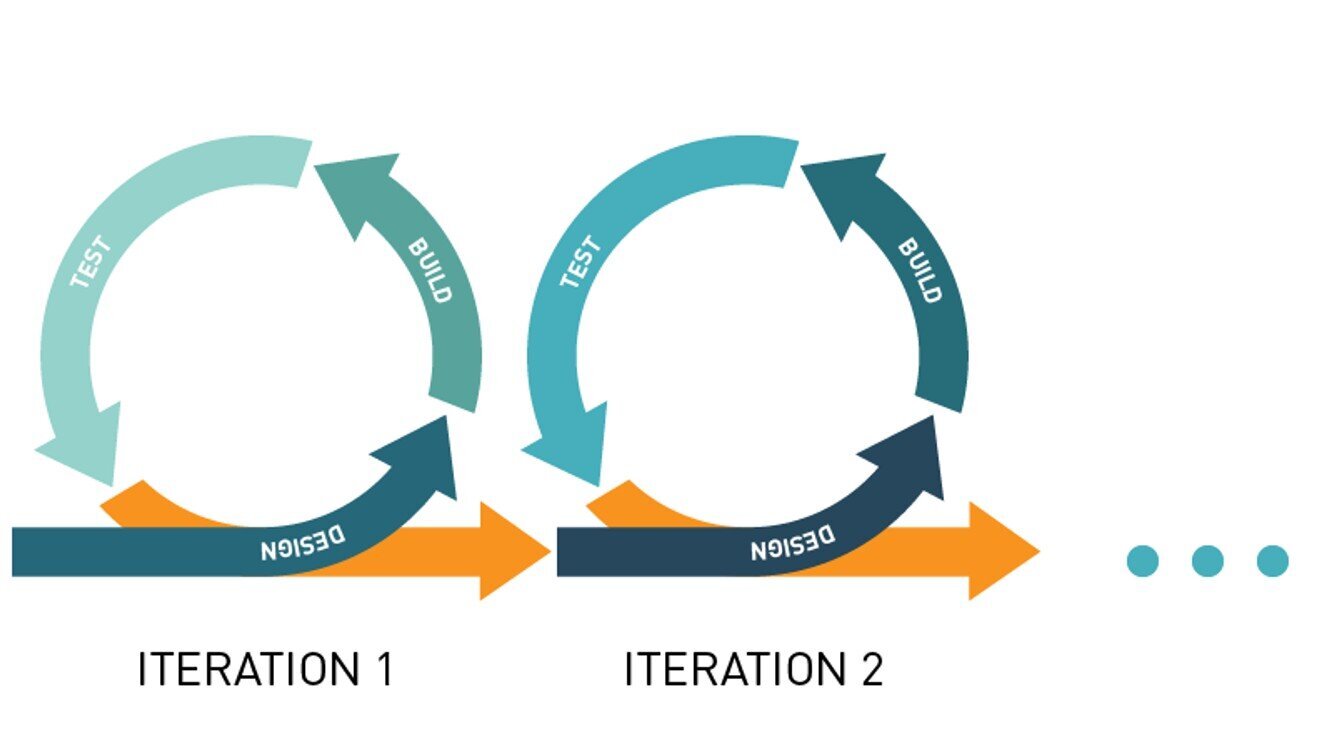
In the context of this episode, Zhora uses the word "iteration" in a sense that became especially popular in early-1990s Russia among people connected to new technology, business, and trade. This was a period of active borrowing into Russian of terminology from programming and mathematics.
The term's origin
The word "iteration" comes from the Latin iteratio, meaning "repetition." In scientific terminology, this term has several specialized meanings depending on the field of application.
In mathematics, an iteration is the result of repeatedly applying some operation or function. For example, given a function f(x), the second iteration is f(f(x)), the third is f(f(f(x))), and so on. This principle is widely used in various mathematical methods for solving equations and systems.
Iteration in programming
In programming, which in the early 1990s was only just beginning to spread widely in the USSR, iteration means organizing data processing through repeated actions. Unlike recursion, an iterative procedure doesn't call itself — it simply repeats a set number of times, or until a certain condition is met.
The simplest example of iteration in programming is a loop. When a programmer needs to perform the same action many times (say, printing text to the screen 100 times), they write an iterative loop that repeats the desired command the specified number of times.
The term's spread into business speech
In early-1990s Russia, a period of rapid growth in private entrepreneurship and new forms of trade, many terms from technical fields began working their way into the everyday speech of educated people, especially those connected to new technology or modern business practices.
Zhora's use of the word "iteration" in the context of shopping ("Repeat the iteration until the first screw-up") shows an attempt to apply scientific terminology to an everyday situation. He proposes a cyclical approach to dealing with a vendor: repeat the same actions (return to the same seller, buy goods) as long as a condition holds (the seller keeps working honestly and reliably).
Sociocultural context
This kind of word usage was typical of the 1990s, a time when speech absorbed many borrowed terms and attempts to sound "scientific" or "modern." People with a technical education, or exposure to new technology, often carried professional terminology over into everyday conversation.
Here, Zhora uses "iteration" as a synonym for "repetition," but with a tinge of system and method, underscoring his desire to present simple street wisdom as a scientifically grounded algorithm.
Practical application of the concept
In essence, Zhora's advice describes an iterative algorithm for dealing with a vendor:
Initial condition: find a reliable seller
Action: make a purchase
Check the result: assess the quality of service
Continuation condition: if the result is satisfactory, repeat the action
Termination condition: if the seller "screws up" (fails to meet expectations), stop iterating and find a new seller
This approach reflects the practical wisdom of doing business amid the unstable economy of the early 1990s, when the reliability of business partners was critically important, and reputation was built through repeated successful interactions.