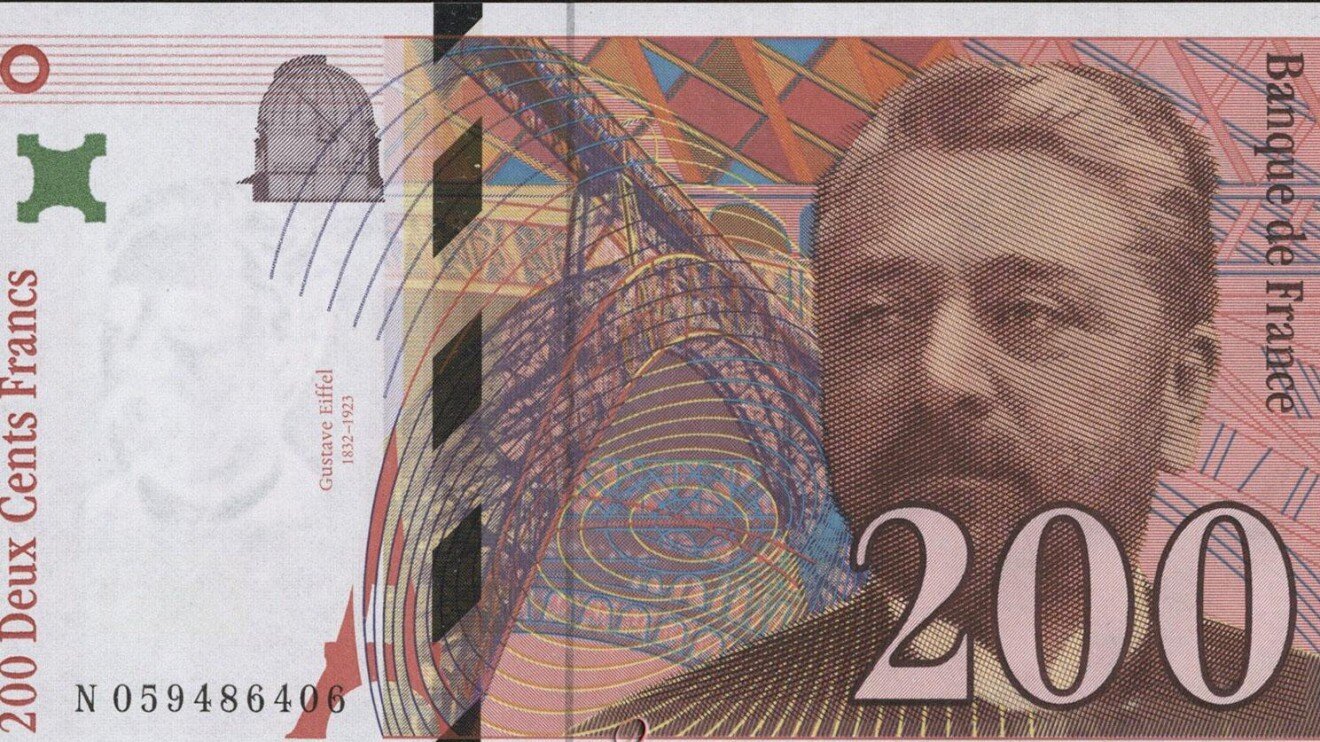
The novel mentions a sum of 48 million francs – at the time the novel is set (April 1996), this was worth roughly $9.3 million US, a very substantial sum for a major construction project at that exchange rate.
What the French franc was
The French franc (French: franc) was the national currency of France, in use from the fourteenth century until the introduction of the euro in 2002. The franc was also the currency of many other countries historically or geographically tied to France, including former French colonies in Africa, Asia, and the Americas.
The name «franc» has several proposed origins. One traces it to the Latin inscription «FRANCORUM REX» («King of the Franks») on the first coins. Another links it to the French word «franc,» meaning «free,» symbolizing the French king’s release from English captivity. A third connects the name to the English word «frank,» meaning «noble.»
The franc-to-dollar exchange rate in April 1996
At the time the novel is set – April 29, 1996 – the French franc traded against the US dollar at roughly $0.194 per franc, or approximately 5.15 francs per US dollar.
That means the 48 million francs mentioned in the novel amounted to roughly $9.32 million US – a very large sum for a mid-1990s investment project.
The franc’s historical development
Medieval origins (1361–1795)
The first coin called a «franc» appeared in France in 1361, under King John II the Good. It was a gold coin weighing 3.885 grams, minted to pay the ransom for the king, then held captive in England. The coin depicted an armored horseman, earning it the name «franc à cheval» («franc on horseback»).
Under John II’s heirs the coin’s design changed – the «franc à pied» («franc on foot») appeared, showing the king standing. Around this time the franc also became a unit of account, equal to 20 sous, not just a coin.
In 1575, under Henry III, the franc was revived as a silver coin weighing 14.07 grams. Under Henry IV its silver content was raised to 23 grams. Under Louis XIII, however, minting stopped, though the franc survived as a unit of account.
The revolutionary franc (1795–1803)
During the French Revolution, on August 15, 1795, the franc was officially established as France’s primary currency. It was a 900-fine silver coin weighing exactly 5 grams. An important innovation was decimalization: the franc was divided into 100 centimes.
The Germinal franc (1803–1928)
In 1803 Napoleon introduced the so-called «franc germinal» (named for the law dated 17 Germinal, Year XI). The system was bimetallic, with a fixed ratio between gold and silver: 6.45 grams of 900-fine gold were worth 20 francs, and 25 grams of 900-fine silver were worth 5 francs.
Gold coins of 20 and 40 francs were minted, and from 1809, silver coins of ¼, ½, 1, and 2 francs. Later, gold coins of 50 and 100 francs appeared.
The Latin Monetary Union (1865–1927)
In 1865 the first international monetary system based on the French franc was created – the Latin Monetary Union. Its members included France, Belgium, and Italy, later joined by Greece and other countries. All members adopted the French monetary system, with uniform standards for the gold and silver content of coins.
In 1878 France abandoned the silver standard, moving to a gold monometallic system. The franc’s gold content remained 322.5 milligrams of pure gold until 1928.
The world wars and instability (1914–1944)
The First World War ended the franc’s stability. The conversion of paper money to gold was suspended, and between 1914 and 1925 the franc lost roughly seven-eighths of its value.
A monetary reform in 1925–1928 replaced the old franc germinal with the «franc Poincaré,» carrying a gold content of 65.5 milligrams. But the new currency also proved unstable amid economic troubles and the Great Depression.
A series of devaluations between 1934 and 1940 cut the franc’s gold content to 21.006 milligrams by 1940.
During the Second World War, occupied France circulated Vichy-government francs at an unfavorable exchange rate (20 francs to the reichsmark), while «war francs» issued by Free France circulated in liberated territories.
Postwar recovery (1944–1960)
After liberation in 1944, the French franc was restored. In 1945 France joined the Bretton Woods system: the franc’s gold content was set at 7.461 milligrams, with an exchange rate of 119.10 francs to the dollar.
Economic difficulties, however, led to a series of devaluations, and by 1959 the gold content had fallen to 1.8 milligrams, with the exchange rate weakening to 493.706 francs to the dollar.
The new franc (1960–2002)
On January 1, 1960, a redenomination took place: the new franc was introduced at a ratio of 100 old francs to 1 new franc. The move significantly simplified accounting and gave the currency greater stability.
The new franc proved more resilient, though it was devalued by 12.5% after the events of May 1968. In the 1970s France took part in the European currency «snake,» and from 1979 in the European Monetary System.
By the mid-1990s, when the novel is set, the French franc was one of Europe’s leading currencies, though it remained somewhat weaker than the German mark.
Denominations and coins
In the 1990s the following denominations circulated in France:
Coins: 5, 10, 20 centimes, and ½, 1, 2, 5, 10, 20 francs. The smallest denominations (1 and 2 centimes) had by then largely fallen out of use.
Banknotes: 20, 50, 100, 200, 500 francs. A 1,000-franc note also existed, but it was withdrawn from circulation in 1993 over counterfeiting concerns.
The banknotes were notably artistic in design and reflected French culture. They featured prominent figures from the arts and sciences: composer Claude Debussy (20 francs), writer and aviator Antoine de Saint-Exupéry (50 francs), painter Eugène Delacroix (100 francs), engineer Gustave Eiffel (200 francs), and scientists Pierre and Marie Curie (500 francs).
The franc in international trade
In the 1990s the French franc was one of the world’s reserve currencies, though it ranked behind the US dollar, the German mark, and the Japanese yen. The franc was widely used in international trade, particularly with African countries that were former French colonies.
Many African nations (members of the so-called «franc zone») pegged their currencies to the French franc. This provided their monetary systems with a degree of stability, but also created dependence on French economic policy.
Exchange-rate policy in the 1990s
During the period depicted in the novel, the French franc operated within the European Monetary System (EMS), which limited how far European currencies could fluctuate against one another. This gave the franc relative stability against other European currencies, especially the German mark.
Against the US dollar, however, the franc could fluctuate more significantly, depending on economic conditions and the monetary policies of central banks.
The economic weight of sums in francs
To grasp the scale of the 48 million francs mentioned in the novel, it helps to consider the franc’s purchasing power in 1996:
• Average monthly salary in France: roughly 12,000–15,000 francs
• An apartment in Paris: 500,000 to 2 million francs
• A mid-range car: 80,000–150,000 francs
• A restaurant meal: 100–200 francs
Forty-eight million francs, then, was an enormous sum – comparable to the annual budget of an average French town or the cost of a major industrial facility.
The transition to the euro
By the time the novel is set, active negotiations were already underway to create a single European currency. The Maastricht Treaty had been signed in 1992, and by 1996 it was clear that the days of national currencies in Europe were numbered.
On January 1, 1999, the franc and the euro began circulating in parallel (initially only in non-cash form) at a fixed rate of 6.55957 francs to 1 euro. On January 1, 2002, euro banknotes and coins entered circulation, and on February 17, 2002, the French franc ceased to be legal tender for good.
That marked the end of more than 600 years of history for one of the world’s oldest currencies, one that played a major role in the European and world economy.
Influence on literature and culture
The French franc has been referenced repeatedly in world literature as a symbol of wealth, elegance, and the French way of life. From the novels of Honoré de Balzac, which specified characters’ incomes in francs down to the last detail, to works of the twentieth century, the currency was an inseparable part of French culture.
In business literature and documents of the 1990s, sums in francs frequently appeared in international contracts, making the currency recognizable well beyond France and the French-speaking world.