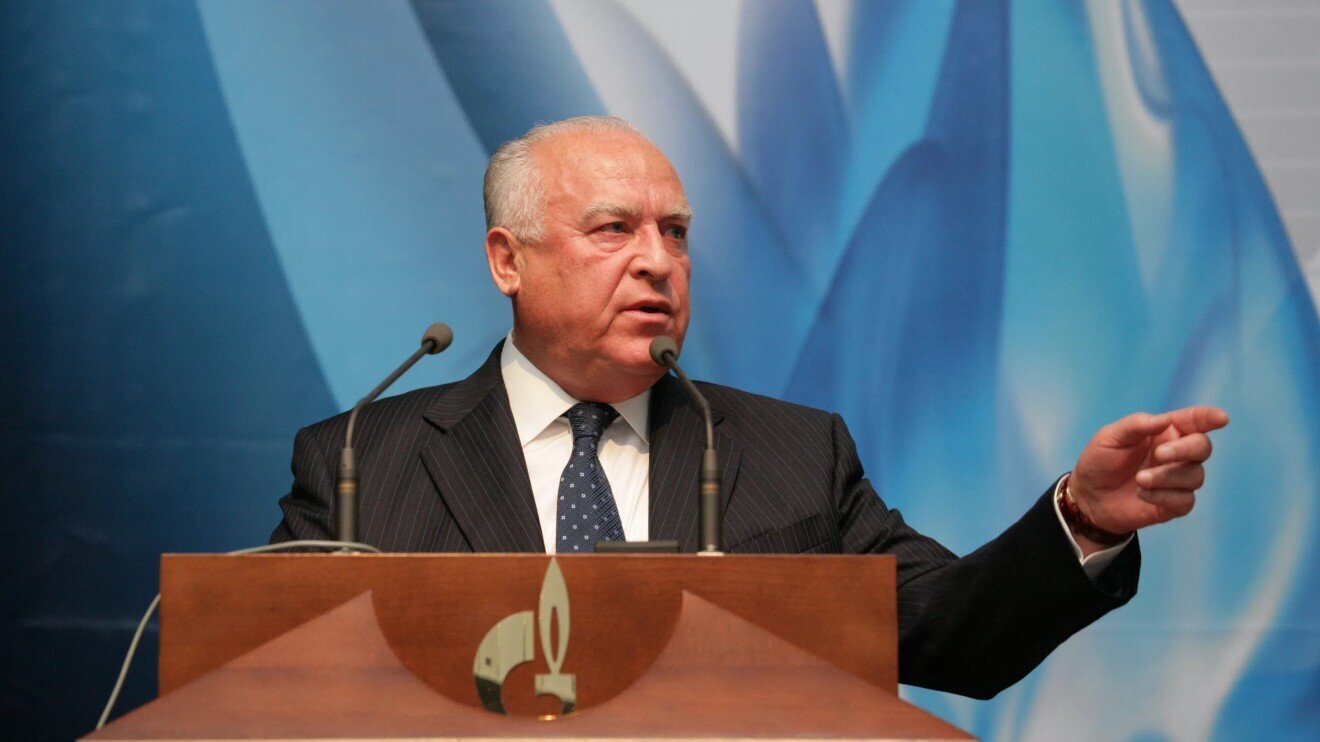
Viktor Stepanovich Chernomyrdin (1938–2010) was one of the key figures in Russian politics of the 1990s, Chairman of the Government of the Russian Federation from 1992 to 1998. In the context of the novel, set in 1996, Chernomyrdin stood at the peak of his political influence.
The path to power
Viktor Chernomyrdin was born on April 9, 1938, in the village of Chyorny Otrog in Orenburg Oblast, into a Cossack family. His father worked as a driver, and the family raised its children under strict discipline and reverence for tradition. Starting out as a fitter at the Orsk Oil Refinery after finishing technical college, Chernomyrdin followed a path typical of the Soviet era, rising from worker to top executive.
After military service and earning a degree as a process engineer from the Kuibyshev Polytechnic Institute in 1966, he worked at the same plant as head of a unit. But the turning point in his career came in 1967, when the Orsk city Party committee pulled him into Party work. As Chernomyrdin himself recalled: «Working at a district or, even more so, a city Party committee in a position of responsibility was the golden dream of career-minded people… But I didn’t need that! I felt like a production man through and through.»
The gas empire
From 1973 onward, the «gas» era of Chernomyrdin’s biography began. He headed the Orenburg Gas Processing Plant, then moved to work in Moscow. In 1982 he became Deputy Minister of the Gas Industry of the USSR, and from 1985 to 1989 he held the post of Minister of the Gas Industry of the USSR. During this period he defended his candidate’s dissertation on natural gas purification technology.
A particularly important step came with his 1989 appointment as chairman of the board of the State Gas Concern «Gazprom.» It was here that Chernomyrdin formed his management philosophy and built the powerful economic base that later became the foundation of his political influence.
Prime Minister of Russia
On December 14, 1992, at the Seventh Congress of People’s Deputies of Russia, an event took place that determined Chernomyrdin’s political fate. President Boris Yeltsin, faced with the Congress’s rejection of Yegor Gaidar’s candidacy, put five candidates for chairman of the Council of Ministers to a vote. The Congress confirmed Viktor Chernomyrdin, and that same day Yeltsin signed a decree appointing him.
From December 25, 1993, following the adoption of the new Constitution, Chernomyrdin became Chairman of the Government of the Russian Federation. He continued Gaidar’s economic policy, but with greater pragmatism and less radicalism. Under him, large-scale privatization of enterprises was carried out, including the controversial loans-for-shares auctions, the market for state short-term bonds (GKOs) developed, and the ruble was redenominated.
The Gazprom premier
As prime minister, Chernomyrdin actively supported RAO Gazprom, then headed by his former deputy Rem Vyakhirev. The core slogan of his policy became the phrase: «What’s good for Gazprom is good for Russia.» This stance drew criticism, especially after a copy of a 1994 trust agreement was published in 2012, under which, by Chernomyrdin’s decree, Gazprom could obtain an option to buy back 30% of its own shares from the state for a mere 71 million rubles, against a real value of roughly $9 billion.
Chernomyrdin’s close ties to the gas sector shaped a particular type of Russian capitalism, in which state corporations played a key role. This created the impression that «solid characters» – representatives of big business, especially from the energy sector – were constantly circling around the premier.
1996: the peak of his influence
1996 was an especially significant year in Chernomyrdin’s career. After Yeltsin’s victory in the presidential election in July, the Government, per the Constitution, resigned on August 9. Chernomyrdin’s candidacy was resubmitted by Yeltsin and approved by the Duma on August 10, 1996, confirming his unassailable position in power.
But the most dramatic moment came in the fall of 1996. On September 19, Yeltsin signed a decree on the temporary exercise of presidential duties, transferring all presidential powers to Chernomyrdin for the duration of his heart surgery. From 7:00 a.m. on November 5 to 6:00 a.m. on November 6, 1996, Chernomyrdin was effectively president of Russia.
In a later interview, Chernomyrdin admitted that while Yeltsin lay on the operating table, certain politicians tried to persuade him to seize power in the country. But the premier flatly refused even to discuss such an idea – a fact that marks him as a man true to his word and to constitutional order.
Political style and public image
By 1996 Chernomyrdin had established himself as a politician of a distinctive type. A man from the provinces, he retained a plainness of speech and directness of judgment that sharply contrasted with the Moscow political elite. His phrases often became catchphrases, though they sometimes drew laughter too. Yet beneath the outward simplicity lay an experienced manager and a subtle political operator.
In May 1995 Chernomyrdin became chairman of the All-Russian socio-political movement «Our Home Is Russia,» which won 10.1% of the vote in the December 1995 State Duma elections. It was an attempt to build a party of power uniting the directors’ corps with the regional elite.
Crisis moments
1996 did not pass without crises. Chernomyrdin had to deal not only with economic matters but with security issues as well. As early as June 1995, following the terrorist attack in Budyonnovsk, he negotiated by telephone with Shamil Basayev, whose detachment had seized the town hospital. That tragedy, in which around 180 people died, showed Chernomyrdin as a politician ready to take responsibility in critical situations.
From July 25, 1996, until the Defense Council was abolished on March 3, 1998, Chernomyrdin also served as deputy chairman of the Russian Federation Defense Council, further strengthening his position within the power structure.
Regional ties and patronage
A distinctive feature of Chernomyrdin’s political style was his accessibility to regional elites. Provincial directors did indeed regularly visit his reception room, seeing in him «one of their own» – a man who understood industry’s problems and was willing to support enterprises. This trait made his office a magnet for representatives of big business, especially from traditional industries.
Chernomyrdin did not forget his home region either. In September 1996, with his support, a church dedicated to St. John the Evangelist was built and consecrated in the village of Chyorny Otrog – a symbol of his ties to his native land.
Human traits
Despite his high position, Chernomyrdin retained simple, human habits. His hobby – hunting – occasionally led to scandal. In 1997, for instance, during Christmas week, he took part in a bear hunt and killed two bear cubs, which drew a sharp public and environmentalist backlash.
His family upbringing left its mark on his behavior even in the highest state offices. As he recalled, even as a government minister, he couldn’t light a cigarette in front of his older brother until the brother offered first – and even less so in front of his father. These traits of patriarchal upbringing shaped his particular style of dealing with subordinates and colleagues.
Conclusion
In 1996 Viktor Chernomyrdin represented a symbol of the new Russian capitalism – pragmatic, tied to major corporations, yet still connected to traditional values. His figure bridged the old Soviet nomenklatura and the new business elite, which made his office a place where the country’s key economic decisions were made. To his contemporaries he embodied stability amid the turbulent 1990s – a man who could come to terms with any force and find compromise in the most difficult situations.