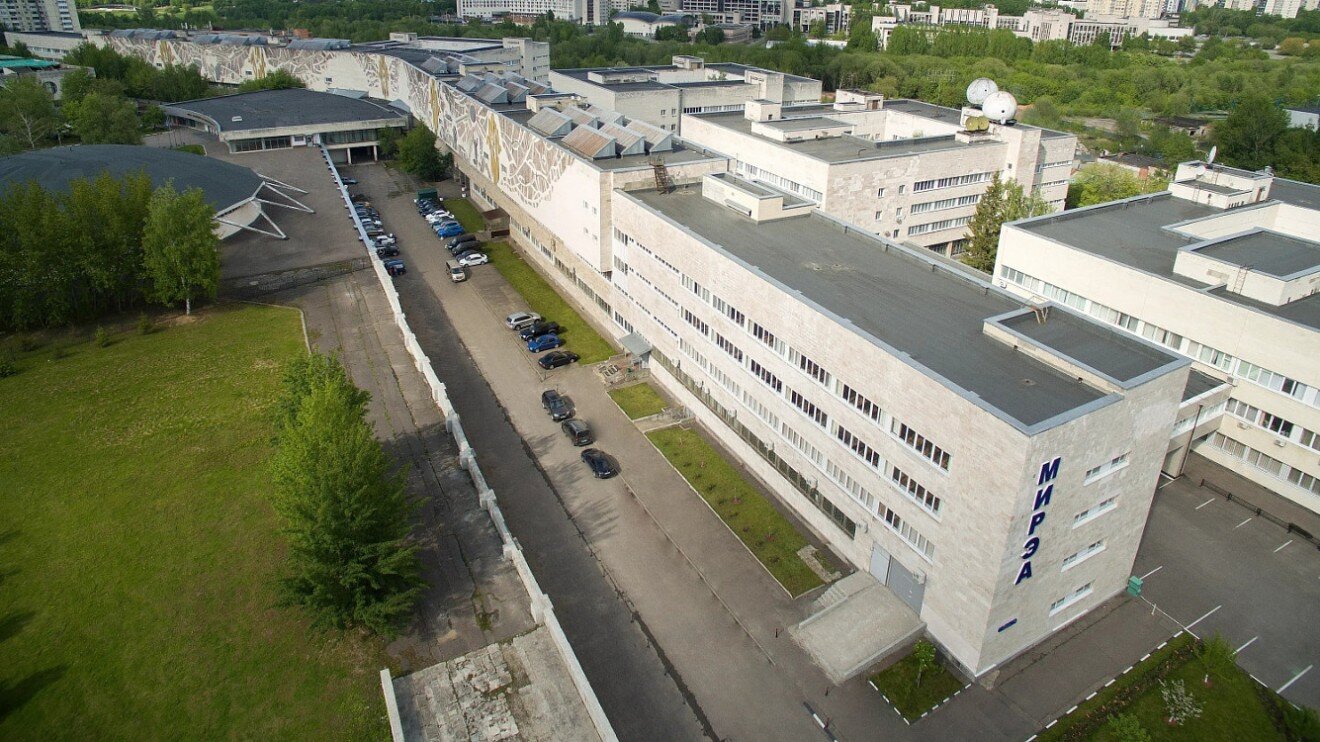
What MIREA is
MIREA — the Moscow Institute of Radio Engineering, Electronics, and Automation — is one of Moscow's leading technical universities, specializing in training engineers for the defense industry and high-tech sectors. In 1993, the institute was living through an important moment in its history, gaining the status of a technical university.
Historical background
MIREA traces its history back to 1947, when the All-Union Correspondence Energy Institute (VZEI) was founded. The institute originally trained engineers for the defense industry and the new branches of the energy sector. In 1967, VZEI was reorganized into MIREA, to train highly qualified engineering personnel for the knowledge-intensive electronics and radio industries.
By 1993, MIREA had more than 25 years of history behind it as a specialized radio-engineering institute. Between 1967 and 1992, the institute graduated 44,897 specialists, attesting to its significance within the Soviet and Russian technical education system.
Key dates
- 1947 — VZEI founded
- 1967 — reorganized into MIREA
- 1993 — gains technical university status
Specialization and departments
In 1993, MIREA was a highly specialized technical institute, with a clear focus on radio engineering, electronics, and automation. Its structure included:
- The Department of Radio Engineering — trained specialists in radio communications and radar
- The Department of Electronics — specializing in electronic devices and systems
- The Department of Automation — automatic control systems
- The Department of Automatic Monitoring and Control
- Departments in newer specialties: biomedical engineering, optoelectronics, applied mathematics
The unique "institute-affiliated department" system
MIREA's distinctive feature
MIREA's chief distinguishing feature was its "institute-affiliated department" (bazovaya kafedra) system, introduced in the mid-1960s with the backing of the country's leading academicians.
This system ensured a close link between education and industry. MIREA students studied not only within the institute's walls, but also at affiliated departments set up at leading Moscow enterprises of the defense-industrial complex:
Research institutes and design bureaus
- NIIP (Instrument Engineering)
- NIIAA (Automatic Equipment)
- NII AP (Automation and Instrument Engineering)
- TsNII "Kometa"
- TsNII "Agat"
Industrial enterprises
- VNIIRT
- NIIDAR
- TsKB "Almaz"
- And others (more than 50 affiliated departments in total)
Thanks to this system, MIREA graduates gained not only theoretical knowledge, but practical experience working on real projects in radio electronics, control systems, and communications.
MIREA vs. MEPhI: key differences
| Parameter | MIREA | MEPhI |
|---|---|---|
| Focus | Radio engineering, electronics, automation | Nuclear physics, atomic energy |
| Dormitories | None | A developed dormitory system |
| Student body | Mostly Muscovites | Students from across the USSR/Russia |
| Industry ties | A system of affiliated departments at enterprises | Ties to the nuclear industry |
| Length of study | 5.5 years, full-time | 6 years |
An important distinction: no dormitories
One of the main differences between MIREA and MEPhI was that MIREA had no dormitories of its own. This meant its students were mostly Muscovites, or residents of the Moscow region, able to commute to the institute daily. Unlike MEPhI, which drew talented young people from across the entire Soviet Union and housed them, MIREA worked mostly with a local student body.
Location and campus
By 1993, MIREA was housed in a modern teaching-and-research complex at 78 Vernadsky Prospekt (in Moscow's Southwestern Administrative Okrug). Construction of this complex began in the late 1960s and was completed in the 1980s.
Building "A"
The main teaching building, opened in 1979
Building "B"
The administrative building, housing the rectorate and deans' offices, built in 1976
Total area
Over 100,000 m² of teaching space across six buildings
Besides its main complex, the institute had teaching buildings on Nalichnaya Street, 3a (since 1968) and on 5th Sokolinaya Gora Street, 20 (since 1969).
Student life in 1993
1992–1993 marked a turning point for student life at MIREA. In 1992, a grassroots youth organization, the "MIREA Student Union," was formed. Its founder and the first secretary of its committee was S.Yu. Gubin.
Features of student life at MIREA
- The absence of dormitories shaped the particular character of the student community
- A practical focus in training, through work at the affiliated departments
- Close ties to Moscow's defense enterprises
- A high level of technical training, thanks to modern equipment
Becoming a technical university
A landmark event of 1993
On November 22, 1993, under Order No. 364 of the Russian Federation State Committee for Higher Education, the Moscow Institute of Radio Engineering, Electronics, and Automation was reorganized into the Moscow State Institute of Radio Engineering, Electronics, and Automation (Technical University).
This transformation was a recognition of the institute's high standard of training and its broad range of specialties. Gaining technical-university status let MIREA:
- Expand its range of educational programs
- Raise its standing within the Russian education system
- Gain greater autonomy in governance
- Strengthen its international ties
Notable achievements
By 1993, MIREA could point to a number of outstanding achievements by its graduates and faculty:
Space projects
1961: VZEI graduate V.I. Kaganov designed the radio transmitter for the "Vostok" spacecraft, aboard which Yuri Gagarin made the first human spaceflight.
1988: Under the leadership of A.P. Reutov (head of a MIREA department), the automatic landing system for the "Buran" space shuttle was developed.
Communications systems
Under the leadership of M.R. Kaplanov (a MIREA professor), the following space communication systems were developed:
- "Molniya-1" (1962)
- "Molniya-2" (1965)
- "Korund" (1969)
- "Kulon" (1973)
The institute's atmosphere in 1993
1993 was a time of great change for the entire Russian education system. MIREA, like other technical institutes, was living through a period of adaptation to the new economic and social conditions. Even so, the institute preserved its traditions of high-quality technical education.
A fourth-year MIREA student in 1993 was a future engineer, being trained at one of the country's leading technical institutes, specializing in high technology.
Studying at MIREA involved:
Academic training
- A solid mathematical foundation
- An in-depth study of physics
- Specialized courses in radio engineering
- Programming and computer science
Practical training
- Work in the institute's laboratories
- Practical training at the affiliated departments
- Real engineering projects
- Thesis projects carried out at enterprises
A social portrait of the MIREA student
A typical MIREA student in 1993:
- A Muscovite or a resident of the Moscow region (due to the lack of dormitories)
- Technically gifted (admission was highly competitive)
- Oriented toward work in high-tech industries
- Connected to the defense-industrial complex through the affiliated departments
- Gaining practical skills at real enterprises
Graduates' prospects
MIREA's 1993 graduates entered the job market during a difficult period of economic transformation. Even so, their technical qualifications and practical skills made them sought-after specialists.
Research institutes and design bureaus
Continued work at research institutions
Commercial firms
A move into the emerging private sector
Entrepreneurship
Starting one's own technical business
Conclusion
MIREA in 1993 was a highly specialized technical institute, with a unique system for training engineers for high-tech industries. The absence of dormitories made it a distinctly "Moscow" institute, while the system of affiliated departments ensured close ties to real-world production. Gaining technical-university status in 1993 was a recognition of the high standard of education this institute gave its students.