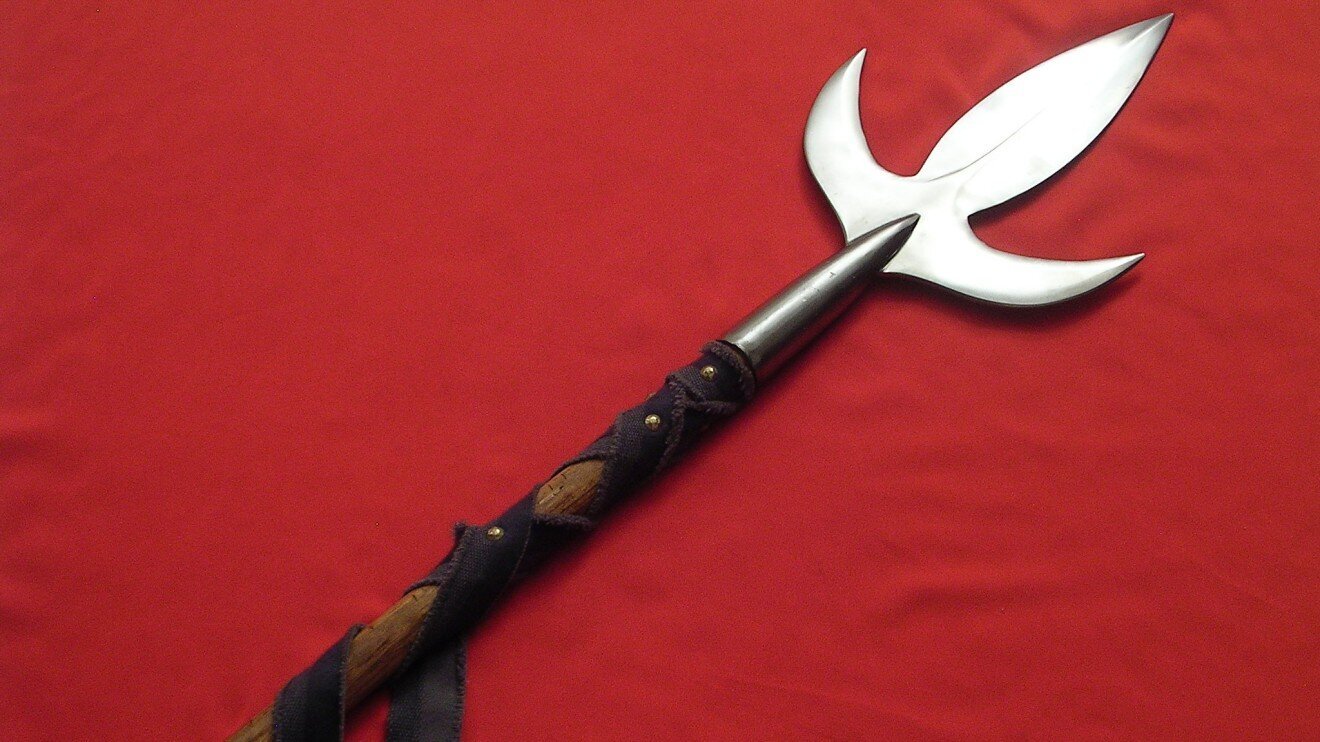
The partisan (Russian: protazan) is a ceremonial thrusting polearm, a variety of spear or halberd, which played an important role in the military history and ceremonial traditions of European armies from the 16th to 18th centuries. This weapon, with its distinctive broad, flat head on a long shaft, became a symbol of officer’s honor and royal authority.
Etymology and Origin of the Name
The origin of the word «partisan» has several competing theories, reflecting the complicated history of how this weapon spread across Europe. The most widespread theory links the name to the German word «Partisane,» which in turn may derive from the French «pertuis» — an opening or hole. This etymological explanation is quite telling: it recalls the wide, deep wounds this weapon left behind.
The French variant «pertuisane» translates literally as «spear with a flat head,» which accurately describes the weapon’s construction. There’s also a theory tracing it to the German «partisane» or Polish «partyzana,» meaning «supporter» or «adherent» — possibly connected to the fact that the partisan was a weapon carried by personal guards and bodyguards.
Especially interesting is the theory of Russian researcher A.F. Veltman, who proposed the reverse path of borrowing. In his view, the Russian berdysh (a type of poleaxe) made its way to northern Europe, where, following the rules of the Gothic language, the ending «-an» was added to the word: «bardis,» «bardisan.» In France, this word transformed into «pertuisane,» then returned to Russia in the form of «protazan.» This theory, though disputed, illustrates the complexity of cultural and military borrowing in medieval Europe.
Construction and Technical Characteristics
The partisan is a polearm with a distinctive broad, flat metal head mounted on a long shaft, 2.5 meters or more in length. The head’s main defining feature is its «wings» — lateral projections of varying length and shape, set in the plane of the blade.
On the earliest 16th-century examples, the wings were small, which often led to confusion with the halberd. Over time, the head’s design grew more elaborate, and the wings became more pronounced and decorative. The head could be either purely functional for combat, or richly ornamented for ceremonial use — with engravings, coats of arms, and religious symbols.
The long shaft was typically made from hardwoods such as ash, oak, or hornbeam. It could be plain, or decorated with carving, inlay, or wrapped in leather for a better grip. The overall weight of the weapon ran from 2 to 4 kilograms, requiring a certain degree of physical conditioning to use effectively.
Historical Development and Use
The partisan emerged in the 16th century as a weapon of the Landsknechts — German mercenary infantry who revolutionized European military tactics. It was initially used as a genuine infantry combat weapon, capable of standing up effectively against both foot soldiers and cavalry.
But by the 17th century, the partisan had largely fallen out of active military use. The development of firearms and shifting battlefield tactics made long-bladed polearms less relevant. The partisan shifted into the category of ceremonial weaponry, becoming a symbol of power and dignity.
In this new role, the partisan became widespread at European courts. It became a standard fixture for royal bodyguards, palace guards, and honor guards. Especially notable is the guard of French King Louis XIV, armed with richly decorated partisans, as captured in the paintings of artist Jacques Lamonnier from the late 17th century.
The Partisan in Russian Military Tradition
The partisan arrived in Russia in the 17th century, first appearing under False Dmitry I (the pretender Dmitry). The weapon fit naturally into Russian military tradition, which already had similar types of polearms, such as the berdysh and the boar spear.
The tsar’s bodyguards, drawn from zhiltsy (court attendants), serving men of the stable department, and streltsy, were armed with partisans alongside berdyshes. This underscored their special status and closeness to the tsar’s person. In Russia, the partisan was seen from the start not merely as a weapon, but as a symbol of power and loyalty.
Peter the Great, carrying out his military reforms, officially introduced partisans into service for junior officers of the fusilier companies and all staff officers of infantry regiments in 1700. This decision was part of the broader Europeanization of the Russian army, bringing it in line with Western standards.
In 1711, an important clarification followed: by decree of Peter the Great, infantry officers were only required to carry partisans in formation during peacetime, and only as needed in wartime. This showed the tsar’s understanding of the weapon’s purely ceremonial character under the new conditions.
A System of Rank Distinctions
Between 1719 and 1720, under Peter the Great, a clear system was introduced for distinguishing officer ranks by the color of the tassels on the partisan’s shaft. This system reflected the strict hierarchy of the Russian army and let observers instantly identify an officer’s rank.
A colonel carried a partisan with a gold tassel; a lieutenant colonel, a silver one; a major, a silver tassel trimmed with gold thread. A captain had a white tassel, a captain-lieutenant a blue one, a lieutenant a red one, and a second lieutenant a green one. An ensign carried no partisan at all, since his hands were occupied with the company’s standard.
It’s worth noting that partisans were never used in the cavalry or the artillery. This was strictly an infantry officer’s weapon, underscoring the special status of the infantry in Peter’s army.
Differences Between Army and Guards Models
An army partisan had a relatively simple steel combat head with no excessive ornamentation. A Guards partisan featured rich decoration: on the crescent of the head sat an image of the Cross of St. Andrew beneath a crown, framed by military trophies. These differences underscored the elite status of the Guards regiments.
Guards partisans were often made by the finest craftsmen and could include elements of precious metal, elaborate engraving, and inlay work. They were not only symbols of power but works of applied art in their own right.
Evolution and Replacement by the Spontoon
By 1730, partisans survived only among musketeer officers, reflecting their gradual decline in use. In 1731, an important change occurred: officers’ partisans were replaced by spontoons — scaled-down partisans with a simpler design.
The spontoon represented an evolution of the partisan toward greater practicality. It was shorter, lighter, and easier to handle, in keeping with the new demands of military affairs. Spontoons continued to be used in European armies until the early 19th century, gradually transforming into purely ceremonial weapons.
Symbolic Meaning and Cultural Influence
In European culture, the partisan became a symbol not only of military power but of justice, order, and royal dignity. Its image appears often in literature, painting, and heraldry. The partisan’s distinctive silhouette, with its broad head and side wings, was easily recognizable and associated with solemnity and authority.
In literature, the partisan is often mentioned as a typical weapon of guards or town militiamen. William Shakespeare repeatedly mentions the partisan in his plays as an attribute of watchmen and townsfolk, reflecting its widespread presence in the everyday life of 16th- and 17th-century European cities.
Baroque and Neoclassical painters often depicted the partisan in battle scenes, portraits of military commanders, and allegorical compositions. Its majestic appearance and rich decoration made it an ideal element for creating a solemn atmosphere.
Technique and Combat Use
Even though, by the 18th century, the partisan had become mainly a ceremonial weapon, its handling technique was well developed. The long shaft let a fighter keep an opponent at a distance, while the broad head delivered serious cutting and thrusting blows.
The partisan’s side wings served not just to reinforce a strike but to catch and break an enemy’s weapon. An experienced fighter could use them to deflect an opponent’s blow sideways or to hook a shield.
In formation, the partisan was used to signal commands and maintain order. An officer could indicate the direction of movement, halt soldiers, or single out particular units. The bright tassels on the shaft were visible from a distance and helped soldiers orient themselves in battle.
Materials and Manufacturing Technique
Making a partisan required the high skill of blacksmiths and weaponsmiths. The head was forged from high-quality steel, often using multi-layer forging techniques to increase strength. Special attention went to tempering and sharpening the blade.
Decorative elements were applied using various methods: engraving, chasing, and inlay with gold and silver. Coats of arms and ornaments could be either engraved directly or executed as applied decoration.
The shaft was typically made from hardwood, carefully dried and treated. It might be painted various colors or coated with lacquer. The head was attached to the shaft with a socket, further reinforced with metal bands.
Regional Variations
Across different European countries, the partisan took on its own distinctive features. French examples were noted for the elegance of their lines and the richness of their decoration; German ones, for practicality and functionality; Italian ones, for artistic expressiveness.
Russian partisans combined European construction with local weaponsmithing traditions. They were often decorated with traditional Russian ornaments and included elements of national symbolism.
Polish partisans had their own distinctive head shapes and decorative styles, reflecting the influence of Eastern traditions and contact with the Ottoman Empire.
Collecting and Museum Holdings
Today, partisans hold significant interest for collectors and military historians. The most highly valued examples are 18th-century pieces with a documented history and rich decoration.
The largest museum collections of partisans are held at the Hermitage, the Kremlin Armoury in Moscow, the Military Historical Museum of Artillery in St. Petersburg, and various European museums — the Louvre, the Metropolitan Museum of Art, and the Army Museum in Paris.
Studying partisans offers insight not just into military history, but into cultural ties between countries, the development of decorative and applied arts, and the evolution of symbols of power.
Conclusion
The partisan represents a unique phenomenon in the history of weaponry — a weapon that transformed from a combat tool into a symbol of power and dignity. Its evolution reflects broader trends in the development of military affairs and changes in the social structure of European society.
Studying the partisan matters not just for understanding military history, but for grasping the cultural processes tied to the formation of European monarchies and their symbolism. This weapon became part of ceremonial protocol and is still used today, in some countries, as an attribute of the honor guard.
The partisan remains a vivid example of how military technology can take on new functions and meanings, becoming part of humanity’s cultural heritage. Studying it helps us better understand the connection between practical needs and symbolic representation across different historical eras.