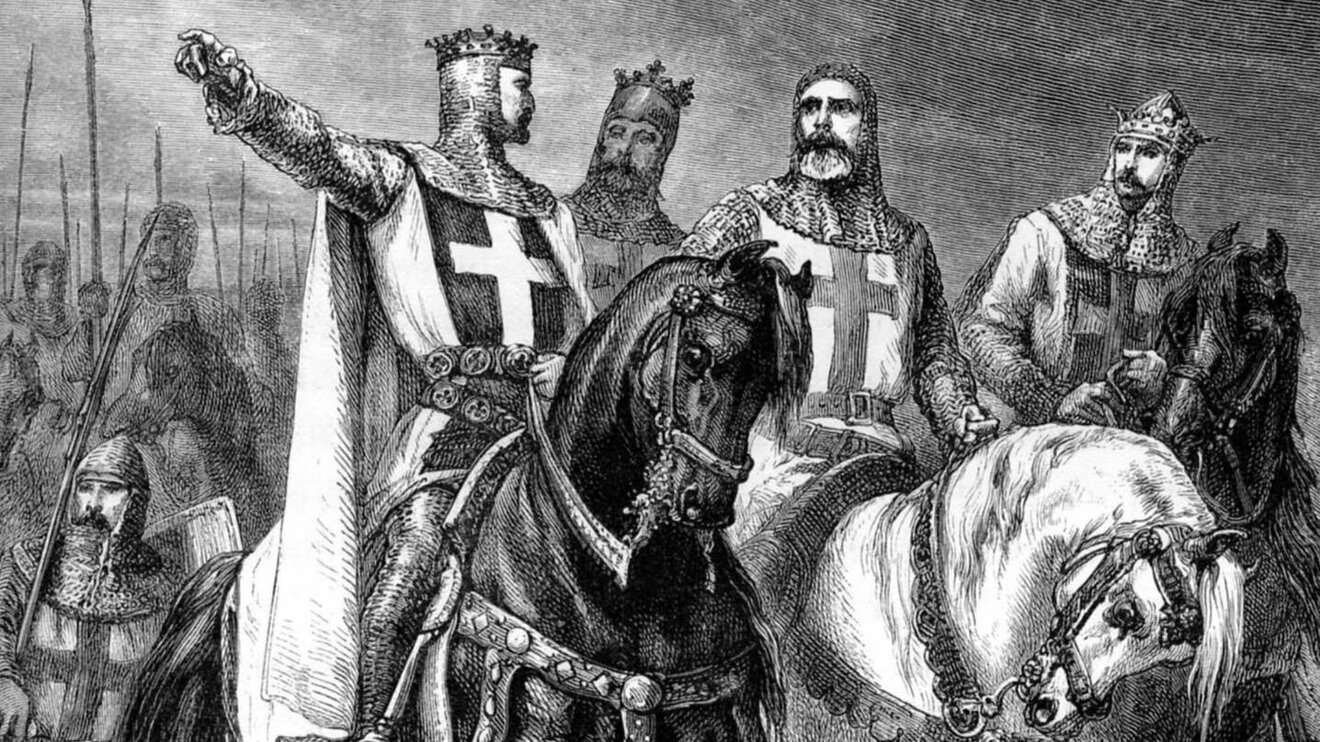
A note on the novel: Roman Peskov’s vision reflects the tragic reality of the First Crusade (1096–1099) — one of the bloodiest episodes of medieval history, when religious fanaticism and greed turned a «holy» war into a string of mass killings.
A Call to «Holy» War
On November 26, 1095, the French city of Clermont witnessed one of the most fateful speeches in human history. Pope Urban II, addressing the assembled nobles and clergy, delivered a sermon that changed the fates of hundreds of thousands of people and shaped relations between the Christian and Muslim worlds for centuries.
«To those who go, absolution from sin. Let those men who have made a habit of warring against their fellow Christians go forth against the infidel, in a battle that shall yield plunder in abundance... That land flows with milk and honey. Let those who were once robbers now become soldiers, who fought against their brothers and kinsmen. Whoever is wretched here will grow rich there.»
These words became the detonator for an explosion whose consequences were felt for centuries. The Pope skillfully combined religious motives with economic incentives, promising participants in the campaign not only the salvation of their souls but material enrichment as well.
The Social Roots of the Crusading Movement
The Pope’s call fell on fertile ground in a medieval Europe wracked by internal conflict and social problems. The continent was going through a difficult period: constant feudal wars, poor harvests, epidemics, and floods created an atmosphere of desperation and a search for a way out.
The problem of landless nobility was especially acute. The system of primogeniture, under which a father’s entire estate passed to the eldest son, created a whole class of young men of noble birth, trained for war but with no means of support. The Crusades became, for them, a legal method of plunder under religious cover.
Social Makeup of the Participants
- Landless nobles
- The urban poor
- Peasants
- Clergy
- Adventurers
The «People’s Crusade» — a Tragic Prelude
Even before the official start of the campaign, set for August 15, 1096, a huge crowd of ordinary people had already set out for Jerusalem on their own, led by the monk Peter the Hermit. This spontaneous movement, known as the «People’s Crusade,» became a tragic omen for the entire crusading movement.
The Scale of the Tragedy
Roughly 50,000–60,000 poor people set out on the campaign, most of whom had never held a weapon. Of the roughly 30,000 who crossed into Asia Minor, only a few dozen survived. 25,000–27,000 were killed, and 3,000–4,000 were taken into slavery.
These people set out without supplies, counting on Christian hospitality. Their hopes went unmet. Passing through Eastern Europe, they plundered the local population, leading to clashes with local authorities. On reaching Asia Minor, the disorganized mob was easily crushed by experienced Seljuk warriors.
The Knights’ Crusade: Organized Brutality
After the destruction of the army of the poor, professional soldiers set out under the command of powerful feudal lords. This was now a serious military force, capable of achieving its stated goals. But from the very start, those goals were far removed from the ideals proclaimed at Clermont.
Betrayal of Allies
The crusaders’ first victim wasn’t a Muslim but the Christian ruler of Edessa, Thoros. Baldwin of Boulogne organized a conspiracy against him to seize power in the city. That’s how the first crusader state, the County of Edessa, was founded.
True Motives
Many crusaders never even reached Jerusalem, seizing land along the way instead. The most enterprising «stayed behind» in Asia Minor and Syria, founding their own principalities there. Mostly the «unsuccessful» ones made it all the way to Palestine.
The Massacre at Jerusalem: the Height of the Brutality
On July 15, 1099, the crusaders stormed into Jerusalem. What happened next became one of the bloodiest episodes in medieval history. Contemporary chroniclers, participants in the campaign themselves, left blood-chilling accounts of what took place.
Eyewitness Testimony
Raymond of Aguilers wrote: «Men rode in blood up to their knees and the bridles of their horses.» Another chronicler noted: «All the squares of the city were piled with the bodies of the dead, so that no one could remain there because of the terrible stench.»
The crusaders spared no one — not the elderly, not women, not children. Killed were not only Muslims but Jews and Eastern Christians as well, whom the Western crusaders considered heretics.
The scale of the massacre was so vast that even by medieval standards it was seen as excessive. Modern historians estimate the death toll in the tens of thousands. The city was thoroughly looted, its treasures divided among the victors.
The Campaign as a Plundering Expedition
The First Crusade was, from the very beginning, openly a plundering enterprise. Religious motives served merely as cover for more prosaic goals — enrichment and the seizure of new lands.
Economic Motives
Pope Urban II directly promised participants material enrichment. «That land flows with milk and honey» — these words were aimed at drawing in the impoverished classes.
Territorial Conquest
The crusaders founded four states in the Middle East, which survived until the end of the 13th century. These were typical feudal entities, ruled by Western nobles.
Trade Interests
The Italian maritime republics — Venice, Genoa, Pisa — won significant trading privileges in the conquered territories, which became a factor in their economic prosperity.
Life in the «Promised Land»
The protagonist’s vision in the novel accurately conveys the reality of crusader life in the Middle East. The promised «peace and riches» turned out to be a mirage for most of the campaign’s participants. Instead of a land «flowing with milk and honey,» they found deserts, endless wars, and deprivation.
«We lived in the sands. We fought in the sands. We died in the sands. The promised peace we never found.»
The crusader states were in a near-constant state of war with their Muslim neighbors. The climate was harsh for Europeans, disease thinned the ranks of the fighters, and a chronic shortage of manpower left the Western enclaves in an extremely precarious position.
Results of the First Crusade
Short-Term Successes
- Capture of Jerusalem and the founding of the Kingdom of Jerusalem
- Creation of four crusader states in the Middle East
- Reduced Muslim pressure on Byzantium
- Enrichment of some participants in the campaign
Long-Term Consequences
- Hundreds of thousands of victims across all faiths
- Deepened religious hatred between Christians and Muslims
- The start of mass pogroms against Jews in Europe
- Erosion of the authority of the papacy and the Catholic Church
Military Outcomes
From a purely military standpoint, the First Crusade was a success. The crusaders achieved their main goal — capturing Jerusalem and founding a Christian kingdom there. But that success was temporary, and achieved at a monstrous cost in lives.
Already by 1187, Jerusalem was reconquered by Muslim forces under Saladin. The city’s brief return to crusader hands in 1229 didn’t change the overall trend. By the end of the 13th century, all the crusader states had ceased to exist.
Social Consequences
The Crusades fundamentally changed European society. They became a catalyst for the growth of trade and the exchange of cultural achievements between East and West. But those positive changes came at the cost of enormous human suffering and religious hatred.
Positive Changes
- Growth of trade and banking
- Exposure to Byzantine and Arab science
- Architectural and cultural borrowings
- Advances in navigation and geographic knowledge
Negative Consequences
- Mass pogroms against Jews in Europe
- Deepened religious intolerance
- The sack of Constantinople in 1204
- Erosion of papal authority
Religious Consequences
Paradoxically, a movement proclaimed as service to God ended up undermining the church’s authority. The crusaders’ brutality, their open pursuit of wealth, internal conflicts — all of this fed growing criticism of the Catholic hierarchy.
Many historians consider the Crusades one of the factors that laid the groundwork for the Reformation. Disillusionment with church policy, criticism of clerical corruption — all of it had roots that reached back, in part, to the crusading movement.
The Campaign’s Place in Historical Memory
The First Crusade left a deep mark on the historical memory of both the Christian and Muslim worlds. For Muslims, it became a symbol of Western aggression and religious fanaticism. For Christians, an example of how noble ideals can be perverted by self-interest.
Acknowledging the Wrongs
In 2011, Pope Benedict XVI apologized to Muslims for the Crusades, expressing «great shame» over the violence committed in the name of the Christian religion. That acknowledgment was an important step toward interfaith dialogue.
Lessons of History
The First Crusade stands as a vivid example of how religious ideas can be harnessed for purely worldly ends. The history of this event shows the tragic consequences that can follow when religious fanaticism, social instability, and political ambition combine.
The protagonist’s vision in the novel captures the central lesson of the Crusades precisely: the promised «peace and riches» turned out to be a mirage, and suffering, death, and destruction became the reality. The sands of the Levant soaked up the blood of hundreds of thousands of people of every faith, and the «holy» war turned into a string of massacres and plunder.
Epilogue
The First Crusade ended in 1099, but its consequences were felt for centuries. The nine crusades that followed the first never managed to secure lasting Western dominance in the Middle East. In the end, as one contemporary put it, «nine crusades amounted to nothing.»
But the price of that «nothing» was monstrous — hundreds of thousands of lives, ruined cities, deepened religious hatred, and eroded trust in church authority. These lessons of history remain relevant today, a reminder of the tragic consequences that can follow when religion is used to pursue political ends.