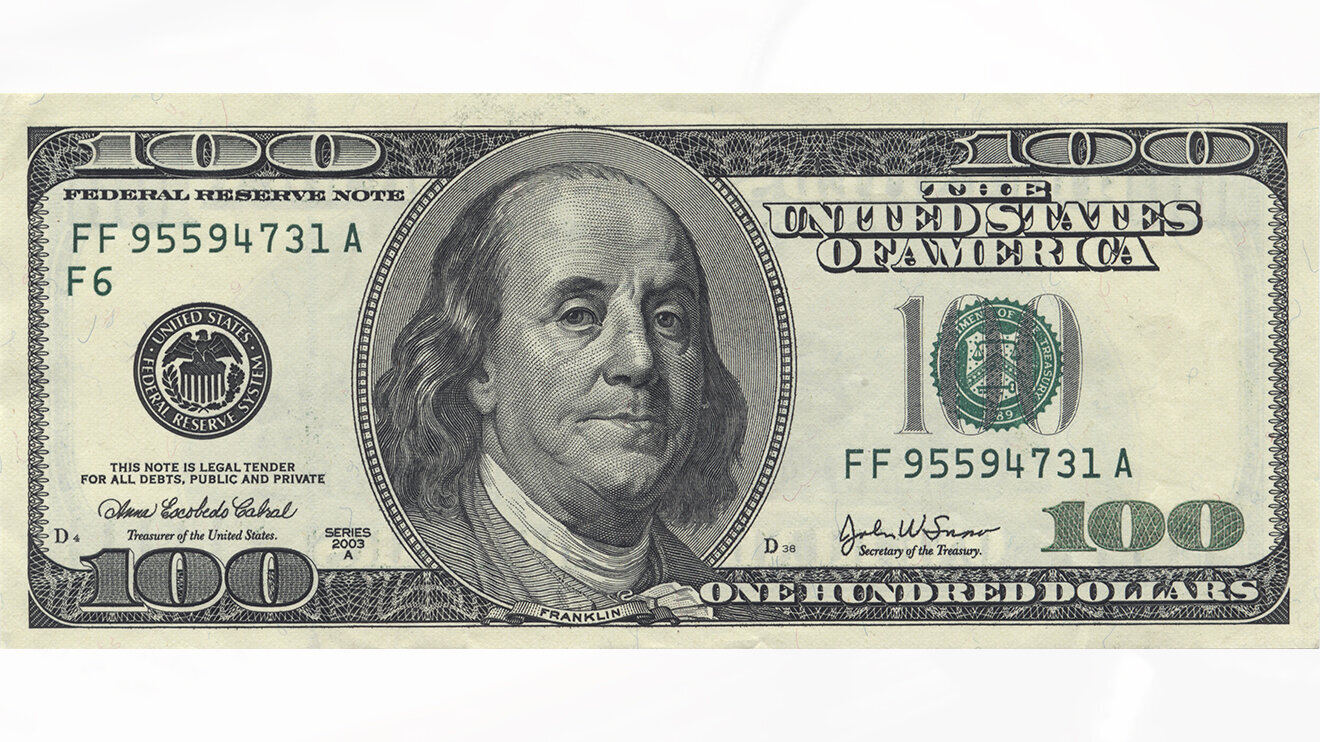
The novel mentions Russian traders' distrust of "banknotes bearing Franklin's image" — a reference to the US $100 bill, which has carried the portrait of one of America's Founding Fathers since 1914.
The history of the $100 bill
The $100 bill is the highest-denomination Federal Reserve note in official circulation since 1969. Although $500, $1,000, $5,000, and $10,000 bills were issued earlier, their production was halted by order of President Richard Nixon, as part of the fight against organized crime.
The first $100 bills were issued by the federal government in 1862, and depicted an American eagle. Over its long history, this denomination has carried the portraits of various historical figures:
- 1863-1869: Oliver Hazard Perry — a hero of the War of 1812, shown abandoning his flagship "Lawrence" during the Battle of Lake Erie
- 1869-1880: Abraham Lincoln, with a symbolic image of Reconstruction
- 1871-1922: Thomas Hart Benton, on gold certificates
- 1878-1891: James Monroe, on silver certificates
- 1890-1891: David Farragut, on treasury notes
- Since 1914: Benjamin Franklin
The image of Independence Hall on the reverse appeared in the 1928 series, when the bill's size was also reduced from 189×79 mm to the modern 156×67 mm.
Benjamin Franklin: not a president, but a Founding Father
It's worth noting that Benjamin Franklin was never president of the United States. He is the only Founding Father whose portrait appears on American currency without ever having held the country's highest office.
Benjamin Franklin's biography
Benjamin Franklin (1706–1790) was an American statesman, diplomat, inventor, scientist, philosopher, and writer. He was born on January 17, 1706, in Boston, into the family of a soap- and candle-maker.
He was largely self-educated — his father could afford only two years of formal schooling. From age 12 he worked as an apprentice at his brother James's print shop. In the 1720s he traveled to London to study printing, and in 1727 founded his own printing shop in Philadelphia.
Major achievements
- 1729-1748: published the "Pennsylvania Gazette"
- 1732-1758: published the yearly "Poor Richard's Almanack"
- 1731: founded the oldest public library in the US
- 1751: established the Philadelphia Academy (the forerunner of the University of Pennsylvania)
- 1737-1753: postmaster of Pennsylvania
- 1753-1774: joint deputy postmaster general of all the North American colonies
- 1776: appointed the first Postmaster General of the United States
Franklin is the only Founding Father to have signed all three of the most important documents of American statehood: the Declaration of Independence, the Constitution, and the 1783 Treaty of Paris.
His selection for the $100 bill is no accident — he made a significant contribution to the American economy and advocated for the colonies' use of paper money in trade. In New Jersey, he set up a printing press for currency and published articles on paper money, including "A Modest Enquiry into the Nature and Necessity of a Paper Currency" (1729). Franklin is also the author of the famous saying "Time is money."
Security features
By the 1990s, $100 bills from the 1985–1993 series had relatively simple security features compared to today's:
- Embedded red and blue security fibers in the paper
- Special paper made of 75% cotton and 25% linen
- Magnetic security ink (introduced in 1988)
- Intaglio engraving printing
- Fine concentric background lines
Serious security features — a watermark, a security thread, microprinting, and color-shifting ink — were only introduced with the 1996 series, after the period the novel depicts.
The counterfeiting problem in the 1990s
In the 1990s, $100 bills really were a popular target for counterfeiters, especially outside the United States. According to US federal authorities, by 2002 at least 15–18 million counterfeit $100 bills were in circulation.
Why "hundreds" specifically?
Several factors made $100 bills attractive to counterfeiters:
- Economic efficiency: for the same production cost, counterfeiting a $100 bill yielded five times the profit of a $20 bill
- Less scrutiny: larger bills were checked for authenticity less often in everyday transactions
- International circulation: dollars were widely used as a reserve currency, especially in countries with unstable economies
- Relatively simple security features on bills from series before 1996
The paradox of the American counterfeit market
Interestingly, the situation within the US itself was the opposite. There, the majority of counterfeit bills were $20 bills, for the following reasons:
- High circulation volume: $20 bills were the most commonly used denomination in everyday transactions
- Less scrutiny: smaller bills received less attention during checks
- A psychological factor: receiving a $20, people rarely suspected a fake
- Easy to pass: a small denomination made it possible to "launder" fakes quickly, through many small purchases
"Superdollars" — masterpieces of counterfeiting
A particular problem in the 1990s was the so-called "superdollar" — extremely high-quality counterfeit $100 bills, exceptionally difficult to distinguish from genuine ones.
Characteristics of "superdollars":
- Made from the same material: 75% cotton, 25% linen
- Used the intaglio printing method, just like genuine bills
- Reproduced every security feature, including the red and blue fibers
- Included exact copies of the seals and watermarks
According to a US law enforcement official, when Secret Service agents first encountered these counterfeits, experts were for a long time unable to determine their authenticity by sight or touch.
The first "superdollars" were discovered in 1989, at a bank in Manila. The US accused North Korea of producing them, though these accusations remain disputed. Iran, various criminal organizations, and even the CIA have also been suspected.
Modern security features
In response to the counterfeiting problem, a new series of $100 bills with upgraded security features was released in 1996:
- A watermark portrait of Franklin
- A security thread reading "USA 100"
- Microprinting in two places
- Color-shifting ink on the "100" numeral
- More complex background line patterns
In 2013, an even more secure series was released, featuring a holographic security ribbon, a 3D image of an inkwell, and other modern features.
Cultural significance
The $100 bill has become firmly embedded in popular culture. In colloquial English, it goes by several names:
- "Benjamin" — after the Franklin portrait it carries
- "C-note" — from the Roman numeral C (one hundred)
- "Hun" or "hundo" — short for "hundred"
- "Yard" — a slang term
The $100 bill's average lifespan, according to the US Bureau of Engraving and Printing, is 89 months — considerably longer than smaller denominations, owing to its less frequent use in everyday transactions.
Conclusion
Russian traders' distrust of $100 bills in the 1990s was quite well founded. The relatively weak security of bills from those series, their high economic appeal to counterfeiters, and the widespread circulation of high-quality fakes, including "superdollars," created genuine risks. The preference for $20 bills owed not only to their lesser appeal to counterfeiters on economic grounds, but to psychological factors as well — smaller bills raised fewer suspicions and were more readily accepted in trade.