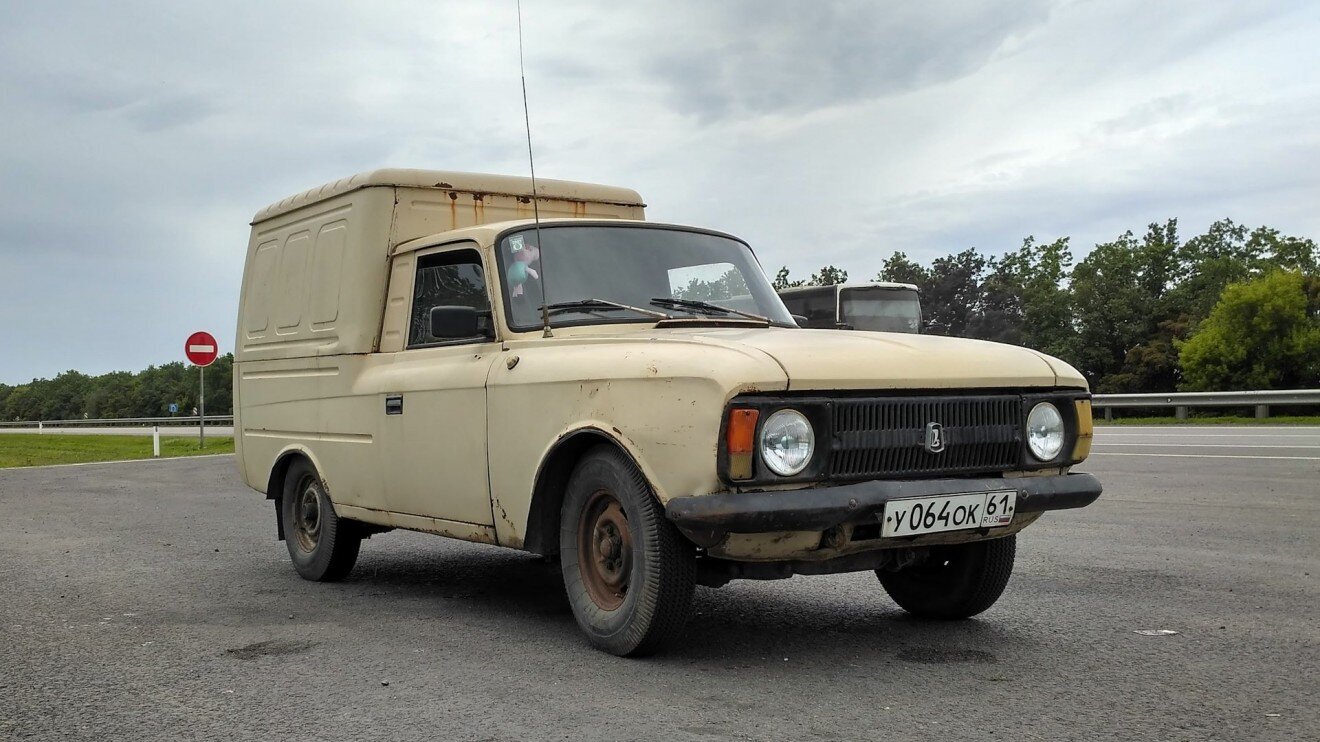
The IZh-2715, popularly nicknamed the "kabluk" ("heel") or "bashmak" ("shoe"), was the only factory-built light delivery van in the USSR, and became a genuine symbol of its era.
Origins of the Name
The name "Moskvich-kabluk" used in the novel reflects popular perception of the car. Formally, the IZh-2715 was never a "Moskvich" at all — it was built at the Izhevsk Automobile Plant. But it was structurally based on the Moskvich-412, which was also produced in Izhevsk, and that's where the blended nickname came from.
The car's distinctive silhouette, with its tall rear section, really did resemble the heel of a woman's shoe, which is how it earned its folk nicknames: "kabluk" ("heel"), "bashmak" ("shoe"), and also "pirozhok" or "pirozhkovoz" ("pastry" or "pastry-hauler"), since it was often used to deliver bread and baked goods.
Origins and Production History
The IZh-2715 was produced at the Izhevsk Automobile Plant for 29 years, from 1972 to 2001. Over the course of production, more than 2.3 million units were built, testament to the model's enormous popularity.
The car was designed as a two-to-six-seat, light-class cargo-passenger vehicle, built as either a van or a pickup. The cab seated two, with separate seats, and the driver's seat adjusted for length and backrest angle.
Technical Basis
The car's front end was borrowed from the Moskvich-412. It was offered with the following engines:
- UZAM-412E — 1.487 L displacement, 75 hp
- UZAM-412DE — 1.487 L displacement, 67 hp
Payload capacity ran to 450–500 kg, making the car ideal for hauling small loads of cargo.
Generations and Variants
First Generation (1972–1982)
The first generation used the Moskvich-412's front end unaltered. Export variants sometimes came with East German-made front trim and headlights borrowed from the IZh-2125 "Kombi."
Main variants
- IZh-2715 — an all-metal panel van with a two-piece rear door
- IZh-27151 — a pickup with a drop-down tailgate (starting in 1974)
Second Generation (1982–2001)
In 1982 the car's exterior got a major update. In place of the AZLK-style radiator grille, it received a new black grille, designed in-house at IzhAvto, with round headlights. It also gained a new hood, recessed door handles, and vent-window-free doors.
Variants after 1982
- IZh-2715-01 — the main van variant (1982–1997)
- IZh-2715-016-01 — an upgraded version with the 1.6L, 80-hp UZAM-0102 engine (1997–2001)
- IZh-27151-011-01 — the second-generation pickup (1982–1997)
- IZh-27156 — a six-seat cargo-passenger variant (1988–2001)
The Special IZh-27156 Variant
The IZh-27156 variant deserves special mention as an attempt to build a versatile vehicle for the growing world of private enterprise. This six-seat cargo-passenger variant was built specifically for co-op operators and individual owners.
Its design features included:
- Two fold-down two-seat benches along the sides of the cargo area
- Large side windows with sliding glass instead of solid panels
- A sliding window in the partition between the cab and the cargo area
- A roof hatch with a lifting metal lid
- An additional interior light
- Padded trim at passenger head height
- Reinforced body elements for passive safety
Export Variants
Special mention goes to the export variant IZh-27151 "Elite PickUp," with an extended cargo bed. In the USSR it was known under the designation IZh-27151-013-01.
It was initially shipped to Latin America (Panama in particular), and later to Finland. Its name followed the pattern of the Moskvich-412, which was sold abroad as the "Elite 1500."
Distinguishing features:
- An extended cargo bed
- Square headlights (as on the first generation)
- The same wheelbase and mechanicals as the standard model
- Designed for bulky, lightweight cargo
Exterior Variations
Over its long production run, the car's appearance went through several changes. Roughly four main variants can be distinguished:
First Variant (Early)
Three reinforcing ribs on the side of the box body, no ribs on the cab, a chrome bumper and radiator grille, smooth rear doors with a metal "IZh 1500 GR" badge, a rear "bumper" made of three tubes.
Second Variant
A single reinforcing rib appeared on the body; the radiator grille and front bumper began to be painted to match the car's color.
Third Variant
Two ribs on the body, an "IZh-2715" stamping on the rear doors, optional "fangs" on the front bumper, a rear bumper made of two side tubes.
Fourth Variant (Late)
A new black radiator grille, recessed door handles, stampings on the roof and cab, three window-shaped stampings on the sides of the box body, a central rear step instead of side tubes.
A Unique Place in the Soviet Auto Industry
Throughout the 1980s, the IZh-2715 was the only factory-built light delivery vehicle in the USSR. Before it appeared, supplying retail organizations with vehicles of this kind traditionally fell to auto repair shops, which converted worn-out sedans and station wagons into delivery vans and pickups.
That circumstance made the IZh-2715 enormously in demand across every sector of the economy, from retail trade to municipal services. The car became a truly popular, everyman's vehicle.
Its Role in the Novel
Given the use described in the novel — members of criminal structures making a run to a warehouse — choosing the "kabluk" in particular looks entirely logical. This car had a number of advantages for such purposes:
- Inconspicuousness — the IZh-2715 was so common it drew no attention
- Versatility — it could carry people or cargo alike
- Off-road capability — its rugged construction let it handle bad roads
- Affordability — relatively cheap to buy and maintain
- Ease of repair — a simple design and widely available parts
For members of criminal groups accustomed to status-symbol foreign cars, using a "kabluk" was a forced concession to discretion — but a technically sound one.
Design Features
Body and Chassis
The all-metal van or pickup body was simple and functional. Its design was maximally standardized with the base Moskvich-412, which simplified both production and maintenance.
The front suspension was independent, on double wishbones with coil springs and telescopic shock absorbers. The rear was a dependent, leaf-spring setup with telescopic shocks.
Transmission
A four-speed manual gearbox with synchromesh on every forward gear. Drive was to the rear wheels, via a driveshaft to the rear-axle differential.
Braking System
Front brakes were disc, rear brakes were drum. The handbrake acted on the rear wheels via a cable.
Operating Qualities
The IZh-2715 was known for being undemanding in use and repair. Its simple design allowed most repair work to be done under ordinary conditions with a minimal set of tools.
Fuel consumption ran to around 9–11 liters per 100 km in mixed driving, which was entirely acceptable for a vehicle of its class.
Top speed reached 120–130 km/h, but the optimal cruising range was 80–90 km/h, where the car showed its best reliability and fuel economy.
Legacy and Significance
The IZh-2715 became a genuine phenomenon of Soviet car manufacturing — a vehicle that found its own unique niche and held onto it for nearly thirty years. Its longevity owed something to the lack of competition, but also to a genuinely successful combination of simplicity, reliability, and functionality.
In 1997 the IZh-2715 was succeeded by the IZh-2717, though production of the original continued until 2001. Total output exceeded 2.3 million units, making the "kabluk" one of the most widely produced commercial vehicles in the history of Russian car manufacturing.
Today the IZh-2715 remains a recognizable symbol of an entire era — a time when a car was not merely a means of transport, but a genuine working partner in labor and daily life.