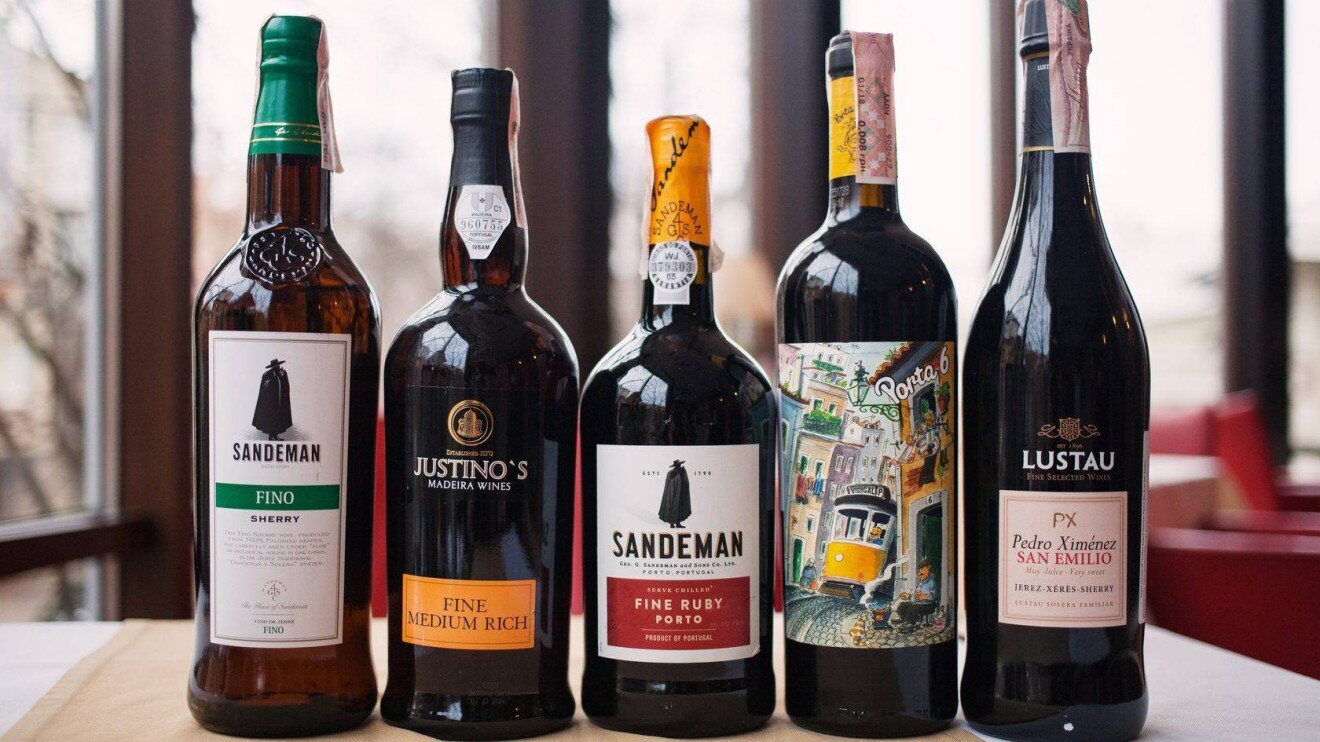
Sherry is a white fortified wine produced in southwestern Andalusia from Palomino grapes. Its name comes from the town of Jerez de la Frontera, the main hub of local winemaking.
Origin and geography
Sherry is produced exclusively within the triangle formed by the towns of Jerez de la Frontera, Sanlúcar de Barrameda, and El Puerto de Santa María in Andalusia. The boundaries of this winemaking territory were fixed by law in 1932. In 1964 the separate Manzanilla de Sanlúcar zone was recognized, with its own terroir, where the lightest style of sherry, manzanilla, is produced.
Vineyard soils range from chalky to clay to sandy. The best wines come from the chalky soils known as «albariza» – a soft, porous soil high in chalk that readily absorbs water and holds it well at depth.
Historical development
The Middle Ages and Shakespeare’s era
The hot Andalusian climate made it possible, as far back as the Middle Ages, to produce rich, sweet, high-alcohol wines here, which were shipped to the lower Rhine and the British Isles, where they were known by the word «sack.» In Shakespeare’s history plays, Falstaff repeatedly sings the praises of these wines.
In 1491 the Duke of Medina Sidonia declared his own town of Sanlúcar a free port for the wine trade, sparking a boom in wine commerce. In 1531, however, the divorce of England’s King Henry VIII from the Spanish infanta Catherine of Aragon led to a rupture in trade relations between England and Spain.
It’s recorded that during a raid on Cádiz in 1587, Drake and Frobisher seized 2,900 barrels of local wine, which sold out in England almost instantly. On the occasion of his appointment as Poet Laureate in 1630, Ben Jonson was granted by the king a butt of sherry, equivalent to 720 large bottles.
The classic sherry style takes shape
Throughout the seventeenth century the English kept high duties on Spanish wines, and after signing a favorable trade treaty with Portugal in 1703, they turned their attention to Portuguese fortified wines instead. Under these conditions the Spanish colonies became the main outlet for sherry. To preserve the wine on long voyages to hot climates, it was fortified. This is how, by the end of the seventeenth century, Andalusia’s classic fortified wines emerged – sweet málaga and dry sherry.
The modern style of sherry took shape over the course of the eighteenth century. It was during this period that winemakers mastered the unique properties of sherry yeast (flor) and aging in a multi-tiered pyramid of barrels (the solera). The pyramid system took hold in southern Spain after the powerful Winemakers’ Guild, founded in 1733 and opposed to the practice of aging wine, lost a lawsuit in 1775 to proponents of aging.
British influence and the «golden age»
Almost all the major sherry houses were founded by Englishmen, Scots, or Irishmen. French émigrés joined them after the outbreak of the French Revolution. Many of Jerez’s wine houses still carry the names of the Britons who founded them.
After Spanish wine duties were lowered in 1825, British merchants bought up almost the entire output of Jerez (as much as 87% of it by the 1860s) and largely dictated its style. The English traveler Richard Ford observed in 1840: «The ordinary Spaniard, outside the district where sherry is made, knows little of its taste. It is a foreign wine, made and consumed by foreigners.»
The first half of the nineteenth century was a «golden age» for sherry producers – demand and prices for the wine climbed steadily. At the peak of its success (the 1860s and 1870s), sherry accounted for 10% of all Spanish exports. Jerez de la Frontera was considered one of the most prosperous and progressive cities in Spain.
Victorian-era literature
Mentions of sherry turn up in the biographies of many famous Victorians. Charles Dickens often gave his characters a fondness for the drink. The writer himself was served a glass of sherry with sugar, orange slices, and biscuits by his servants at exactly noon every day. Each morning he also brought his beloved canary, Dick, a thimbleful of sherry.
Quality problems and decline
The higher sherry’s price climbed, the greater the temptation to counterfeit it. Sherry was shipped in barrels and bottled right at British ports, where unscrupulous suppliers could blend in low-grade wine stock. Lesser South African wines were passed off as sherry, and Germany exported «Elbe sherry» – a cheap blend of spirit and wine byproducts of murky origin.
These problems damaged sherry’s reputation, and by the 1880s it could no longer compete in sales figures with Catalan table wines. By 1920 sherry exports had fallen from 350,000 hectoliters to 100,000 hectoliters.
Production technology
Raw material and grapes
Modern Spanish sherry is made from three grape varieties: Palomino Fino (up to 95% of all production), Pedro Ximénez, and Moscatel Fino. Before the late-nineteenth-century phylloxera epidemic, 42 different grape varieties were used. In 2021 the use of six more nearly vanished varieties was officially permitted again.
The wine is made from fully ripe grapes, harvested in September in a partial, repeated picking. For the sweet styles, grapes are spread on straw mats before pressing and left out in the sun, sometimes for up to two weeks.
The unique «sherry-making» process
A distinctive feature of sherry production is what might be called «sherrification» – a particular method of aging. Sherries are aged either under a distinctive film of special sherry yeast, called flor, or through contact with oxygen (the oxidative method). For this, the barrels are filled only partway.
In the biological method, the wine spends its entire aging period in partly filled vessels, under a surface film of sherry yeast. This yeast layer is called flor (Spanish for «flower»). By shielding the wine from contact with air, the flor layer prevents oxidation and gives sherry its distinctive bouquet and flavor.
The solera system
Sherry is aged in partly filled barrels using the «solera y criadera» method. The technique involves simultaneously storing and aging wines from different vintages in a pyramid of barrels. The bottom row of barrels is called the «solera» (from the Spanish suelo, «floor»), and the rows above it are the «criaderas.»
Sherry is bottled strictly from the bottom row: two or three times a year, part of the wine is drawn off from it and then topped up from the barrels in the row above – and so on, up to the topmost row, into which young wine is poured. This method of aging produces sherries that are stable and nearly identical in composition, year after year.
Classification and styles of sherry
Dry, Fino-type styles
Fino – made from the first pressing of Palomino grapes grown on chalky soil. The entire aging process takes place under flor. Always dry, with an ABV that never exceeds 17%. Drunk as an apéritif with tapas, nuts, or green olives.
Manzanilla – a briny, herbaceous fino produced only in the area around the port of Sanlúcar. The name evokes chamomile tea, which its characteristic dry-herb aroma is often compared to. Thanks to the coastal microclimate, flor thrives there year-round. Drunk as an apéritif or with seafood.
Oxidative, Oloroso-type styles
Oloroso – sherry made from second-pressing must that never developed flor. Through contact with oxygen it takes on a deep amber color and a distinctive nutty-caramel bouquet. ABV exceeds 16%.
Pedro Ximénez (PX) – a liqueur wine, the sweetest style of sherry. Made from the grape of the same name, further dried out. Dark, nearly black in color, with an extremely thick texture and an intense aroma.
Transitional styles
Amontillado – a fino aged by the oxidative method after its flor has died off. Pairs beautifully with aged cheeses. Unafraid of contact with air, so an opened bottle can keep for several months.
Palo Cortado – begins its life as a classic fino, but after the flor disappears, it continues maturing by the oloroso method. A fairly rare style of sherry, combining traits of both fino and oloroso. No more than 100,000 bottles are produced each year.
Differences from other fortified wines
Unlike port, sherry is always a white wine. Another difference: it has no inherent sweetness – Palomino-based sherry is a dry drink, into which spirit is added after fermentation is complete, rather than during it. Unlike málaga and madeira, sherry does not involve any heat treatment.
Sherry in Russia and the USSR
The first international award for a Crimean sherry went in 1904 to the G. Khristoforov partnership. Large-scale industrial production of sherry-style wines in the USSR got underway after the Great Patriotic War, mainly in Crimea and Moldova.
Massandra Sherry – a strong vintage wine, produced since 1944 from Sercial, Verdelho, and Albillo grapes. The solera method is not used. ABV 19.5%, aged for 4 years.
Yalovyeni Dessert Sherry – produced in Moldova since 1968 from Aligoté, Traminer, Pinot Blanc, and Rkatsiteli grapes. ABV 19%, aged for 1.5 years.
Drinking culture
Sherry is recommended to be drunk from a small, elongated glass (around 100 ml) with a rounded, tulip-like shape. The Spanish names for such a glass are copita and catavino.
The main importers of Spanish sherry are the United Kingdom, the Netherlands, and Germany. In Britain, a warming glass of sherry before December lunch or dinner is a centuries-old tradition. The lion’s share of sales falls in the weeks leading up to Christmas.
Dry, light styles of sherry are often used in making apéritif cocktails. When needed, fino sherry can stand in for dry white vermouth in a cocktail. In hot countries it’s common to mix fino with tonic.
The present day
For centuries, sherry was Spain’s leading wine export, but over the thirty years spanning the turn of the twentieth and twenty-first centuries, sales fell by 80%. Since the early 2000s, demand for sweet sherries and oxidative styles has steadily declined. Within Spain demand is relatively stable, but only fino and manzanilla remain in real demand.
Because of protected designation of origin rules, producers outside Spain have stopped labeling their wines «sherry» or «jerez.» In the US, producers must state the place of origin on the label, as in «California sherry.» In Australia and Canada, under pressure from the European Union, comparable wines were renamed Apera.
Sherry should not be confused with sherry brandy – a strong spirit produced in the same region of Spain, now made in considerably larger volumes than sherry itself.