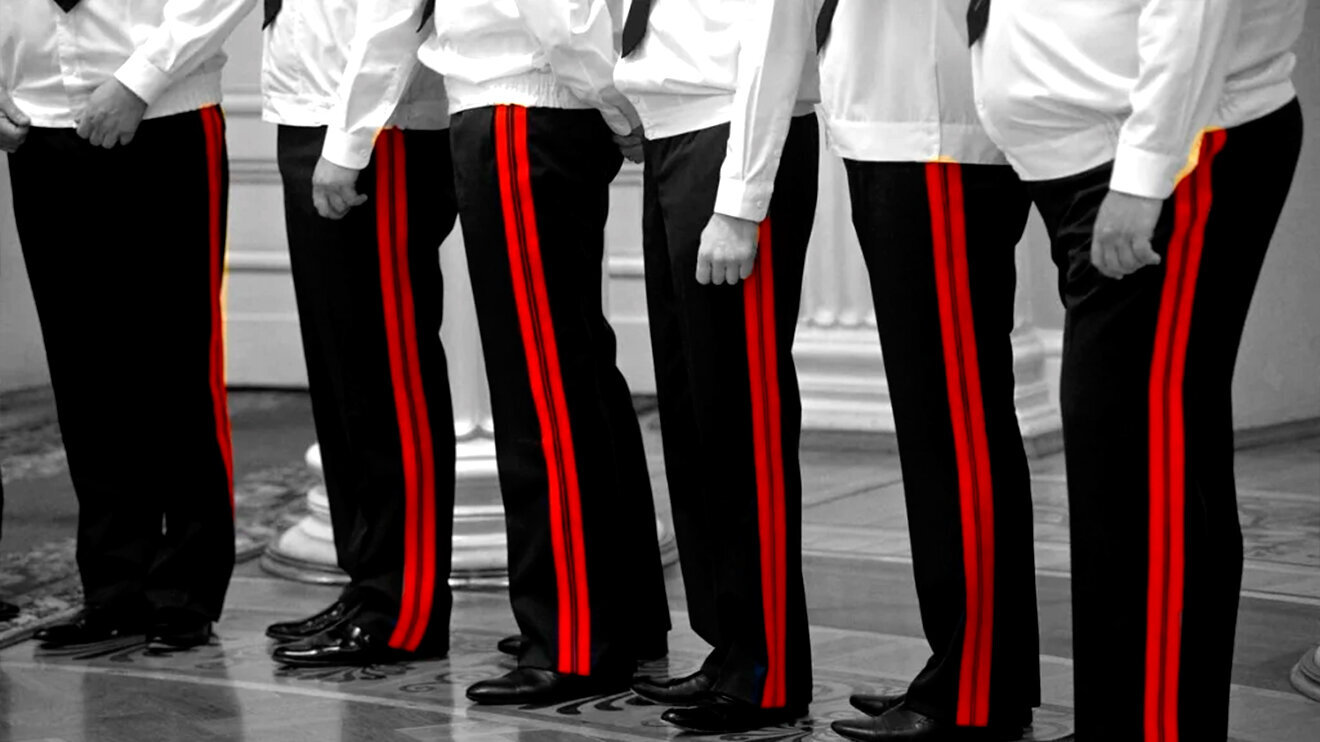
The excerpt from this 1996-set novel uses the expression «drinking with the lampasy,» which needs some unpacking for a modern reader. This is 1990s criminal-world slang with deep roots in military dress tradition.
The Historical Roots of the Term
A «lampas» (stripe) was originally a wide decorative band of fabric running down the outer seam of military dress trousers. This element of the uniform served as an insignia, letting people identify a serviceman’s rank and branch. In the Soviet Union, general’s stripes were introduced in 1940, specifically for Red Army generals.
The stripe’s color carried real information: army generals wore red, air force generals wore light blue, and signals, engineering, and quartermaster officers wore crimson. Width mattered too — the higher the rank, the wider the stripe. A general’s stripes were especially conspicuous and prestigious, making their wearers instantly recognizable in public.
The stripes took on special significance within the Interior Ministry (MVD) and KGB. Generals of these agencies wore them as a symbol of high rank and special authority. In the MVD system, a general’s stripes were red, matching the general army tradition, while state-security officers might wear stripes of other colors depending on the era and their specific branch of service.
It’s worth noting that in the Soviet system, generals of the security agencies enjoyed not only high official status but substantial social privileges — access to scarce goods, special distribution networks, quality medical care, and other perks unavailable to ordinary citizens. These privileges extended to leisure as well, including time spent at exclusive restaurants and top-tier clubs.
In the novel’s context, «drinking with the lampasy» means drinking alongside generals of the security services. Such gatherings weren’t simply friendly get-togethers — they were an important part of doing business in the criminal-commercial world of the time.
These drinking sessions served several purposes: strengthening personal ties, discussing «delicate» matters in an informal setting, and displaying the status and influence of those present. For 1990s businessmen, having such connections was practically a matter of survival — running a serious business without a security-services «roof» was extremely risky.
The Social Context
The ability to «drink with the lampasy» was seen in criminal circles as a mark of high status and influence — proof that a person had access to the upper echelons of power, could solve difficult problems with a single phone call, and had serious protection from law enforcement.
Generals, for their part, needed extra sources of income, since their official salaries during the hyperinflation of the early 1990s were extremely small. Mutually beneficial cooperation with businesspeople let them maintain their accustomed standard of living.
Tellingly, the novel’s text mentions that Seva «can’t drink like the old days with the lampasy» because of liver trouble — a hint at how intense these gatherings were, and how important they were for maintaining business ties. Alcohol traditionally served as «social lubricant» in Russian business culture, helping build trusted relationships.
Cultural Significance
The phrase «drinking with the lampasy» became a kind of marker of the era, capturing the specific texture of business relationships in 1990s Russia. It reflects a time when the line between legal and illegal business was blurred, and personal connections often mattered more than formal procedure.
For today’s reader, the phrase is a key to understanding the social atmosphere of a period when people from every walk of life — from crime bosses to high-ranking officers — were forced to find new ways of interacting amid a sweeping transformation of the state and economic system.
So the phrase «drinking with the lampasy,» in the context of a novel set in 1996 Russia, isn’t merely slang — it’s an important cultural-historical marker, helping the reader grasp the texture of personal and business relationships during Russia’s transitional era.