Historical background
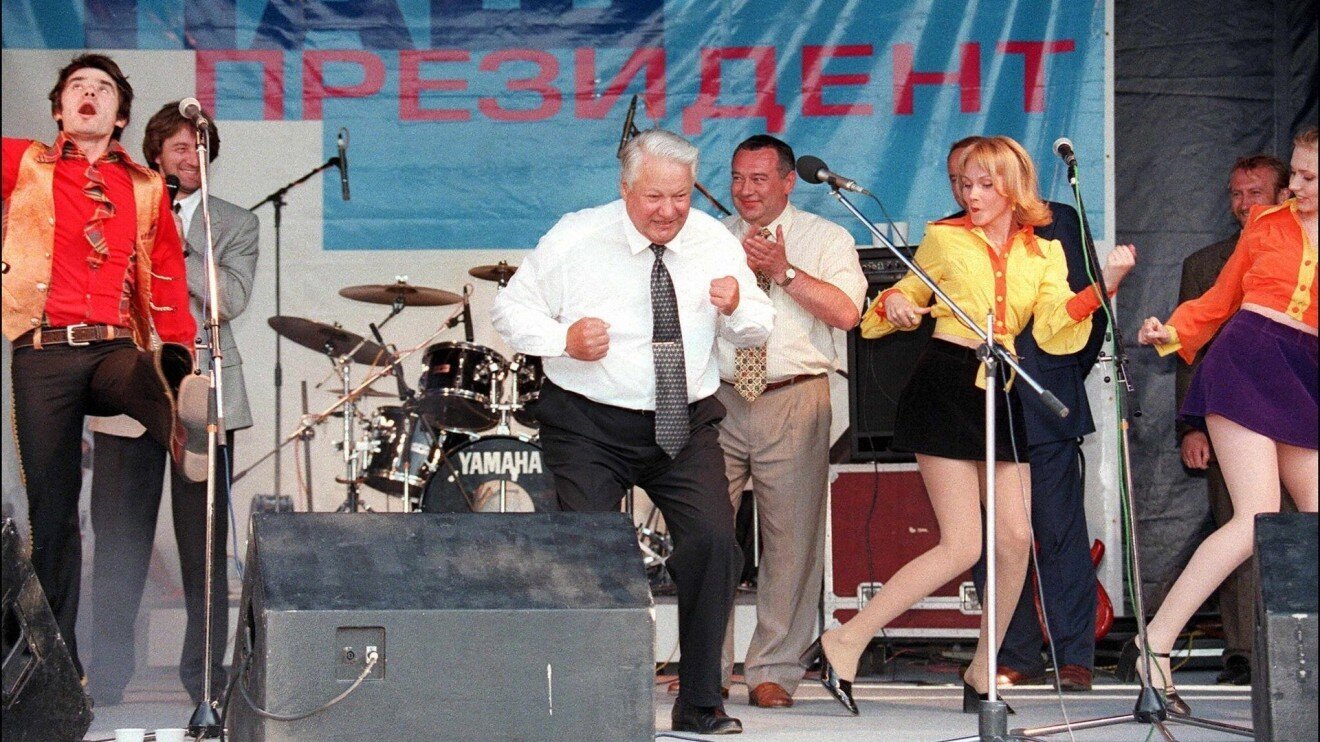
The 1996 presidential election was one of the most dramatic and consequential in the history of modern Russia. It unfolded amid deep economic crisis, social instability, and a sharp political standoff between supporters of continued democratic reform and its opponents.
First-round results (June 16, 1996)
Boris Yeltsin
35.28%
26.6 million votesGennady Zyuganov
32.03%
24.2 million votesLieutenant General Alexander Lebed unexpectedly took third place with 14.52% (10.7 million votes), which made his voters decisive for the runoff’s outcome.
Between the rounds: political maneuvering
The period between the first and second rounds (June 16 – July 3, 1996) was one of intense political negotiation and backroom deals. A key event was the June 18 appointment of Alexander Lebed as Secretary of the Security Council of the Russian Federation, in exchange for his support of Yeltsin.
Dramatic events
- June 19: The detention of Sergei Lisovsky, an organizer of the «Vote or Lose» campaign, carrying a box containing $500,000
- June 26: Yeltsin suffered his sixth heart attack since the summer of 1995
- The firing of Defense Minister Pavel Grachev and the resignation of Alexander Korzhakov
Economic and business sentiment
The novel’s line that «some people move capital out of Russia, others move it in» captures precisely the mood of Russian business during this period. Entrepreneurs and oligarchs were living with genuine uncertainty:
A Yeltsin victory scenario
- ✓ Continued privatization
- ✓ Market reforms preserved
- ✓ Protection of private property
- ✓ Support for the oligarchs
A Zyuganov victory scenario
- × Possible nationalization
- × Privatization revisited
- × Tighter state control
- × A threat to big business
The «Davos Pact» and the oligarchs’ role
Russian oligarchs, including Boris Berezovsky, Vladimir Gusinsky, and others, struck an unofficial agreement to bankroll Yeltsin’s campaign. Estimates of the total spent on Yeltsin’s re-election campaign range from $700 million to $3–4 billion.
«In exchange for a guarantee that state enterprises would be privatized and that they would receive large stakes, they committed to funding his election campaign and bringing in specialists who could guarantee favorable coverage of the president’s activities.»
The international dimension
The 1996 election carried enormous international weight. Western leaders and investors watched events closely, understanding that a communist victory could fundamentally alter Russia’s relationship with the West and affect the global economy.
The runoff: July 3, 1996
Final results
Boris Yeltsin: 53.82%
40.2 million votes
Gennady Zyuganov: 40.31%
30.1 million votes
Against all candidates: 4.82% (3.6 million votes)
Geographic divide
The results starkly revealed a divided Russian society:
- Yeltsin was backed by: Moscow, St. Petersburg, major industrial cities, the Russian North, Siberia, the Far East
- Zyuganov was backed by: the rural regions of central Russia, the Chernozem belt, the Volga region, the so-called «Red Belt»
Consequences for business
Yeltsin’s victory meant:
Economy
Continued market reforms and privatization
Business
Preserved standing for major entrepreneurs
The world
Continued integration into the global economy
Relevance to the novel’s plot
The mention of the runoff, in a conversation about investment and capital flight, shows that the novel’s characters – representatives of Russian business – are making strategic decisions about the future of their assets at the moment of maximum political uncertainty.
The mood of the era
A conversation aboard a yacht near Nice, discussing multimillion-dollar deals against the backdrop of Russia’s political uncertainty, captures precisely the atmosphere of that time, when Russian capital was searching for safe harbors ahead of a decisive election.
Boris Yeltsin’s inauguration took place on August 9, 1996, at the State Kremlin Palace, and was the shortest in modern Russian history – just 16 to 20 minutes instead of the planned hour and a half, owing to the president’s poor health.