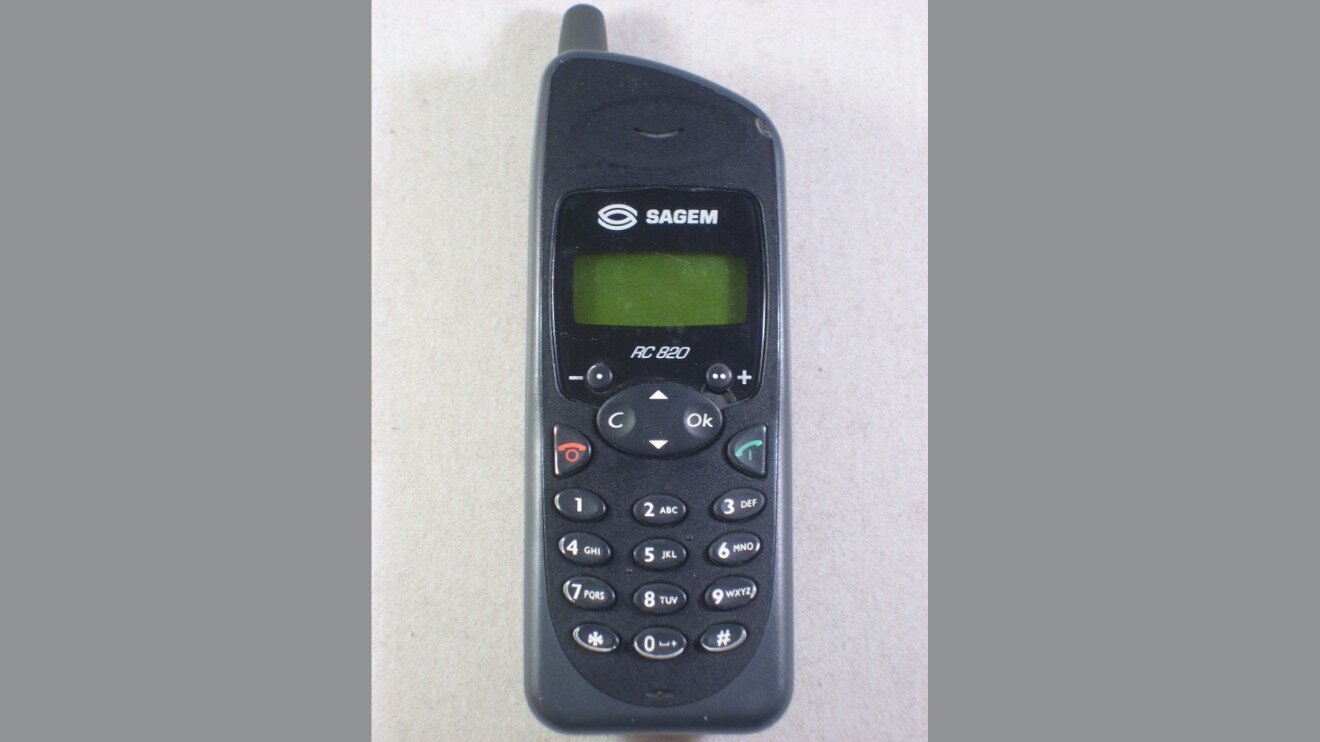
At the end of the 1990s, a strict hierarchy of prestige ruled the Russian mobile phone market. The Motorola StarTAC and the Nokia 8110 (the «banana») were status symbols, while French SAGEM phones occupied the budget niche, for those who couldn’t afford a «real» mobile.
The history of SAGEM
Société d’Applications Générales de l’Électricité et de la Mécanique (SAGEM) was a French company founded in 1924 by Marcel Méhé, a 25-year-old entrepreneur. The firm initially specialized in mechanical equipment, electrical components, and defense technology. One of its key early clients was the tire maker Michelin, for whom SAGEM manufactured various tools and equipment.
In 1942, at the request of the French Ministry of Telecommunications, SAGEM developed a new communications system – a teleprinter. This product marked the company’s move into a broader role in the telecommunications sector. After the Second World War the company became increasingly involved in France’s defense and aerospace industry.
In 1961 SAGEM was chosen to supply inertial navigation systems for France’s first ballistic missiles, as well as optical and navigation systems for its first ballistic-missile submarines. The company kept its focus on defense even after Méhé retired in 1962.
The move into telecommunications
Although in the postwar era SAGEM was primarily a defense contractor, it also developed telecommunications products, including a range of teleprinter machines, becoming the world’s second-largest producer in that category. SAGEM’s leadership stressed the importance of research and development, which allowed the company to take a leading role in communications technology in the early 1980s.
When Japanese fax machines began pushing out expensive teleprinters, SAGEM didn’t spend enormous sums developing its own product to compete with the new technology. Instead the company entered a distribution agreement with the Japanese company Murata, adapting their fax machines for the European market while simultaneously developing its own technology.
The mobile phone era
In the mid-1990s SAGEM adapted its technology for automotive control systems, quickly becoming a major European supplier of automotive electronics. The company also began producing televisions, credit-card readers, and set-top boxes.
Starting in 1997, mobile phone sales grew enormously. SAGEM quickly became one of the world’s leading GSM phone manufacturers, as well as the leader of the French market, at one point holding roughly 50% of it.
Technical features of SAGEM phones
SAGEM mobile phones from the late 1990s were distinguished by several characteristic features:
- Compact size: French engineers emphasized miniaturization, producing genuinely small devices
- Simple design: a minimalist look without frills, typical of the French school of industrial design
- Basic functionality: SAGEM phones provided standard GSM capability without extra «bells and whistles»
- Reliability: the devices were noted for stable operation and longevity
Positioning on the Russian market
In late-1990s Russia, SAGEM mobile phones occupied a particular niche. They were more affordable than the prestigious Motorola and Nokia, while still being full-fledged GSM devices. That made them attractive to the middle class and young people who wanted a mobile phone but couldn’t afford top-tier models.
Social stigma
Despite their technical solidity, SAGEM phones suffered from an image problem in Russia. In a society where the mobile phone was not just a means of communication but a status symbol, the French devices were seen as «phones for the poor.» This reputation stuck for several reasons:
- Low brand recognition: SAGEM wasn’t as well known in Russia as American Motorola or Finnish Nokia
- No marketing: the company didn’t invest significantly in promoting its phones in Russia
- Price positioning: a lower price automatically got associated with lower status
- Simple design: against the futuristic StarTAC or stylish Nokia 8110, SAGEM phones looked modest
Popular models in Russia
Several SAGEM models were sold in the Russian market, each with its own quirks:
SAGEM RC 922
One of the most compact models of its time. Its extremely small size was its chief selling point. It had a simple monochrome display, a basic phone book, and standard SMS functions.
SAGEM RC 930
A more advanced model with an improved display and expanded phone book. It offered several ringtone options and simple games.
SAGEM MC 850
A mid-range model with a better antenna and improved signal reception. It was known for reliability and long battery life.
Technical specifications
SAGEM phones from the late 1990s had the following technical characteristics:
- Standards: GSM 900/1800 MHz
- Display: monochrome LCD, usually 2–3 lines of text
- Battery life: up to 100 hours standby, up to 3 hours of talk time
- Memory: a phone book for 50–100 numbers
- Extra features: SMS, alarm clock, calculator, simple games
- Weight: typically 150–200 grams
- Size: compact, often smaller than competitors
Comparison with competitors
To understand SAGEM’s position in the 1998 market, it’s worth comparing the French phones with their more prestigious rivals:
vs. the Motorola StarTAC
The StarTAC was a revolutionary flip phone, a symbol of status and technological progress. Next to it, SAGEM lost out on design and prestige, but won on price and practicality.
vs. the Nokia 8110 (the «banana»)
The Nokia 8110, with its distinctive curved shape and sliding keypad, was a style icon. SAGEM couldn’t compete with it on recognition or «coolness,» but offered comparable functionality for less money.
vs. Ericsson
Swedish Ericsson phones occupied a middle ground between prestige brands and budget solutions. SAGEM was often cheaper than Ericsson at comparable specs.
Quality and reliability
Despite its «budget» reputation, SAGEM phones were noted for high build quality and reliability. French engineers applied strict quality-control standards inherited from defense manufacturing. Many users noted that their SAGEM phones ran for years without breaking down.
Particularly praised were:
- Call quality and receiver sensitivity
- Battery longevity
- Case durability
- Software stability
Localization problems
One of SAGEM’s problems in Russia was insufficient product localization. The phone interfaces were often only in English, which created inconvenience for users. Russian-language support only appeared on later models, by which point the market had already formed its opinion of the brand.
Service support
SAGEM had a limited network of service centers in Russia. That created problems for users needing repairs or maintenance. Unlike Nokia or Motorola, which actively built out service infrastructure, the French company didn’t pay this issue proper attention.
Marketing and advertising
SAGEM barely advertised its mobile phones in Russia. The company relied on dealer networks and word of mouth. That was a fundamentally wrong strategy for the Russian market, where consumers desperately needed information about new technology and brands.
Unlike competitors, who actively used:
- Television advertising
- Print advertising
- Trade show participation
- Event sponsorship
SAGEM remained practically invisible to the broader audience.
Dealer networks
SAGEM phones were sold in Russia mainly through independent dealers and small communications shops. Large federal retail chains preferred to work with better-known brands. That limited the availability of the French phones and reinforced their perception as «second-rate.»
Pricing policy
SAGEM’s main competitive edge was price. French phones cost 20–40% less than comparable models from Nokia, Motorola, or Ericsson. For many Russian consumers, that was the chance to buy their first mobile phone.
Approximate prices in 1998:
- Motorola StarTAC: $800–1,200
- Nokia 8110: $600–800
- Ericsson (mid-range model): $400–600
- SAGEM (mid-range model): $250–400
The brand’s fate
By the end of the 1990s it became clear that SAGEM couldn’t compete with the giants of the mobile industry in the long run. In 1999 the company’s revenue topped 22.3 billion French francs, with net profit approaching 1 billion francs, but most of that growth came from business lines other than mobile phones.
In 2005 SAGEM merged with SNECMA to form the Safran Group, focused on aviation, defense, and security. The telecommunications and mobile businesses were spun off into separate companies: Sagemcom and MobiWire, respectively.
SAGEM’s legacy
Despite its reputation as «phones for the broke,» SAGEM played an important role in democratizing mobile communications in Russia. Affordable French phones let many people gain access to mobile service for the first time without breaking the bank on a prestige device.
Many of SAGEM’s technical solutions were later borrowed by other manufacturers. The company contributed to the development of miniaturization, power efficiency, and call-quality technology.
Conclusion
SAGEM’s story in the Russian mobile phone market is one of missed opportunities. With a quality product and competitive technology, the French company failed to position itself correctly in the fast-growing Russian market. A lack of marketing, a weak dealer network, and insufficient localization led SAGEM to be perceived as a «second-tier» brand.
Still, for many Russians, SAGEM phones were their first step into the world of mobile communications. And though they were called «phones for the broke,» they honestly did their main job – providing quality service at an affordable price.
In the context of Roman Peskov’s novel, the SAGEM phone in his back jeans pocket symbolizes not only the character’s economic position, but also his practical approach to life – choosing function over status, substance over form.