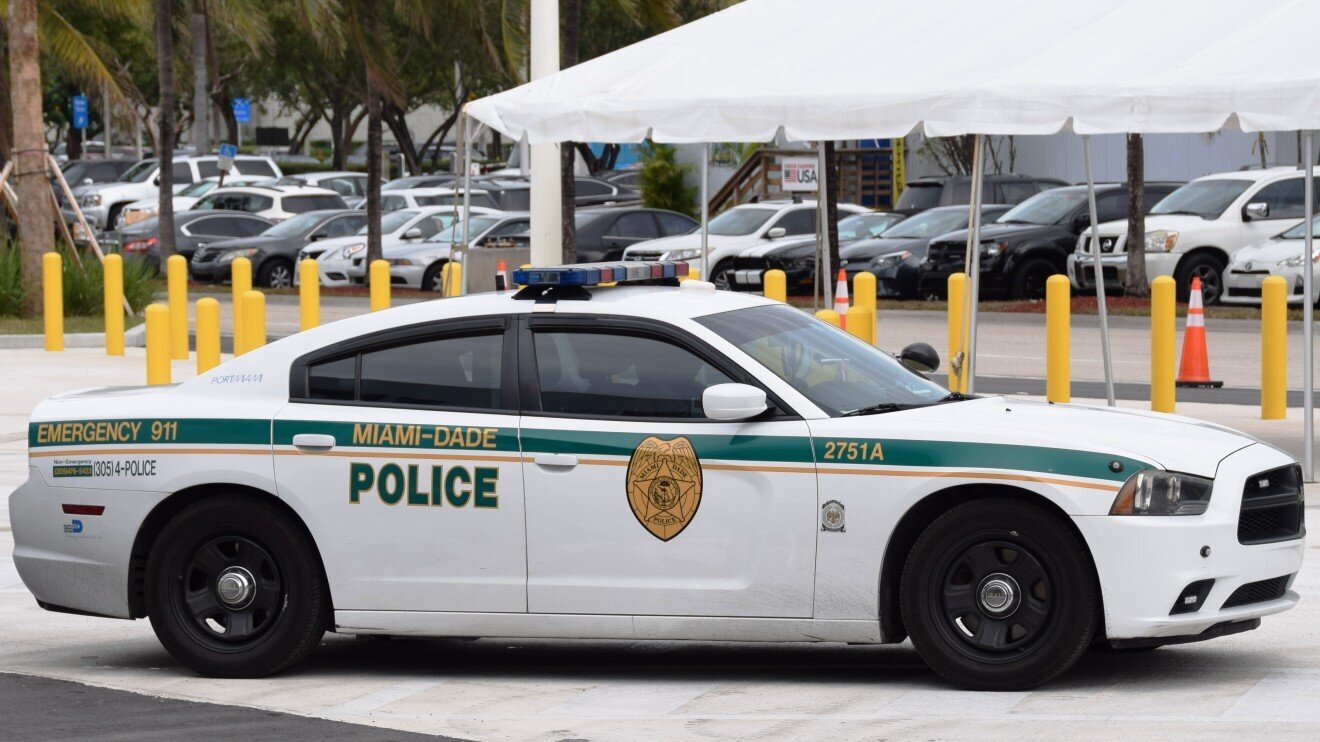
Key Differences
The City of Miami
- Status: A standalone city
- Population: ~433,000
- Area: 143.15 km²
- Rank: 43rd-largest city in the US
Miami-Dade County
- Status: An administrative county
- Population: ~2.5 million
- Area: 6,296 km²
- Includes: 34 cities, including Miami
Geographic Location
Miami is a city located within Miami-Dade County. The county is a far larger territory, encompassing many cities, towns, and unincorporated areas.
The City of Miami
Miami sits on the Atlantic coast in southeastern Florida. The city covers a relatively small area -- just 143.15 km², of which only 92.68 km² is land, the rest being water. By area, Miami is comparable to San Francisco or Boston, making it one of the smallest major cities in the US.
The city’s elevation never exceeds 4.5 meters above sea level, averaging about 0.91 meters across most neighborhoods. Most of the city sits either along the shore of Biscayne Bay or on natural or artificial barrier islands.
Miami-Dade County
Miami-Dade County covers a much larger area -- 6,296 km², of which 4,916 km² is land and 1,380 km² is water. The average elevation above sea level is 1.8 meters.
The county borders Broward County to the north, Collier County to the northwest, and Monroe County to the south and west. To the east and south, it’s bounded by the Atlantic Ocean.
Administrative Structure
It’s important to understand that Miami-Dade County is an administrative unit of the state of Florida that comprises 34 incorporated cities. The city of Miami is just one of them, albeit the best known.
| Characteristic | City of Miami | Miami-Dade County |
|---|---|---|
| Type of administrative unit | Municipality (city) | County |
| Year established | 1896 | 1836 |
| Administrative seat | — | City of Miami |
| Number of included cities | 1 (Miami itself) | 34 cities |
History of Formation
Miami-Dade County
The county was created on January 18, 1836, under a US land act. It was originally named Dade County, after Francis L. Dade, a US Army officer. Only in 1997 was the county renamed Miami-Dade -- which happened after the events described in the novel.
So in 1997, when the novel’s events take place, the county was still simply called «Dade» -- it received its present name, «Miami-Dade,» that very year.
The City of Miami
The city of Miami is much younger than the county. It officially became a city on July 28, 1896. At the time it had only a few hundred residents -- the city’s first citizens numbered 444 people, of whom about 400 men were eligible to vote at the incorporation meeting.
The city’s founding is tied to Julia Tuttle, a wealthy woman from Cleveland who in 1891 purchased a huge citrus plantation of roughly 640 acres. She managed to persuade railroad magnate Henry Flagler to extend his railway to Miami, which became the catalyst for the city’s development.
Neighborhoods and Structure
Neighborhoods of the City of Miami
The city of Miami is traditionally divided into four main areas:
Downtown/Central
Includes Brickell, Virginia Key, Watson Island, and PortMiami. Home to the central business district, with the highest concentration of international banks in the US.
South
Includes Coral Way, Roads, and Coconut Grove. Coral Way is a historic residential neighborhood founded in 1922.
West
Includes Little Havana, West Flagler, and Flagami. The traditional settling ground for immigrants from Central America and Cuba.
North
Includes Midtown, Edgewater, and the Wynwood Art District. Home to numerous high-rise residential towers and cultural institutions.
Structure of Miami-Dade County
Miami-Dade County comprises 34 incorporated cities, among them:
- Miami County seat
- Miami Beach
- Coral Gables
- Homestead
- Hialeah
- And 29 more cities
Economic Significance
Miami is recognized as one of the most important financial centers in the US. The city has the country’s highest concentration of international banks, most of them along Brickell Avenue. It also hosts the Latin American headquarters of more than 1,400 multinational corporations.
Miami International Airport and PortMiami are among the busiest in the country, driven largely by cargo traffic from South America and the Caribbean. PortMiami is considered one of the busiest seaports in the world.
Demographics and Culture
Population
By the mid-1990s, Miami’s demographics had shifted dramatically compared to the 1960s. Whereas non-Hispanic white residents made up 90% of the city’s population in 1960, by 1990 that share had fallen to under 12%.
Waves of Immigration
Several waves of Cuban immigration were especially significant:
- The 1960s: Following the 1959 Cuban Revolution, more than 400,000 Cuban refugees relocated to Miami
- 1980: The mass exodus known as the Mariel boatlift brought around 125,000 new Cuban immigrants
- 1994: Another wave of Cuban immigration, after which the Clinton administration revised US immigration policy
Language
By the 1990s, Miami had developed a unique linguistic landscape. Alongside English, Spanish is widely spoken, and in some neighborhoods, Haitian Creole. In the «Little Haiti» area around the intersection of 2nd Avenue and 54th Street, Haitian Creole was even adopted for use on election ballots.
Climate and Natural Conditions
Miami has a tropical monsoon climate, with hot, humid summers and short, mild winters. The Gulf Stream, flowing just 24 kilometers off the coast, keeps the climate warm and mild year-round.
Winter
Average January temperature: 19.6°C
A clearly defined dry season
Rare frosts (the last snowfall was in 1977)
Summer
Temperature: 29-35°C
High humidity
Rainy season (May to mid-October)
Annual rainfall: 1,420 mm
Natural Features
The city sits on flat terrain between the Everglades wetlands and Biscayne Bay. Many of Miami’s western neighborhoods reach the southeastern edge of the Everglades, creating unique ecological conditions -- but also certain problems, as alligators and crocodiles occasionally turn up on highways or in residential areas.
Environmental Features
Starting in 1906, a series of canals were built to drain the overly waterlogged land west of Miami. These engineering projects allowed the city to expand, but also reshaped the Everglades ecosystem.
Miami Beach: A Separate Status
It’s worth noting that, despite its name, the famous Miami Beach is a separate city within Miami-Dade County. It sits on barrier islands east of the city of Miami, across Biscayne Bay.
Miami Beach
Miami Beach occupies the largest of the natural and artificial barrier islands in Biscayne Bay. South Beach is one of the world’s most famous tourist destinations, renowned for its nightclubs, beaches, historic Art Deco buildings, and shopping.
Transportation Infrastructure
Miami serves as a critical transportation hub for the entire region. Miami International Airport is the busiest in the state of Florida and the main US gateway to Latin America. PortMiami, home to the world’s largest cruise lines, is likewise one of the busiest seaports anywhere.
Conclusion
So the core difference between Miami and Miami-Dade comes down to scale and administrative status:
Miami
A specific city with a population of roughly 433,000, occupying a small territory of 143 km² on the shore of Biscayne Bay.
Miami-Dade
A vast administrative county with a population of 2.5 million, comprising 34 cities across more than 6,000 km².
For the novel’s context: when the character says they’re «turning Miami-Dade upside down,» he means activity happening at the scale of the whole county, not just the city of Miami -- underscoring the seriousness and reach of the events being described.