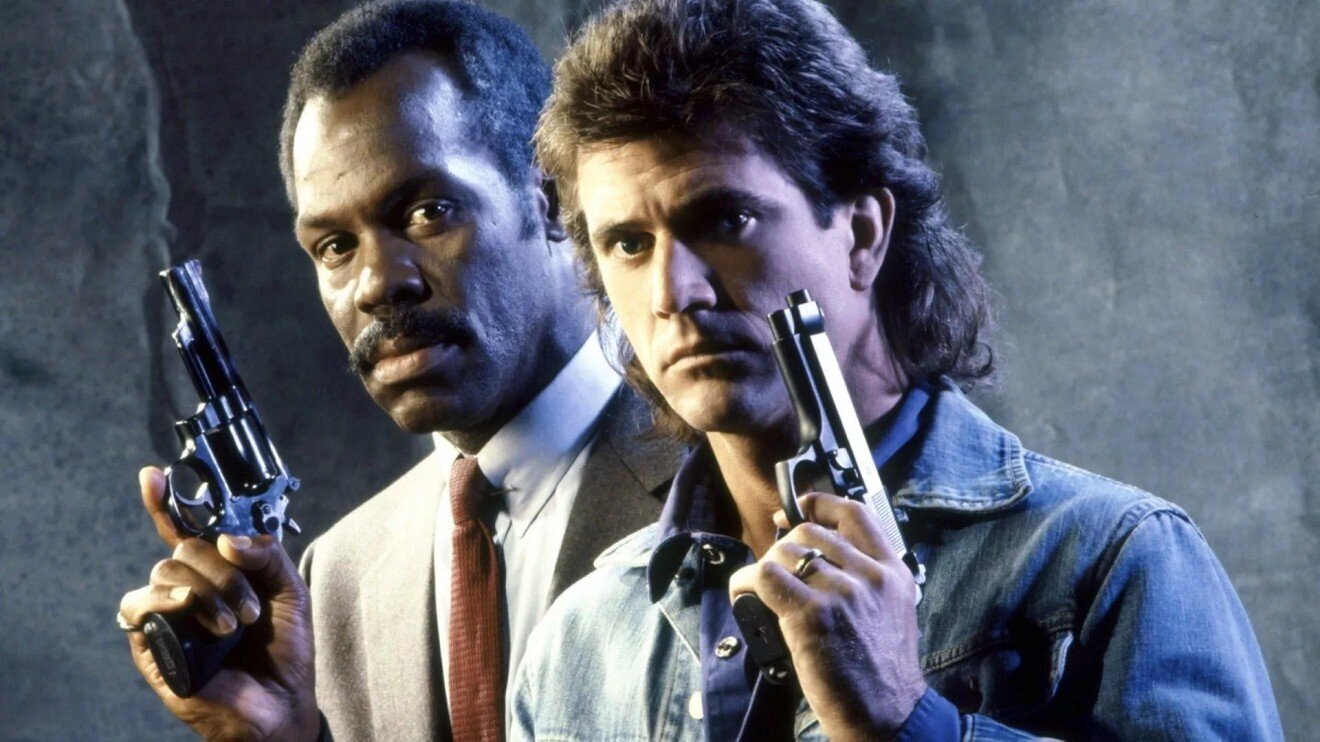
«Lethal Weapon» is an action film directed by Richard Donner, made in the U.S. in 1987 from a screenplay by Shane Black. The picture received an Academy Award nomination for Best Sound in 1988. The film launched a successful series and became one of the best-known action movies of the 1980s.
Plot
The story unfolds in Los Angeles. A young woman named Amanda Hunsaker takes her own life by jumping from a hotel balcony. Police detective Roger Murtaugh arrives at the scene and learns the deceased is the daughter of a fellow soldier from his time in Vietnam.
In parallel, the audience meets detective Martin Riggs, a young officer struggling with suicidal thoughts after his wife’s recent death. Riggs intercepts a call about a sniper, arrives at the scene where a child was wounded, kills the perpetrator, and then makes an arrest of drug dealers.
The head of the homicide division assigns Riggs as Murtaugh’s partner, over the objections of a psychologist who wants Riggs pulled from duty. The detectives begin investigating Amanda’s death. Riggs and Murtaugh drive to Beverly Hills to check the address of a man who’d been paying the dead woman’s rent. There they find two girls packaging drugs.
Riggs develops a theory involving a witness named Dixie, a prostitute who saw Amanda jump. The next day the detectives head to Dixie’s place, but the house explodes before they arrive. Kids playing nearby describe a man from the gas company with a snake-and-dagger tattoo.
Blood tests show Amanda was poisoned. The investigation leads the detectives to her father, Michael Hunsaker, who during the Vietnam War had belonged to a CIA group that wiped out drug traffickers. After the war, the group took over the drug business itself and began smuggling narcotics into the U.S. Hunsaker had been laundering money for the criminal organization. Mid-conversation, Mr. Joshua appears and shoots Michael.
General Peter McAllister orders Riggs killed. The detective is shot at on the street from a passing car, but he’s wearing a bulletproof vest. The detectives decide to fake Riggs’s death. The criminals kidnap Murtaugh’s daughter, killing her boyfriend, and set up a meeting in the desert. A shootout ends with the detectives captured. General McAllister takes Riggs prisoner; Mr. Joshua wounds Murtaugh.
The captured Riggs is tortured at a club, but breaks free, killing his torturer, then rescues Murtaugh and his daughter Rianne. Chasing Mr. Joshua, Riggs loses the criminal on the freeway. Murtaugh kills the general and realizes Joshua knows his home address. Joshua arrives at Murtaugh’s house, kills two patrol officers, and goes inside, but the family is already gone. In the yard, Riggs challenges Joshua to a one-on-one fight. Martin wins, though it’s a hard-fought battle, and the police grab Joshua. The criminal grabs an officer’s pistol and tries to kill Riggs, but the detectives shoot him first.
In the finale, Riggs visits Murtaugh on Christmas Eve and hands his daughter the bullet he’d once meant to shoot himself with. Murtaugh invites his partner in for Christmas dinner.
The Film’s Significance
The picture became the first in a four-film series about detectives Riggs and Murtaugh. The second installment came out in 1989, the third in 1992, the fourth in 1998. The «Lethal Weapon» series helped define the «buddy cop» genre — a police action film about partners with contrasting characters and methods.
Mel Gibson
Mel Columcille Gerard Gibson was born January 3, 1956, in Peekskill, New York. He is an Australian-American filmmaker, a two-time Academy Award winner, and a Golden Globe winner for directing the historical drama «Braveheart» in 1996. In 2017 he received Oscar and Golden Globe nominations for directing the war drama «Hacksaw Ridge.» Gibson holds an honorary Order of Australia.
Early Years
Gibson was born into an Irish Catholic family, the sixth of eleven children. His paternal grandmother was opera singer Eva Mylott, born in Australia to Irish parents. His grandfather was John Hutton Gibson, a millionaire who owned a tobacco business in the American South.
The actor’s first name honors Saint Mel, patron of Ardagh, his mother’s home region. His middle name, Colm-Cille, echoes the Irish saint Columba and an estate in Longford where his mother grew up.
In 1968 the Gibson family moved to Australia, where five more children were born. His father, having lost his job, won $145,000 from a company over a workplace injury lawsuit. After finishing Australian schooling, Mel enrolled at the National Institute of Dramatic Art in Sydney. His first role came as a student, in the film «Summer City.»
Early Career
In 1979, the actor appeared in «Tim» and «Mad Max,» earning several award nominations for both. At the same time, Gibson performed onstage as a member of the South Australian State Theatre Company in Adelaide. His roles there included Estragon in «Waiting for Godot» and Biff Loman in a 1982 production of «Death of a Salesman.»
During this period Gibson struggled with an inferiority complex. He was short and had to stand on a low box during filming. He drank heavily and got into fights, which made him unpopular with colleagues.
Gibson’s role in «Mad Max 2» in 1981 brought him worldwide fame. After that success, he began working in Hollywood, debuting there in «The Bounty» in 1984.
The Role in «Lethal Weapon»
In «Lethal Weapon,» Gibson played detective Martin Riggs, a young police officer with suicidal tendencies following his wife’s death. The actor created the image of an unstable but highly capable detective, prone to reckless, risky action. The role of Riggs became one of the most recognizable of Gibson’s career and cemented his status as an action-movie star of the 1980s.
Directing Career
In the early 1990s, Gibson founded the production company Icon Productions, deciding to try his hand at directing. His directorial debut was «The Man Without a Face.» His second directing effort proved more successful: the epic historical drama «Braveheart,» about the Scottish struggle for independence led by William Wallace. The film received ten Oscar nominations and won five, including Best Picture and Best Director. Its battle scenes involved as many as two thousand extras.
In 2000, Gibson starred in Roland Emmerich’s «The Patriot» and Nancy Meyers’s «What Women Want.» Both films did well at the box office. In 2002 he appeared alongside Joaquin Phoenix in the mystery thriller «Signs.»
In 2004, Gibson directed «The Passion of the Christ,» which shocked audiences with its extremely violent scenes and its detailed reconstruction of first-century Judea, using Aramaic, Latin, and ancient Hebrew. The film attempts to reconstruct in detail the last twelve hours of the life of Jesus Christ. «The Passion of the Christ» earned praise from Pope John Paul II. Despite mixed reviews from many critics, the film was a box-office success.
In 2006 came Mel Gibson’s historical epic «Apocalypto,» devoted to the final period of Maya civilization, depicting its decline as it stood on the edge of collapse by 1500. Ten years later, in 2016, Gibson’s fifth directorial work premiered — the war drama «Hacksaw Ridge.»
Danny Glover
Danny Lebern Glover was born July 22, 1946, in San Francisco. He is an American filmmaker and public figure.
Education and Early Career
Glover graduated from San Francisco State University and trained at the Black Actors’ Workshop of the American Conservatory Theatre. His film debut came in 1979, with a bit part in Don Siegel’s «Escape from Alcatraz.» He then appeared in several minor films — «Chu Chu and the Philly Flash» (1981), «Out» (1982) — as well as on television.
Glover drew attention in 1984 with a role in Robert Benton’s drama «Places in the Heart.» The following year he played a police officer in Peter Weir’s Oscar-winning thriller «Witness,» starring Harrison Ford. Glover also became known for «Predator 2» (1990), «Pure Luck» (1991), «The Color Purple» (1985), and «Silverado» (1985), along with popular TV movies.
The Role in «Lethal Weapon»
Glover found worldwide fame playing Sergeant Roger Murtaugh in the «Lethal Weapon» series, partnered with Mel Gibson. The first film came out in 1987, the fourth in 1998.
Glover played an experienced detective nearing retirement age, a family man with conservative views on police work. Murtaugh’s character contrasted with the unstable, risk-taking Riggs, creating the partner dynamic that became the foundation of the series’ success. The actor built the image of a level-headed officer gradually finding common ground with an unpredictable partner.
Later Career
From the late 1990s on, Glover appeared in «Switchback» (1997), «Beloved» (1998), «The Royal Tenenbaums» (2001), «Saw» (2004), a documentary short in 2005, «Shooter» (2007), «Stride» and «Ghost Train» in 2009, and «5 Star Day» in 2010. His most widely recognized recent role has been in Roland Emmerich’s «2012,» where he played the President of the United States.
On May 31, 1997, Glover received an honorary doctorate in the arts from San Francisco State University.
Videocassettes in Early-1990s Russia
In the early 1990s Russia saw a mass spread of VCRs and videocassettes carrying foreign films. Official distribution of Western movies was limited, and licensed videocassettes were either unavailable or priced out of reach for most people. The main source of video content became pirated copies, circulated through video salons, rental points, and private collectors.
The Videocassette Copying System
Films spread through a multi-tiered copying system. At the top sat master cassettes — original recordings brought in from abroad or copied from professional media. Owners of master cassettes made first-generation copies, which they sold or passed to second-tier distributors.
Second-tier distributors made copies of the first copies, producing second-generation copies. The process continued down to third-, fourth-, fifth-generation copies and beyond. Every link in the chain tried to profit by producing as many copies as possible for sale or trade. The copying system was decentralized — many people worked simultaneously at different tiers, making copies.
The Technical Side of Quality Loss
Every act of copying a videocassette degraded picture and sound quality. This degradation came from the nature of analog video recording onto magnetic tape.
A VHS signal was recorded as changes in the magnetic field on tape coated with a ferromagnetic layer. On playback, the video heads read these changes and converted them back into an electrical signal. That reading process was never perfect — signal fluctuations arose from uneven magnetic coating, tape wear, imprecise head positioning, and electromagnetic interference.
During copying, the video signal passed through two devices: the playback VCR read the source cassette, converted it into an electrical signal, which then fed into the recording VCR. The recording device converted that electrical signal back into a magnetic recording on the new cassette.
At every stage of conversion, noise crept into the signal. The playback head introduced read noise, the electronics of both devices added electrical interference, the recording head introduced write noise. On top of that, the useful signal’s amplitude dropped — high-frequency components of the picture weakened more than low-frequency ones, causing a loss of fine detail and sharpness.
Accumulating Distortion
Each successive copy carried all the distortions of the previous one, plus new distortions added during that latest round of copying. After two or three rounds, picture quality noticeably declined — graininess appeared, object outlines blurred, colors lost saturation. By the fourth or fifth copy, fine details became hard to make out, the image took on a characteristic blur, and color information was distorted.
Dark scenes suffered especially badly — the low signal level in dark areas of the picture made the signal-to-noise ratio unfavorable, and noise became more noticeable than the actual image. In action scenes with fast motion, blurring worsened further due to the limited bandwidth of the video path.
The Problem of Identifying Characters
On fifth- or sixth-generation copies, picture quality degraded to the point where telling actors’ faces apart in certain scenes became difficult. In action films, where actors were often moving, in shadow, at a distance from the camera, or in tricky lighting, the problem grew worse.
In «Lethal Weapon,» many scenes took place at night, in dimly lit rooms, during chases and shootouts. On a good copy, a viewer could clearly tell Mel Gibson and Danny Glover apart even in fast-moving scenes. On a fifth or sixth copy, the actors’ faces in such scenes turned into blurry smudges, and figuring out which detective was on screen was only possible from secondary cues — clothing, build, the scene’s context.
A Yardstick for VCR Quality
A VCR’s ability to play back low-quality copies with a passable picture became an important criterion for judging equipment. Cheap VCRs couldn’t compensate for distortion accumulated across multiple generations of copying. Quality Japanese-made units had better video heads, more sophisticated signal-processing circuits, and distortion-compensation systems.
Testing a VCR on fourth- or fifth-generation copies became a standard practice when buying one. If a machine let you make out actors’ faces and the main details of the picture on such a copy, it was considered good quality. «Lethal Weapon» was often used for exactly this test — its dynamic scenes, high-contrast lighting, and the need to distinguish between its two lead characters made it a convenient benchmark for evaluating video equipment.
The Videocassette Market
By 1993, the videocassette market in Russia was entirely unofficial. Video salons, rental points, and market vendors offered catalogs of hundreds of films. A cassette’s price depended on copy quality — master tapes and first-generation copies were expensive and rare, second- and third-generation copies made up the mid-range of the market, and fourth- and fifth-generation copies sold cheap and were the most common.
Trading cassettes was widespread among VCR owners. Collectors built personal video libraries, catalogued films, and kept track of new releases. Copy quality was noted when trading — «second copy,» «third copy,» and so on. The label «fifth copy» meant the picture would be mediocre, but for undemanding viewing or testing equipment, such a cassette was perfectly acceptable.
Conclusion
«Lethal Weapon» became a landmark film of the late 1980s, shaping the development of the buddy-cop action genre. Mel Gibson and Danny Glover created a memorable duo of partner detectives whose dynamic became the foundation of a four-film series’ success. In early-1990s Russia, the film spread through a pirated videocassette-copying system, in which every successive copy lost quality due to the nature of analog recording. A VCR’s ability to play back low-quality copies became an important measure of equipment quality, and testing it on heavily copied cassettes became a standard part of buying one.