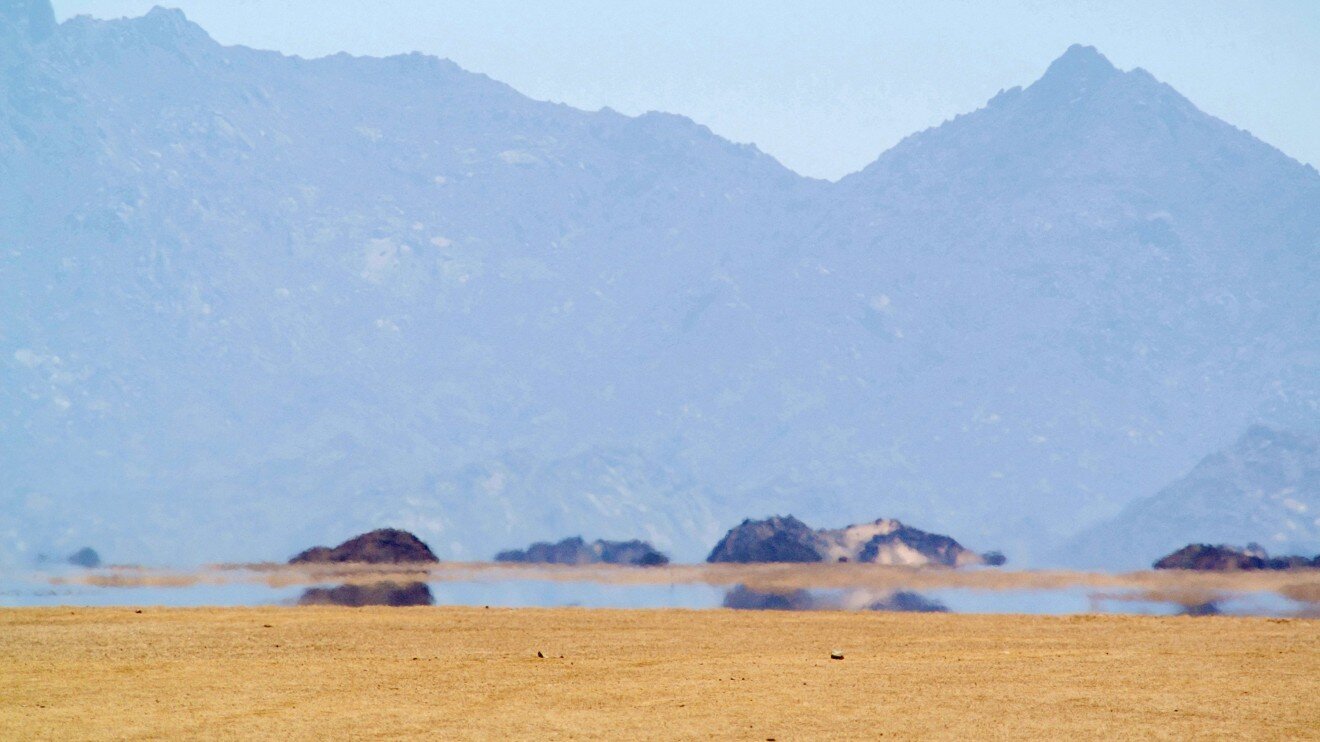
A mirage is a remarkable natural phenomenon in which optical illusions create the impression that objects exist, or are moving, where in fact there is nothing at all. It’s a phenomenon that deceives our eyes, making us see, for instance, water on the road on a hot day, or flying ships on the horizon.
The Nature of a Mirage
A mirage arises from light refracting through layers of air of differing density. Air density, in turn, depends on temperature. As light passes through layers of air at different temperatures, its path bends, producing an illusory image.
The main cause of mirages is the temperature difference between the ground or water surface and the surrounding air. That temperature contrast creates density gradients that distort the path of light rays. The human eye perceives these bent rays as a continuation of a straight line, producing the illusion of objects or their reflections.
Types of Mirages
There are two main types of mirages:
1. Inferior mirage
This type is most often seen in hot weather, on asphalt roads or in deserts, for instance. Hot air near the ground has lower density than the cooler air above it. Light rays bend upward, and the observer sees an illusory reflection that looks like water or a mirror.
Example: on a hot day, a driver might see a «puddle of water» on the road that vanishes as they approach.
2. Superior mirage
This type occurs when cold air sits close to the ground and warm air lies above it. As a result, light rays bend downward, and objects can appear lifted above the horizon or floating in the air. Superior mirages are often seen over open sea.
Example: ships «sailing» in the sky, or islands that appear visible even though they actually lie beyond the horizon.
Conditions for a Mirage to Occur
The following factors matter for a mirage to appear:
-
A temperature gradient. A sharp temperature change between layers of air.
-
A clear line of sight. Open space with no obstacles, such as buildings or trees.
-
Particular weather conditions. Mirages most often occur in hot deserts, on roads on sunny days, or in cold regions experiencing a temperature inversion.
Scientific and Cultural Significance
Mirages have long been a source of inspiration for myths and legends. In ancient times, without scientific explanations, people considered mirages mystical events or omens. Desert mirages, for instance, gave rise to countless stories of mythical oases, while images of «flying ships» inspired tales of heavenly kingdoms.
From a scientific standpoint, mirages became an important subject of study in optics and meteorology. They show how light interacts with its surroundings and how the human brain interprets visual signals.
Conclusion
A mirage isn’t just an illusion, but an example of how remarkable and complex our world is. The phenomenon shows how the laws of nature can produce striking spectacles that both amaze and confound us. Understanding the nature of mirages helps us grasp just how much our perception depends on our surroundings and physical processes.