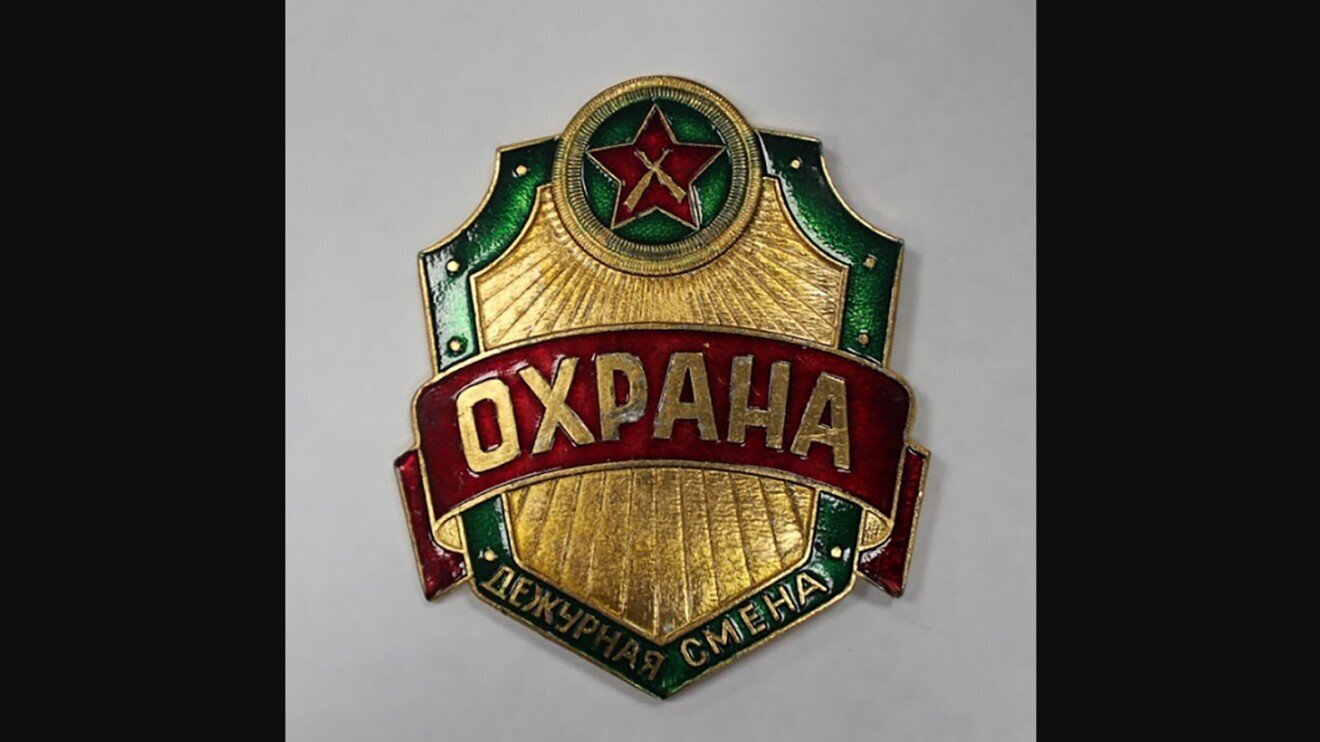
What VOKhR is
Vnevedomstvennaya okhrana (VOKhR, non-departmental security guard) is a set of specialized units under the internal affairs agencies, created to guard state and private facilities of special importance to the country's economy and security.
Historical roots of the system
Russia's non-departmental security system has deep historical roots reaching back to the Soviet era. The first industrial-police units were created as early as March 3, 1920, in the RSFSR, to guard industrial facilities and stocks of goods and raw materials — a response to the economic collapse and criminalization of society during the Civil War.
The system took its final shape on February 6, 1924, when the RSFSR Council of People's Commissars adopted a resolution establishing departmental militia. Under the approved regulations, it was created to guard the property of state enterprises and institutions, as well as private organizations of state importance. An important feature was that the departmental militia was established on a contractual basis with facility administrations, and was funded by them.
Creation of the modern VOKhR system
A fundamentally new stage in the development of the facility-protection system began on October 29, 1952, when USSR Council of Ministers Resolution No. 4633-1835 established the non-departmental outdoor watchman guard (VNSO) under the Ministry of Internal Affairs. This decision centralized the security system, placing under MVD control the watchman brigades that had previously guarded trade and economic facilities.
The creation of VNSO was driven by several factors. First, the need for more effective use of personnel freed up from security work by the introduction of new technology. Second, the need to unify security-service standards across the entire USSR. Third, the state's desire to strengthen control over strategically important facilities of the national economy.
Development of the system in the 1960s-80s
In 1959, the functions of the non-departmental guard were significantly expanded — it was given the authority to inspect departmental security services. This meant VOKhR gained the right to oversee the quality of security services provided by other security structures.
Starting in 1962, the non-departmental guard was tasked with introducing technical security equipment. This included installing security and fire alarms and developing centralized facility protection. Technical equipment significantly improved the effectiveness of security measures and reduced the number of personnel needed.
The 1966 model regulation
On February 18, 1966, a USSR Council of Ministers resolution approved the Model Regulation on Non-Departmental Security under the Militia Agencies. Under this document, the security system consisted of two types of units:
- Paramilitary units — for guarding especially important and restricted-access facilities
- Watchman units — for guarding all other facilities
Structure and armament
The paramilitary units of the non-departmental guard had a clear hierarchical structure, made up of detachments, separate teams, groups, and squads. Watchman units were organized into brigades. The paramilitary units were armed with carbines, rifles, pistols, and revolvers, underscoring the seriousness of the tasks assigned to them.
VOKhR personnel underwent special training, including the fundamentals of security work, legal regulation, technical security equipment, as well as physical and drill training. The paramilitary character of the units demanded high discipline and rigorous performance of duty from their personnel.
Scale of activity in the USSR
By 1975, the non-departmental security system had reached considerable scale: its total personnel numbered 53,000, and it guarded 200,000 different facilities across the Soviet Union.
The system peaked in the late 1980s. As of early December 1987, the total strength of the USSR's non-departmental guard was nearly 1 million people. Of these, 178,000 were militia officers, but the bulk consisted of watchmen. Under guard were:
Protected facilities
- • 600,000 facilities
- • 1 million premises
- • Over 50% of industrial enterprises
- • Practically all trade and catering establishments
- • 410,000 apartments
Operational effectiveness
Over the course of 1987, VOKhR personnel prevented up to 30 thefts and detained up to 40 criminals and offenders every day.
Technical modernization
An important direction in the system's development was the introduction of technical security equipment. Between 1977 and the end of 1987, thanks to technical equipping, the number of watchmen was reduced by 143,000 people, saving 134.7 million rubles a year in wage-fund spending. This attested to the high effectiveness of the technical modernization of security systems.
The transitional period of the early 1990s
The collapse of the USSR in 1991 posed serious challenges for the non-departmental security system. The economic crisis, the breakdown of economic ties, and the privatization of state enterprises all demanded a fundamental rethinking of how security work was organized.
On August 14, 1992, the Government of the Russian Federation adopted a new "Regulation on Non-Departmental Security under the Internal Affairs Agencies of the Russian Federation." This document adapted the Soviet system to the new Russian realities, while preserving the basic principles of how security work was organized.
VOKhR in 1993: the realities of the transitional period
In 1993, when the events of the novel take place, the non-departmental security system was going through a period of serious transformation. The economic crisis led to reduced funding, and many enterprises had trouble paying for security services. At the same time, rising crime, especially property crime, made VOKhR's services extremely sought after.
Features of VOKhR's work in 1993
Amid economic instability, VOKhR personnel often worked under difficult conditions: delayed wages, a shortage of technical equipment, and increased workload from rising crime. Nonetheless, the system continued to function, providing security for thousands of facilities across the country.
Checkpoint access control
One of the key functions of VOKhR personnel was controlling checkpoint access at guarded facilities. This included:
- Checking documents — every visitor had to present a passport or other identifying document
- Issuing passes — temporary or permanent permits to be on the facility's territory
- Logging entry and exit — keeping visitor logbooks
- Inspections when necessary — checking personal belongings and vehicles
The VOKhR officer at the checkpoint was the public face of an enterprise's security system. The effectiveness of all security measures depended largely on his professionalism and attentiveness. The novel mentions a typical situation: a visitor shows a passport and signs for receiving a pass — a standard procedure of the time.
The social status of VOKhR personnel
In Soviet times, working in the non-departmental security system was considered prestigious and stable. Personnel received uniforms, had certain benefits, and their work was socially valued. In the early 1990s, the situation changed: inflation eroded wages, the profession's prestige declined, and many experienced personnel left for commercial security firms.
Nonetheless, the core of the system consisted of dedicated professionals who continued to conscientiously carry out their duties even under difficult economic conditions. Many of them had years of experience, knew the specifics of the facilities they guarded, and were respected among the staff of the enterprises they served.
Technical equipment during the transitional period
By 1993, many facilities guarded by VOKhR were equipped with technical security equipment: alarms, video surveillance systems, and communications equipment. Economic difficulties, however, often delayed equipment upgrades and repairs, creating additional complications in the work.
Centralized security consoles, which had become widespread in the 1980s, continued to function, but their effectiveness declined due to technical problems and lack of funding. Many facilities had to rely on traditional guarding methods — the physical presence of personnel and visual monitoring.
Relations with enterprises
Relations between VOKhR and enterprise administrations in 1993 were not simple. On the one hand, enterprises badly needed quality security amid rising crime. On the other hand, financial difficulties forced managers to economize on every line item, including security services.
This led to conflicts over the quality of the services provided, the level of pay, and the scope of security measures. VOKhR personnel often found themselves in a difficult position, balancing management demands to follow every procedure against an understanding of what enterprises could actually afford.
A typical day for a VOKhR officer in 1993
A checkpoint officer's workday began early in the morning and often lasted 12 hours. It included checking that technical equipment was in working order, receiving instructions from management, hours of dealing with visitors and enterprise staff, keeping records, and patrolling the territory. The job demanded constant attentiveness and readiness for any unusual situation.
Legal basis of the work
VOKhR's activities in 1993 were governed by several regulatory acts. The main one was the federal law "On the Militia," along with subordinate MVD Russia regulations. Personnel had certain powers to detain offenders, draw up reports, and use physical force in cases established by law.
Legal regulation of security work during the transitional period was imperfect, however. Many matters were resolved on the basis of subordinate regulations or even established practice. This created a degree of uncertainty in the work, and required personnel to have a good knowledge not only of formal rules but of their practical application.
Prospects for development
By 1993, it was already clear that the non-departmental security system needed serious reform. The development of a market economy, the appearance of private security companies, and changes in the structure of property ownership all called for new approaches to organizing security work.
Nonetheless, VOKhR retained its important role in ensuring the security of facilities of state importance. The experience accumulated over decades, its professional personnel, and its technical base all provided a foundation for the system's further development under new conditions.
Conclusion
The mention of a "vokhr" in the novel about Russia in 1993 accurately reflects the realities of that time. VOKhR personnel were an integral part of the everyday life of many enterprises and organizations. Their work, often unnoticed by outsiders, ensured the safety of people and the security of property during a difficult period of Russian history.
The VOKhR system, created in Soviet times, proved its viability under new conditions as well. Adapting to changed realities, it continued to perform its basic functions, though under significantly more complicated conditions during the transitional period of the early 1990s.