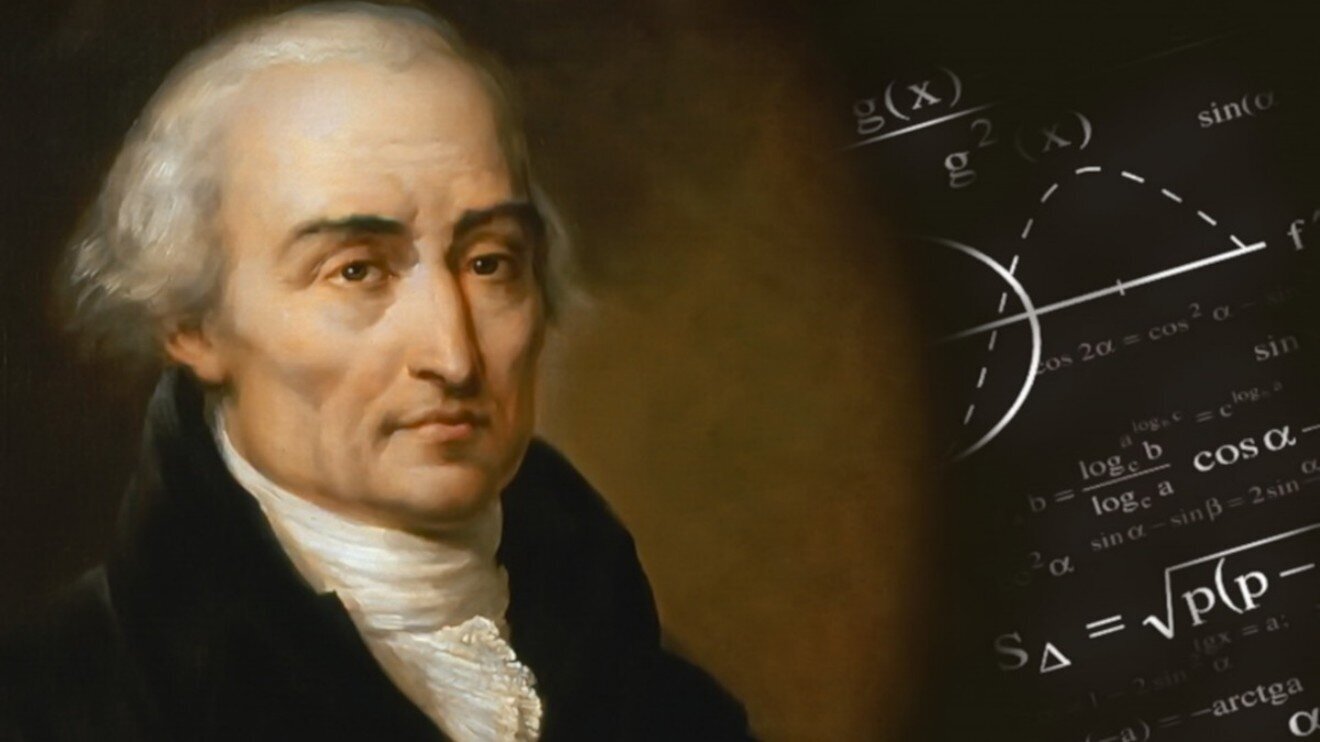
The Lagrange interpolation polynomial is one of the most important tools of numerical analysis, widely taught in Soviet and Russian higher education institutions in courses on mathematical analysis and numerical methods.
The mathematical essence
The Lagrange polynomial solves the fundamental problem of interpolation: how to construct a polynomial of minimal degree that takes on given values at a given set of points. In other words, if the coordinates of several points on a plane are known, the Lagrange polynomial makes it possible to find a function that passes exactly through all of them.
The distinctive feature of the method is that each basis polynomial li(x) equals one at the point xi and zero at all the other given points. This guarantees that the resulting polynomial passes exactly through all the original points.
Practical applications
In the Soviet era, Lagrange polynomials were actively used:
- In numerical integration — for the approximate calculation of definite integrals
- In engineering calculations — for approximating experimental data
- In computer graphics — for constructing smooth curves
- In physics and astronomy — for processing the results of observations
The method was especially prized for its versatility: unlike the least-squares method, it is guaranteed to pass through all the given points, which is critical for precise calculations.
Joseph-Louis Lagrange (1736-1813)
The method's creator was the outstanding French mathematician of Italian descent Joseph-Louis Lagrange, one of the greatest mathematicians of the 18th century alongside Euler. Born in Turin, he worked in Berlin at the court of Frederick II, then in Paris under Louis XVI and Napoleon.
Major achievements
- The creation of the calculus of variations
- "Analytical Mechanics" (1788)
- Number theory and algebra
- Numerical methods
Scientific honors
- Member of the Berlin Academy of Sciences
- Member of the Paris Academy of Sciences
- Count of the French Empire
- Legion of Honour
Lagrange published his interpolation formula in the late 18th century, although similar ideas had been proposed earlier. His achievement lies in the rigorous mathematical grounding and practical implementation of the method.
Study in the USSR and Russia
At Soviet universities, Lagrange polynomials were traditionally taught in the upper years of mathematics, physics, and engineering programs. The topic was part of the mandatory curriculum for courses in "Numerical Methods," "Computational Mathematics," and "Mathematical Analysis."
Students learned both the theoretical foundations of the method and the practical skills of constructing interpolation polynomials. Special attention was paid to:
- Proving the uniqueness of the interpolation polynomial
- Estimating interpolation error
- Comparison with other methods (Newton's, splines)
- Programming the algorithms in Fortran and other languages
Difficulty of the material
Lagrange polynomials were considered one of the most technically demanding topics in the numerical methods course. Students had to not only understand the theory, but also be able to:
"Calculate the coefficients of the basis polynomials, find the remainder term, estimate the accuracy of the approximation, and apply the method to solve practical problems."
The formulas were dense with products and fractions, demanding precision in algebraic manipulation. It's no surprise that many students found this topic difficult, associating it with especially intense mental effort.
The Lagrange method remains relevant today, widely used in modern computer algebra systems and numerical modeling.