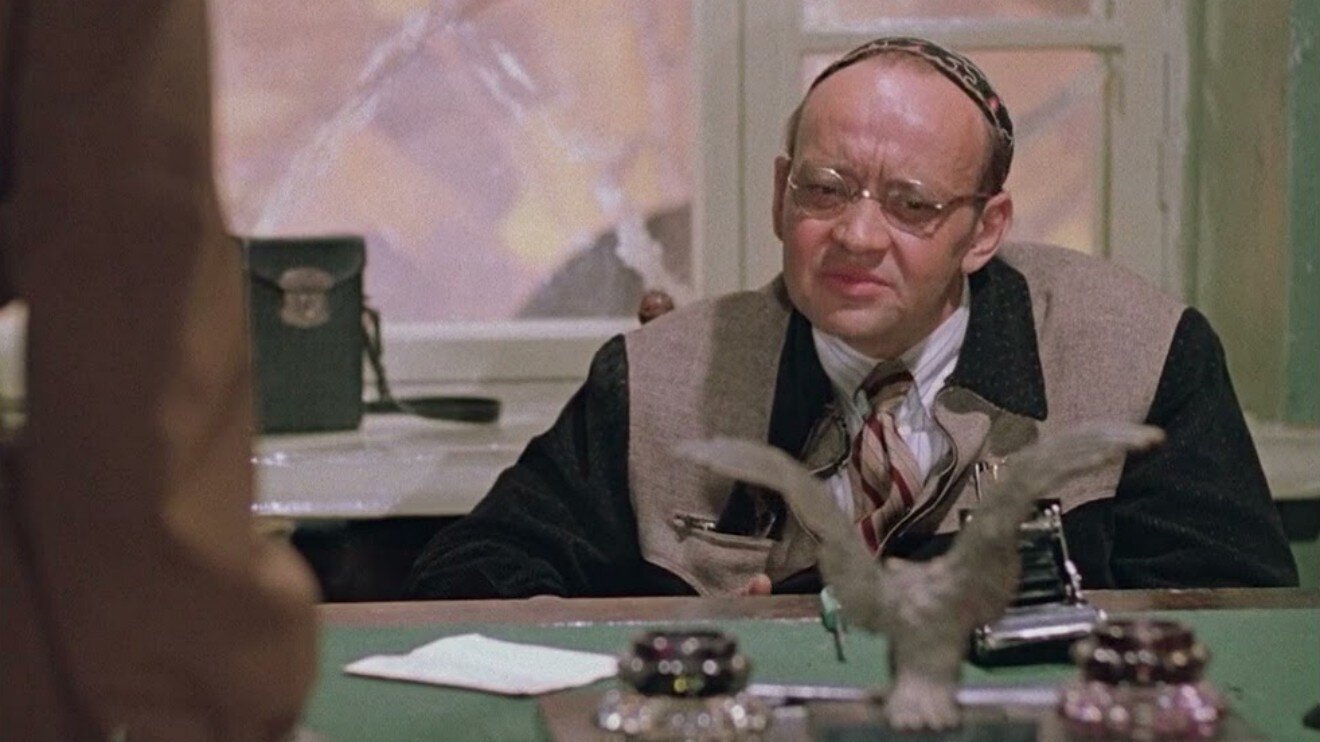
Stanislav Govorukhin's television film "The Meeting Place Cannot Be Changed" (1979) holds a special place in the history of Soviet cinema, and remains one of the most quoted works of Russian culture.
Its production and premiere
This five-part detective film was made based on the Weiner brothers' novella "The Age of Mercy," at the Gorky Film Studio. It premiered on Soviet Central Television in November 1979, and instantly won nationwide love. Work on the film went on for nearly two years, with shooting in Moscow, Odessa, and other Soviet cities.
Stanislav Govorukhin, already a well-known director by then, created a work that became the gold standard of the Soviet detective genre. The screenplay was written by the Weiner brothers themselves, together with the director, ensuring the author's vision was rendered on screen with maximum fidelity.
Plot and main characters
The film is set in Moscow in 1945, right after the end of the Great Patriotic War. At the center of the plot is a confrontation between officers of the Moscow Criminal Investigation Department (MUR) and a dangerous gang of repeat offenders, led by the elusive "Black Cat." The main characters — the seasoned detective Gleb Zheglov (Vladimir Vysotsky) and the young Lieutenant Vladimir Sharapov (Vladimir Konkin) — investigate a string of brazen robberies.
The character of Gleb Zheglov, brought to life by Vladimir Vysotsky, became one of the most vivid and memorable figures in the history of Soviet film. Zheglov is a seasoned detective who at times uses questionable methods, but is utterly devoted to his work. His counterpart, Vladimir Sharapov, is a young idealist, freshly returned from the front, who believes in the triumph of justice and the rule of law.
Fun fact
Vladimir Vysotsky was not initially the first choice for the role of Zheglov. The director searched for a suitable actor for a long time, but it was Vysotsky who created the unforgettable image that stuck with audiences.
Minor characters and their significance
The film's minor characters hold a special place, each with a vivid characterization of their own. Among them stands out Grisha Kozodoev, nicknamed "6 by 9" for his short stature. This character, played by actor Boris Klyuyev, is a typical Soviet everyman — cowardly, fussy, yet still striving to appear important.
Grisha "6 by 9" appears at critical moments in the plot, often delivering lines that became proverbial. One of the most memorable — "we need to do something, Gleb Yegorych! we need to do something!" — is spoken at a tense moment, when Sharapov is in mortal danger and Gleb Zheglov is forced to wait for a train to pass. This line, delivered by the film's most useless character, became a symbol of fussy helplessness in a critical situation.
Catchphrases and their cultural significance
"The Meeting Place Cannot Be Changed" gave the Russian language a great many catchphrases, which became firmly embedded in everyday speech. Besides Grisha "6 by 9"'s already-mentioned line, Gleb Zheglov's remarks became especially popular: "A thief belongs in prison," "Or would you like me to give you the key to the apartment where the money is, too?" "Balls after balls."
These phrases became part of the cultural code of Soviet, and later Russian, society. They are used not just in their literal sense, but as a way of ironically commenting on various life situations. What sets these expressions apart is that they are understood across different generations and social groups.
Its influence on the culture of the 1990s
By 1994, when the novel about Roman Peskov is set, Govorukhin's film had already achieved the status of a cult classic. During the economic upheaval and social change of the early 1990s, quotes from "The Meeting Place Cannot Be Changed" took on new resonance. Characters' lines came to be used to express confusion, irony, or, conversely, resolve in difficult situations.
The mention of Grisha "6 by 9"'s line, in the context of the economic shock the novel's protagonist is living through, is a vivid example of how film quotes help express an emotional state. When a person faces a crisis — whether falling sales or any other problem — they unconsciously reach for familiar cultural codes to describe their state of mind.
The era's context
In 1994, Russian society was living through a period of economic instability. Many entrepreneurs and businessmen faced sharp swings in demand, financial losses, uncertainty. In such a situation, reaching for phrases familiar since childhood, from beloved films, became a way of coping and of self-deprecating humor.
Artistic features of the film
"The Meeting Place Cannot Be Changed" stands out among other Soviet detective films for its distinctive atmosphere and psychological depth. Stanislav Govorukhin managed to create not just an entertaining work, but a serious drama about human character, about the choice between ends and means, about the price of justice.
Anatoly Ivanov's cinematography creates an authentic atmosphere of postwar Moscow. The black-and-white footage, the carefully crafted sets, costumes, and makeup immerse the viewer in the era. Special attention was paid to the details of daily life, the characters' manners, and their patterns of speech.
The film's musical score, including songs performed by Vladimir Vysotsky, became an inseparable part of its artistic identity. Songs like "A Stone Lies in the Steppe" and "The Honor of the Chess Crown," among others, don't just add atmosphere — they reveal the protagonist's inner world.
Acting and character
Vladimir Vysotsky created, in Zheglov, a complex, contradictory character. His hero is not without flaws — he can break the law to see justice done, use questionable investigative methods. Yet Zheglov is sincerely devoted to his work, and ready to risk his life to protect innocent people.
Vladimir Konkin, as Sharapov, represents the opposite type — a young romantic, believing in ideals. The conflict between these two approaches to justice forms the film's ideological core, and keeps it relevant in any era.
As for the character of Grisha "6 by 9," Boris Klyuyev masterfully created the image of a man striving to seem important and significant, but revealing his true nature at critical moments. His lines often land as out of place and comic, underscoring the gap between the character's pretensions and his real capabilities.
Its social undertones
The film touches on important social themes: the problem of crime in postwar society, questions of morality and ethics, the relationship between law and justice. Made in the late 1970s, it reflected concerns relevant to the fight against crime at the time, but its themes proved timeless.
The image of the "Black Cat" and its gang represents more than just a criminal organization — it is a symbol of the evil that seeks to destroy the ordinary lives of people. The struggle between good and evil, between law and lawlessness, forms the work's philosophical foundation.
Technical craft
From a technical standpoint, the film shows the high level Soviet cinema had reached by the late 1970s. Dynamic editing, expressive cinematography, and quality sound design create a gripping narrative. The chase scenes, shootouts, and investigative sequences were shot with great skill, and remain compelling to watch even today.
Its work with dialogue especially deserves mention. Every character has their own manner of speech, their own style of communication. The characters' lines sound natural and memorable, which explains, in large part, the number of catchphrases the film gave the Russian language.
Its legacy and influence
"The Meeting Place Cannot Be Changed" had an enormous influence on the development of the detective genre in Soviet and Russian cinema. Many later films and TV series drew on Govorukhin's techniques for structuring a plot, building characters, and writing dialogue.
The film has been rereleased repeatedly, broadcast on television, and issued on various formats over the years. Its popularity has not faded with time, testifying to its high artistic quality and the ongoing relevance of the issues it raises.
Cultural significance
Lines from the film have become part of Russians' everyday communication. They are used not just for quotation, but as a way of expressing various emotional states — from irony to resolve.
Conclusion
The television film "The Meeting Place Cannot Be Changed" is a unique phenomenon in the history of Russian culture. Created as an entertaining detective story, it grew into a work that has shaped the cultural codes of several generations of Russians.
Using Grisha "6 by 9"'s line in a novel about 1994 Russia shows how film quotes help express complex emotional states. When a person faces a crisis and doesn't know how to act, they unconsciously reach for familiar cultural touchstones. The fussy line of a minor character from the film becomes a way of conveying the novel's protagonist's own confusion and panic.
"The Meeting Place Cannot Be Changed" thus continues to live on in contemporary culture, not just as a classic detective story, but as a source of linguistic tools for expressing various life situations. Stanislav Govorukhin's film remains a relevant, widely quoted work, whose influence reaches far beyond cinema itself.