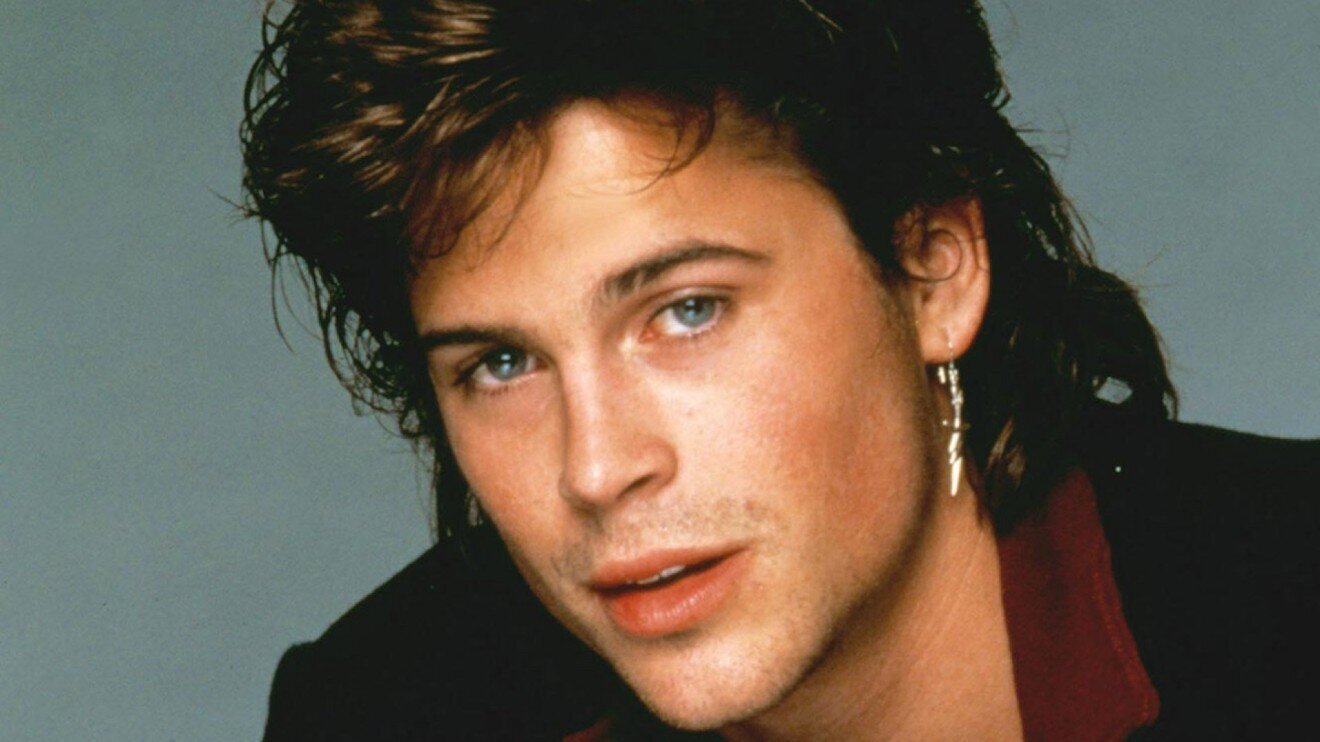
Robert Hepler «Rob» Lowe (born March 17, 1964) is an American actor who, by the mid-1990s, had already firmly established himself as a Hollywood star and one of the most recognizable faces in American film. His appearance on the covers of glossy magazines as a benchmark of male attractiveness was entirely fitting for the era.
Rob Lowe’s peak popularity came in the 1980s, when he became one of the key members of the so-called «Brat Pack» — a group of young Hollywood actors that also included Demi Moore, Emilio Estevez, Andrew McCarthy, Molly Ringwald, and others. This informal group defined the face of youth cinema for the decade and set the beauty standards for an entire generation.
Lowe’s greatest fame came from roles in cult 1980s youth films: «The Outsiders» (1983) by Francis Ford Coppola, in which he starred alongside Tom Cruise, Matt Dillon, and Patrick Swayze; «St. Elmo’s Fire» (1985); and the comedy «About Last Night...» (1986). These films made him the face of American youth cinema and a symbol of the era.
By 1996, Rob Lowe’s looks could genuinely be considered a benchmark of classic male beauty. Regular features, expressive eyes, a perfect brow line, and a distinctive high forehead created the look that, by the mid-1990s, was seen as the standard. It’s no accident that the novel’s character chooses his photos as a model for the plastic surgeon — Lowe embodied the American ideal of male attractiveness at the time.
It’s worth noting that by 1996, the actor had already weathered the serious 1988 scandal involving the release of compromising videotapes, which had significantly damaged his career. But this didn’t affect his status as a style and beauty icon. If anything, overcoming his personal crisis and struggles with alcohol and drugs only added a certain depth and maturity to his image.
In the mid-1990s, Lowe was in the process of rebuilding his career after the scandal. He was married to makeup artist Sheryl Berkoff (since 1991) and, by 1996, already had two young sons. This period of his life was marked by a drive toward stability and family values, a contrast to his turbulent youth in the 1980s.
The actor’s physical traits — a height of 6 feet, an athletic build, dark hair, and blue eyes — matched the canons of male beauty at the time. His face had well-proportioned features: a high forehead, a straight nose, a sharply defined jawline. These traits made him an ideal candidate for men’s magazine covers, and an object of imitation.
Interestingly, the mention of Rob Lowe in the context of plastic surgery in 1996 seems entirely plausible. Aesthetic medicine was developing rapidly at the time, and Hollywood beauty standards were becoming increasingly attainable as surgical techniques improved. Lowe’s image, with its classic features, could genuinely serve as a reference point for anyone hoping to change their appearance.
So the appearance of Rob Lowe’s photos as a model for plastic surgery in a novel set in 1996 is historically grounded and reflects the realities of the era, when Hollywood stars set beauty standards and served as models to emulate, not just in lifestyle, but in appearance as well.