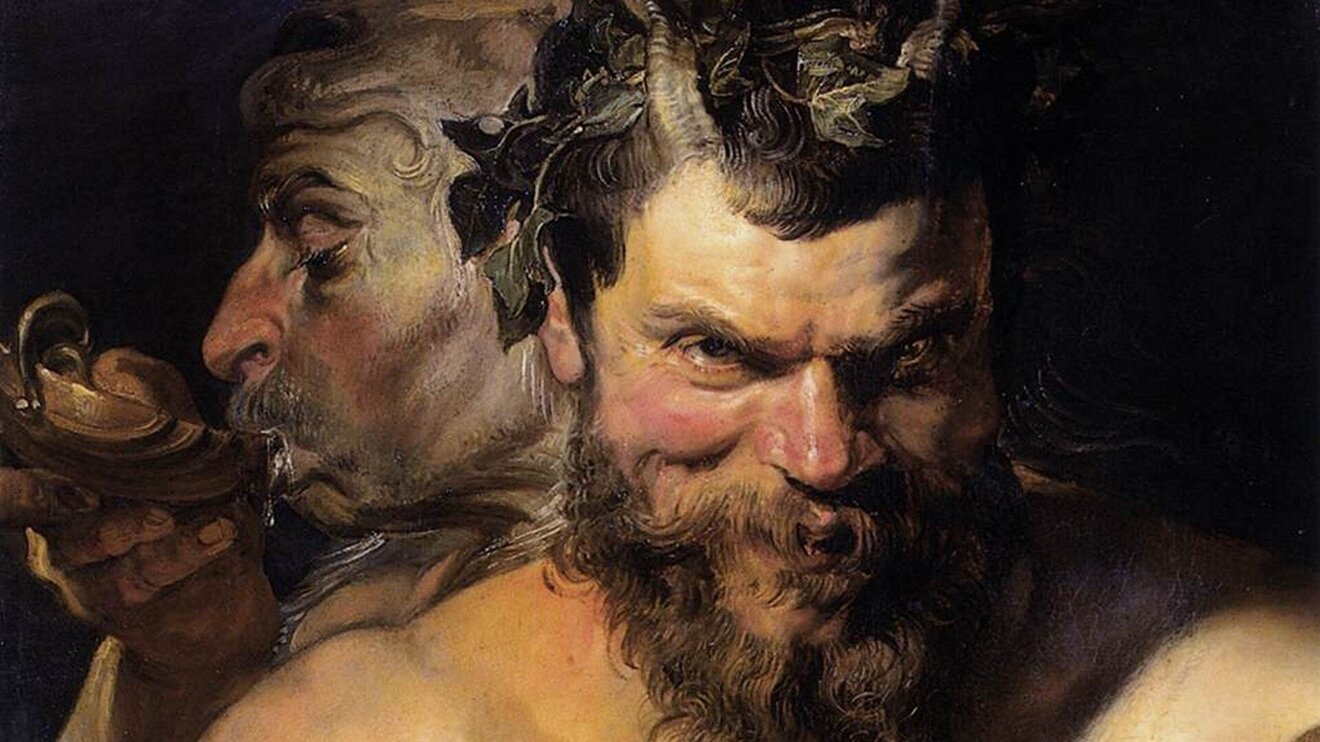
The Dionysian impulse is one of the central concepts in the philosophy of Friedrich Nietzsche, first developed in detail in his work The Birth of Tragedy (1872).
Dionysus and Apollo: Two Principles of Culture
Nietzsche identified two opposing but complementary principles in human culture, borrowing their names from the ancient Greek gods:
The Dionysian Principle
- • Unbridled passion for life
- • Instinctive impulse
- • Ecstasy and intoxication
- • Unity with nature
- • Dissolution of individuality
- • Chaos and becoming
The Apollonian Principle
- • Measure and harmony
- • Rationality
- • Beauty of form
- • Individuation
- • Dream-like illusion
- • Order and structure
The Essence of the Dionysian Impulse
The Dionysian impulse is the primal, fateful force of life that «comes from the very depths of nature.» It’s an elemental principle that:
«returns a person to a direct harmony with the world and a unity of all things with one another»
In the Dionysian state, a person transcends the boundaries of individual existence, dissolving into the cosmic current of life. This experience is marked by:
- Rejecting rational constraints
- Following instincts and desires
- Experiencing life as immediate event
- Merging with the primal forces of nature
- Creative intoxication and ecstasy
The Tragedy of Culture: The Exile of Dionysus
According to Nietzsche, a healthy culture is only possible when the Dionysian and Apollonian principles coexist in harmony. But a catastrophe occurred in the history of European civilization: starting with Socrates and Plato, a purely rational approach to life took over.
Socrates, who asserted «the possibility of comprehending, and even correcting, life through the dictatorship of reason,» became the symbol of this cultural rupture. As a result:
Dionysus was exiled from culture, and Apollo degenerated into logical schematism. Culture became «bloodless and stripped of myth.»
Nietzsche and Immoralism
The Dionysian impulse is closely tied to Nietzschean immoralism — his critique of conventional morality. Nietzsche called for thinking «beyond good and evil,» for liberation from the moral constraints imposed by Christian civilization.
The philosopher held that:
«truly free thought must place itself above moral constraints»
A Modern Reading
In the context of everyday life, the Dionysian impulse can be understood as:
- Following one’s immediate desires without regard for social convention
- Rejecting calculation and mercenary motives in favor of spontaneity
- Experiencing the moment as a value in itself
- Embracing one’s animal nature and instincts
A Note on the Author
Nietzsche’s philosophy is set out mainly in the form of aphorisms and was never organized into a system.
Friedrich Wilhelm Nietzsche was a German philosopher, composer, cultural critic, and philologist, one of the most influential thinkers of the 19th century, whose ideas left a deep mark on 20th-century philosophy, literature, and culture.
Life and Fate
Born October 15, 1844, into the family of a Lutheran pastor in Röcken, near Leipzig. At just 24, he became the youngest professor of classical philology in the history of the University of Basel — an unprecedented appointment for European universities of the time.
Nietzsche’s life was marked by a constant battle with illness. From age 18 he suffered severe headaches and insomnia, and by 30 he was nearly blind. In 1879 he was forced to give up teaching and was granted a pension. Despite his physical suffering, it was precisely during this period that he wrote his major works.
«At thirty-six, I had sunk to the lowest point of my vitality — I still lived, but without seeing three paces ahead of me... amid the torture of headaches lasting three days running, I possessed the clarity of a dialectician par excellence»
In January 1889, at age 45, his mind gave way for good — according to legend, after the philosopher witnessed a horse being beaten in the streets of Turin and rushed to protect it. He spent his final years first in his mother’s care, then his sister’s. He died on August 25, 1900, in Weimar.
Philosophical Legacy
Nietzsche never built a systematic philosophy, preferring an aphoristic style. His thought developed in constant motion and becoming, reflected in the form of short, striking aphorisms — «thought captured in motion.»
Key Ideas
- «The Death of God» — his diagnosis of the crisis in European Christian culture and traditional values
- The Übermensch (Overman) — the ideal of a person capable of creating their own values
- The Will to Power — the fundamental driving force behind all living things
- Eternal Recurrence — the idea that all events repeat in an endless cycle
- Revaluation of All Values — the necessity of overturning conventional moral foundations
- The Dionysian and the Apollonian — culture’s two principles: the elemental and the ordering
Immoralism and the Critique of Morality
Nietzsche subjected conventional morality to radical critique, setting against it a «morality of masters» and a «morality of slaves.» He called for thinking «beyond good and evil,» holding that truly free thought must stand above moral constraints.
He criticized every philosopher before him, starting with Plato, for failing to question morality’s basic premises. In his view, all conventional values were the product of a «decadent» culture that weakened human vitality.
Influence and Distortion
After the philosopher’s death, his sister Elisabeth Förster-Nietzsche took over publishing his unpublished works, distorting them significantly in the direction of German nationalism and antisemitism — ideas Nietzsche himself firmly rejected. This led to the false perception of his philosophy as a forerunner of Nazi ideology.
Only in the second half of the 20th century were Nietzsche’s authentic texts restored, and his philosophy finally received an accurate interpretation. His influence can be traced through existentialism, postmodernism, psychoanalysis, and many other currents of modern thought.
Major Works
- • The Birth of Tragedy (1872)
- • Human, All Too Human (1878)
- • Daybreak (1881)
- • The Gay Science (1882)
- • Thus Spoke Zarathustra (1883–1885)
- • Beyond Good and Evil (1886)
- • On the Genealogy of Morality (1887)
- • The Antichrist (1888)
Famous Aphorisms
«God is dead! And we have killed him!»
«What does not kill me makes me stronger»
«Become who you are»