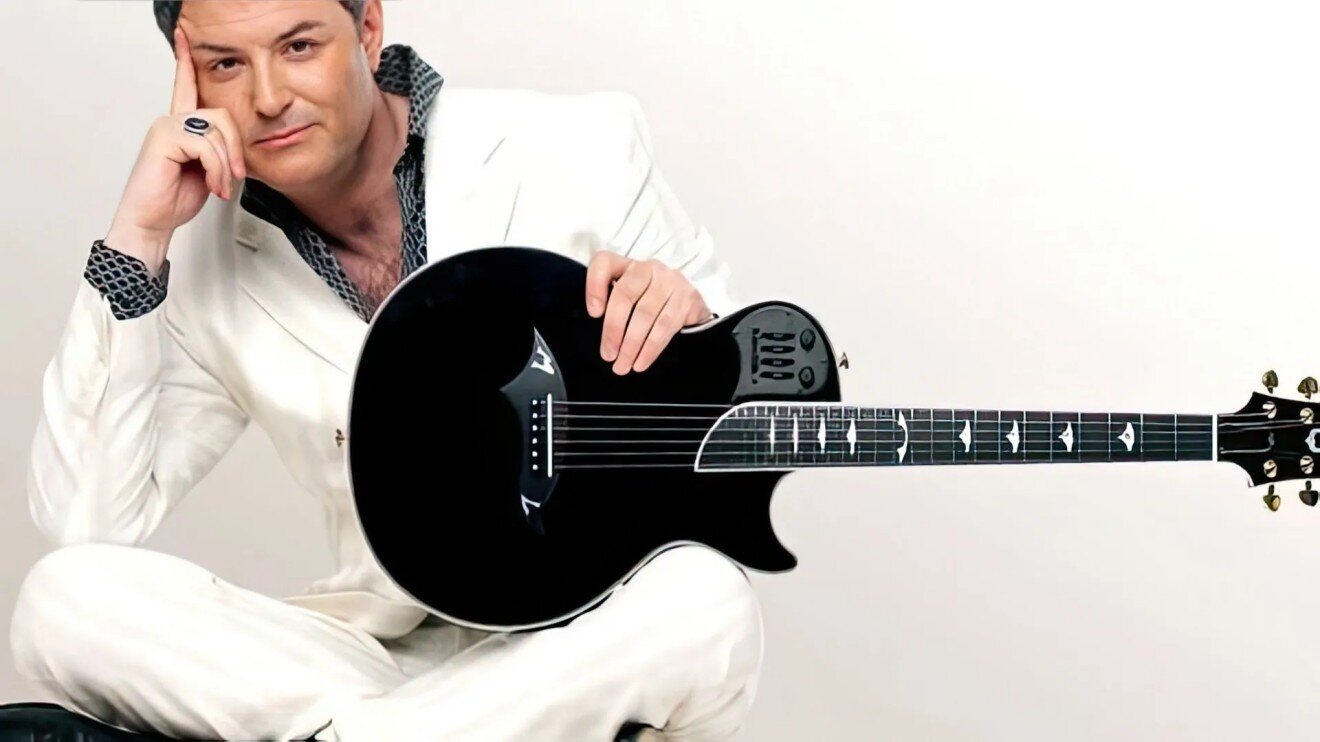
The song «Videnie» («A Vision»), popularly known as «The Girl-Vision,» became one of the most recognizable hits of 1990s Russian popular music. Written by Maxim Leonidov, it not only defined his solo career but became a cultural phenomenon of the era.
Maxim Leonidov: from Sekret to a solo career
Maxim Leonidovich Leonidov was born on February 13, 1962, in Leningrad, into a family of actors from the Leningrad Academic Comedy Theatre. His parents, Lyudmila Alexandrovna Lyulko and Leonid Yefimovich Leonidov (born Shapiro), were both Honored Artists of the RSFSR, which more or less predetermined their son’s creative path.
Maxim received his musical training at the Glinka Choral School attached to the Leningrad State Academic Capella, graduating in 1979. Later, in 1983, he graduated from LGITMiK (the Leningrad State Institute of Theatre, Music, and Cinematography), studying under Arkady Katsman and Lev Dodin.
Leonidov did his military service with the Song and Dance Ensemble of the Leningrad Military District, where he met Nikolai Fomenko and Yevgeny Oleshev – future collaborators in his musical career.
The Sekret years
In 1983 Maxim Leonidov became one of the founders of the legendary beat quartet Sekret. The band also included Nikolai Fomenko, Andrei Zabludovsky, and Alexei Murashov. The group began performing professionally in 1985 and quickly won over Soviet youth.
Alongside his work with the band, Leonidov built a solo career. In 1985 he appeared on the TV program «Dobro Pozhalovat’» («Welcome»), and in 1987 he released his debut solo EP, «Priznanie» («Confession»), on the Melodiya label, featuring four songs by composer Yakov Dubravin.
From 1984, Maxim Leonidov hosted the Leningrad TV program «Kruzhatsya Diski» («The Records Spin»), co-hosting alongside a talking parrot named Vaka. Journalist Leonid Parfenov, writing in the newspaper «Sovetskaya Kultura,» called the show «made skillfully and with taste,» praising the choice of host.
Writing «Videnie»
After leaving Sekret in 1989, Maxim Leonidov turned his full attention to his solo career. Among the first and most significant hits of this period was «Videnie,» written in the mid-1990s.
How it was written
The song was written during filming for the TV show «Ekh, Dorogi» («Ah, the Roads»), which Maxim Leonidov co-hosted with Andrei Makarevich. The project was about road trips by car, and it was during one of the trips, in France, that the famous song was born.
In Leonidov’s own words, the song «wrote itself by accident,» as many of his songs did. The key phrase – «I looked back to see whether she’d looked back to see whether I’d looked back» – had been running through his head for a long time, but he didn’t know what to do with it.
The song took its final shape during filming for an episode on the French Riviera, in the town of Villefranche. Leonidov had one day off, during which he wrote both the music and the lyrics in about an hour, sitting in a lounge chair under the French sun.
The personal story and its dedication
By the time he wrote the song, Maxim Leonidov had already divorced his first wife, actress Irina Selezneva, and had fallen for a young actress, Anna Banshchikova. It was to her that he dedicated the future hit, something he hasn’t hidden to this day.
Interestingly, Anna Banshchikova herself, who became Leonidov’s second wife (from September 1999 to 2003–2004), has said that Maxim dedicated many songs to her that, in her opinion, were far better. She wasn’t especially fond of «The Girl-Vision» itself, finding it too childish for her taste.
Musical features and influences
As often happens with popular hits, «Videnie» was quickly suspected of plagiarism. Leonidov himself openly admitted that the line «I looked back to see» was indeed borrowed from a «cheerful little blues number» by musician Popa Chubby. He stressed, however, that only the line was borrowed – the story, the music, and the mood were entirely his own.
The song is written in the lyrical style characteristic of Leonidov, blending elements of rock ballad and pop music. The melody is instantly memorable, and the lyrics are built on a contrast between the mundane («an ordinary gray Petersburg evening») and romantic reverie («a girl, or maybe a vision»).
Cultural significance and influence
«Videnie» became more than just a popular song – it became a cultural phenomenon. It secured a lasting place in the golden fund of 1990s Russian pop music and had a significant influence on many other performers.
The song played a real role in many people’s lives and became a kind of anthem of the era’s romanticism. Maxim Leonidov himself has admitted that after «The Girl-Vision,» he went through a period, like many self-absorbed performers, of «strutting around with a peacock’s tail.»
Impact on his career
The success of «Videnie» firmly established Maxim Leonidov as a standalone artist, capable of writing hits outside the framework of Sekret. The song became the calling card of his solo work and shaped the direction of everything that followed.
In 1996, after returning from Israel, where he had lived from 1990 to 1996, Leonidov founded the band Hippoband, which still exists today. Its core lineup consisted of professional musicians: composer and guitarist Vladimir Gustov, keyboardist Yevgeny Oleshev, and bassist Yuri Guryev.
The music video
In 1996 a music video was filmed for «Videnie,» which received heavy rotation on Russian television. The video only added to the song’s popularity and became one of the defining music videos of the mid-1990s.
The video’s visual style matched the song’s romantic, faintly melancholic mood, depicting a lyrical hero wandering the city in search of his vision.
Discography and its place in his body of work
«Videnie» appeared on various albums and compilations by Maxim Leonidov. It became part of his concert repertoire and is still performed at his shows today.
Within Leonidov’s discography, the song occupies a special place, representing the transitional period between his work with the band and his solo career – a bridge between the Sekret era and the next stage of his artistic life.
Live performances
«Videnie» is a fixture of Maxim Leonidov’s concert programs. The song is always met with enthusiastic applause and often performed as an encore. For many fans, it has become a symbol of an entire era in Russian music.
Literary and poetic features
The lyrics of «Videnie» are a fine example of the lyrical poetry characteristic of 1990s Russian pop music. The songwriter uses the contrast between prosaic reality and romantic dreaming.
One feature of the lyrics is their circular structure: the song opens and closes with the theme of searching for the mysterious girl. The refrain, with its famous line about looking back, became a catchphrase used in all kinds of contexts.
Poetic imagery
The song’s central image is a mysterious girl, balanced somewhere between reality and vision. That image echoes the romantic tradition in literature and music, in which a woman appears as an unattainable ideal.
Comparing the girl to a caravel sailing over green waves creates a vivid poetic image, one easily remembered and repeated by listeners.
Influence on popular culture
«Videnie» had a significant influence on 1990s Russian popular culture. The song became part of the collective memory of the generation that came of age during that decade.
The famous line from the refrain came to be used in all sorts of contexts – from everyday conversation to literary works. It entered the era’s stock of cultural references and continues to be used in contemporary culture.
Influence on other performers
The success of «Videnie» inspired many performers to write songs in a similar style and mood. The song became something of a benchmark for the lyrical ballad in Russian pop music.
Many musicians have noted Maxim Leonidov’s influence on their own work, particularly in writing lyrical texts and crafting melodies.
How it’s viewed today
Decades after it was written, «Videnie» remains a popular song. It regularly airs on the radio, appears in retrospective programs, and is performed at concerts.
New generations of listeners keep discovering the song, finding in it a reflection of the eternal themes of love, searching, and romantic longing. It has become a classic of Russian pop music that has outlasted its era.
Conclusion
Maxim Leonidov’s song «Videnie» became a landmark work of 1990s Russian popular music. Written during the songwriter’s creative prime, it brought together a personal story, poetic imagery, and musical craft.
«Videnie»’s influence on Russian musical culture is hard to overstate. The song not only defined Maxim Leonidov’s solo career but became part of the collective memory of an entire generation. Its lines continue to surface in all kinds of contexts, confirming its status as a genuine classic.
The story of how «Videnie» was written and how it has lived on reflects important processes in Russian culture during a transitional era, when new artistic traditions and aesthetic values were taking shape. The song remains relevant today, continuing to resonate with listeners across generations.