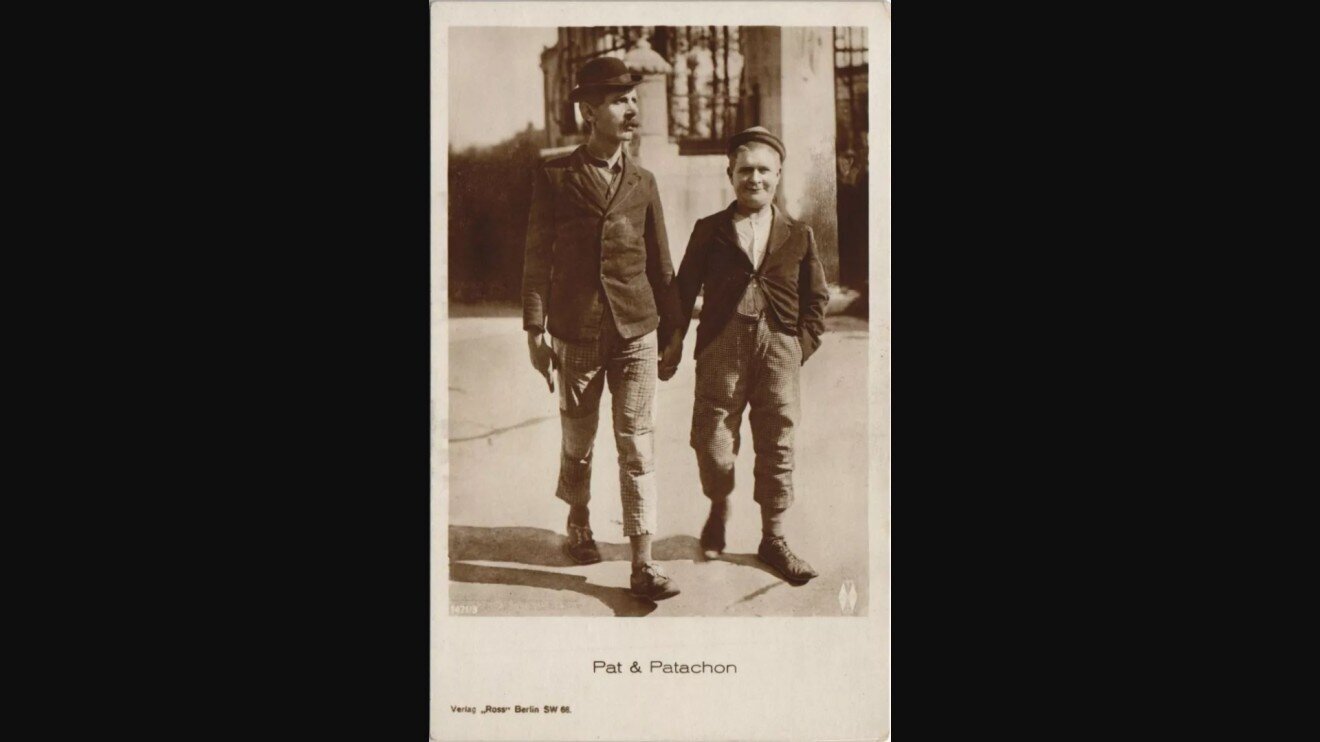
A legendary Danish comedy duo who became one of the first international phenomena in the history of 1920s cinema.
Origins
The duo «Pat and Patachon» (original Danish name — «Fyrtårnet og Bivognen,» literally «The Lighthouse and the Sidecar») formed in 1921. It consisted of two actors with strikingly contrasting looks:
- Carl Schenstrøm (1881-1942) — a tall (188 cm), thin actor with a long, mournful face, who played Patachon («the Lighthouse»). In the international duo he took the name «Patachon.»
- Harald Madsen (1890-1949) — a short (157 cm), stout actor with a round face, who played Pat («the Sidecar»). In the international version his character was named «Pat» — a short, punchy nickname fitting his stocky build.
Their creative partnership came together thanks to Danish director Lau Lauritzen Sr., who saw the comic potential in the contrast between their figures. Lauritzen initially shot a short film with them as an experiment for the film company «Palladium,» but its unexpected success led to the creation of a full-fledged duo.
The Era of Popularity
The duo’s peak popularity fell in the 1920s — the golden age of silent film. Between 1921 and 1940 they appeared in more than 50 feature and short films. The best known of these include:
«Don Quixote» (1926) — a loose interpretation of Cervantes’s classic novel
«A Trip to Mars» (1924) — one of the earliest science-fiction comedies in cinema
«Pat and Patachon in America» (1930) — the duo’s attempt to conquer Hollywood
The duo’s comic style was built on the contrast between their looks and personalities. Patachon (Schenstrøm) usually played the enterprising but clumsy leader, while Pat (Madsen) played his loyal but slow-witted companion. Their films were marked by physical comedy, stunts, and pantomime, which made them accessible to audiences in different countries regardless of language.
The duo gained international fame; their films were shown successfully not only in Europe but also in the USA, Japan, and even the Soviet Union. It was during the process of international distribution that the names «Pat and Patachon» arose, becoming especially popular in Russia and Eastern Europe. These names carry no particular linguistic meaning — they were invented as catchy, memorable nicknames for foreign audiences. Different countries called the duo by different names: in France, «Doublepatte et Patachon»; in Germany, «Der Lange und der Kurze» («The Tall One and the Short One»); in Spain, «Gordo y Flaco» («Fat and Skinny»).
Fun Facts
- The names «Pat and Patachon» are a result of localization for the international market and carry no particular meaning; they were chosen for how they sounded and how easy they were to remember.
- Interestingly, the international adaptation created some confusion: in the original, the «Lighthouse» (the tall one) was Schenstrøm’s character, but in the Russian version he became «Patachon» — a name with an augmentative suffix, even though it would have made more sense to give that name to the stout Madsen.
- The duo was so popular that their images were printed on postcards, candy boxes, and other merchandise all across Europe.
- In the Soviet Union their films were shown with great success, despite censorship of foreign pictures.
- Pat and Patachon are considered the forerunners of many comedy duos.
- The actors performed together until the early 1940s, creating one of the most enduring comedy partnerships in the history of early cinema.
The Decline of Their Career and Their Legacy
The arrival of sound film in the late 1920s posed a serious challenge for the duo. Their first sound films were less successful than their silent work. This was partly because the magic of their comic style relied mainly on visual humor and pantomime.
Despite attempts to adapt to the new era, the duo’s popularity gradually faded. Their last joint film was made in 1940. Carl Schenstrøm died in 1942, while Harald Madsen continued to act as a solo performer until his death in 1949.
The influence of Pat and Patachon on world cinema is hard to overstate. They not only created one of the first recognizable international film brands, but also laid the groundwork for many future comedy duos. Their comic formula — «tall and thin plus short and fat» — became a classic and was later used by many comedians.
In Denmark, Pat and Patachon are still considered a national treasure. Their films have been restored and included in the Danish cultural canon. In 1994, the Danish Film Institute released a major retrospective of their work, introducing a new generation of viewers to the duo’s films.
In the USSR, the duo’s heirs were considered to be the pair of People’s Artists of the Ukrainian SSR, actors Yukhym Berezin («Shtepsel») and Yuriy Tymoshenko («Tarapunka»). The duo of a policeman (Tymoshenko) and an electrician (Berezin) debuted in 1941, was relaunched after the war, and it was then that the stage names Tarapunka and Shtepsel appeared. The duo performed for 40 years, until Tymoshenko’s death in 1986.