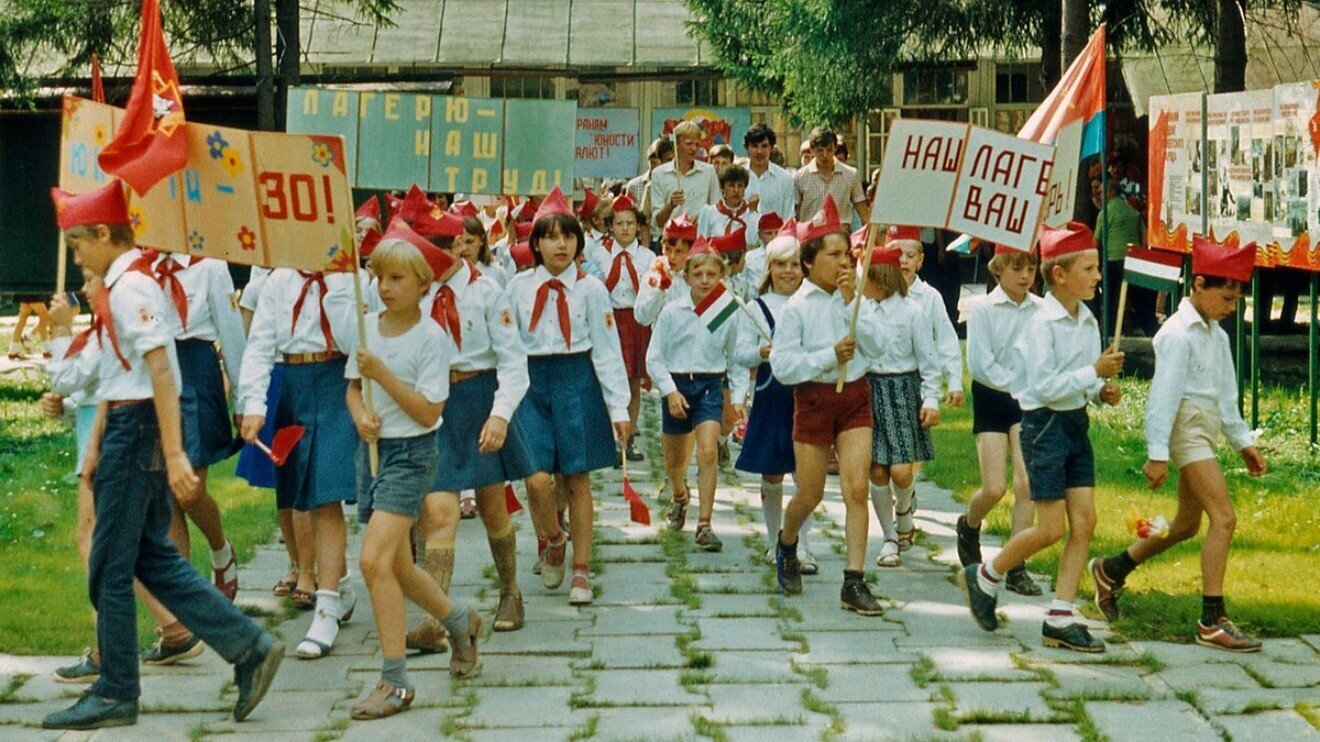
A Pioneer camp was an educational and recreational institution in the USSR, intended for the temporary stay of Young Pioneers and schoolchildren aged 7 to 15 during school holidays.
Origins
The first Pioneer camps appeared in the USSR in the early 1920s, a continuation of the Scouting movement but recast with communist ideology. The idea for their creation belonged to Z. P. Solovyov, chairman of the Russian Red Cross Society. The first camp of the new type was the famous «Artek,» opened in 1925 in Crimea.
Originally, Pioneer camps were organized by individual Pioneer troops, which traveled together, with their regular troop leader, to camps set up for a single summer season. Such a camp was, in effect, a continuation of the troop’s regular activities into the summer, with an emphasis on athletic and military-patriotic upbringing.
At «Artek,» in 1927, a full-time counselor position was introduced for the first time, and the practice began of forming troops directly at the camp rather than bringing them ready-made. This model became the template for the entire Soviet Pioneer-camp system.
Organizational structure
Pioneer camps were run by a variety of organizations:
- Trade unions
- Komsomol organizations
- Economic enterprises
- Collective and state farms
- Public education authorities
- Public health authorities
- Physical culture and sports committees
In the postwar period, most camps were organized along trade-union or departmental lines – run by enterprises and institutions for the children of their employees. A camp’s level of material support depended directly on its sponsoring enterprise’s budget.
Types of Pioneer camps
By location and format
Out-of-town camps were located on the outskirts of cities, usually in scenic settings. Children stayed there around the clock for the full duration of the session.
Day camps were run without overnight stays, usually based at schools. Children attended during the day only.
Tourist camps were tent camps set up in forests or on the shores of a sea, lake, or river, where the program centered on hiking and living close to nature.
By specialization
Sanatorium camps served therapeutic and preventive-health purposes. They drew on natural healing factors (climate, mineral waters) combined with physical therapy, therapeutic exercise, and medically prescribed diets.
Health-improvement camps focused on strengthening children’s health through sports and active recreation.
Sports camps had an intensive athletic focus, aimed at developing children’s physical abilities.
Military-sports camps had a notably rigorous character. Children there received basic military-sports training, including land navigation, marksmanship, and survival skills for extreme conditions.
Specialized camps were created for children with particular interests: young technicians, naturalists, geologists. Such camps ran programs tailored to their specific focus or theme.
By ideological orientation
Camps for Pioneer and Komsomol activists gathered schoolchildren who led Pioneer detachments and troops, for ideological training.
Work-and-rest camps were the most common form of organizing socially useful labor for older students. Their main goal was to instill a love and respect for work.
The USSR’s largest Pioneer camps
By the 1980s, the USSR had up to 40,000 out-of-town Pioneer camps, hosting roughly 10 million children a year. The largest and best-known were the camps of All-Union significance:
- «Artek» (Crimean Oblast, Ukrainian SSR) – the most famous Pioneer camp, an international hub
- «Orlyonok» (Krasnodar Krai, RSFSR) – one of the largest camps on the Black Sea coast
- «Okean» (Primorsky Krai, RSFSR) – the Far Eastern hub of the Pioneer movement
- «Alye Parusa» («Scarlet Sails,» Kuibyshev Oblast, RSFSR) – a camp on the Volga
- «Molodaya Gvardiya» («Young Guard,» Odessa Oblast, Ukrainian SSR) – a camp on the Ukrainian coast
- «Zubryonok» (Minsk Oblast, Byelorussian SSR) – the Belarusian Pioneer hub
- «Kosmos» (Krasnodar Krai, Anapa, RSFSR) – now the resort «Zhemchuzhina Rossii»
«Artek» served as a special international hub, hosting official foreign delegations and children from countries in the socialist bloc.
Infrastructure and layout
A typical Pioneer camp was a fenced compound with a gate, containing:
- An entrance plaza
- Dormitory buildings for the children
- A dining hall
- A medical building
- A cinema or clubhouse
- A gymnasium
- A swimming pool (in larger camps)
- A stadium and sports fields
- Shower facilities
- A library
- Rooms for hobby-club activities
- A radio room
- Guest quarters for staff specialists
- A garage
- A museum (in some camps)
Life at camp
Management structure
Camps formed temporary Pioneer detachments and troops. A troop usually consisted of 25 to 30 children of roughly the same age. A counselor worked with each troop – typically a college student or young professional, and a member of the Komsomol.
Various children’s amateur groups operated by interest: choirs, dance troupes, drama clubs, technical clubs, sports sections.
Daily schedule
Life at a Pioneer camp was strictly regimented. A typical day included:
- Wake-up and morning exercises
- Morning hygiene routines
- Morning assembly with the flag-raising
- Breakfast
- Troop activities and club work
- Beach time or sports
- Lunch and quiet hour
- Afternoon snack
- Evening activities
- Dinner
- Evening assembly with the flag lowering
- Lights out
Discipline
An important feature of Pioneer-camp life was moving from place to place in formation, accompanied by songs or chants. Children marched in formation to the dining hall, to assembly, on excursions. This instilled in them a habit of identifying with the collective.
Violations of the schedule earned reprimands, and activities outside the official routine were canceled. If a child strayed from the troop or fell out of a counselor’s sight, they could be declared missing.
The ideological component
Pioneer camps were not just a place of rest but an important instrument of ideological upbringing. They held:
- Political talks and lessons
- Meetings with veterans of war and labor
- Themed events tied to Soviet holidays
- The military-sports game «Zarnitsa»
- Waste-paper and scrap-metal collection drives
- Concerts and performances for the local population
Particular attention went to anti-religious education and to instilling a materialist worldview. Children were trained in collectivism, discipline, and unquestioning obedience to their elders’ instructions.
Wartime
Even during the Great Patriotic War, Pioneer-camp operations were never fully halted. By some accounts, camps operated even during the siege of Leningrad in the summer of 1942.
«Artek» was evacuated to the settlement of Belokurikha (Altai Krai), where it hosted Siberian schoolchildren for their holidays. In the summer of 1944 the camp resumed operations in a liberated Crimea.
Cultural legacy
Pioneer camps became an important part of Soviet culture. Feature films were made about them («The Bronze Bird,» «Welcome, or No Trespassing»), books were written, songs composed.
Many Pioneer-camp traditions – campfires, songs around the guitar, troop activities, sports competitions – became an inseparable part of children’s summer recreation and have survived in today’s children’s camps.
Symbols and paraphernalia
Pioneer camps had a rich set of symbols and paraphernalia:
- Red Pioneer neckerchiefs
- Pioneer badges
- Troop flags and banners
- Bugles and drums
- Traditional Pioneer songs
- Flag-raising and flag-lowering rituals
- Formal assemblies
- Pioneer oaths and laws
The central symbol was the red neckerchief – a mark of belonging to the Pioneer organization, worn at every official event.
The international dimension
The largest Pioneer camps, especially «Artek,» hosted children from countries in the socialist bloc and states friendly to the USSR. This was part of international communist propaganda and a way of showcasing the achievements of the Soviet system.
«Artek» hosted children from Bulgaria, Hungary, Vietnam, East Germany, Cuba, Mongolia, Poland, Czechoslovakia, and other countries. Special programs were arranged for foreign guests, showcasing the advantages of the socialist system.
Significance in Soviet society
Pioneer camps played an important social role in the USSR:
- They provided organized recreation for children during school holidays
- They let parents keep working without worrying about their children
- They contributed to children’s health
- They shaped a collectivist worldview
- They developed creative abilities through club activities
- They prepared future citizens of Soviet society
For many Soviet children, a trip to a Pioneer camp was the highlight of the summer holidays, leaving vivid memories for a lifetime. Camp vouchers were in short supply and were allocated through the enterprises and institutions where parents worked.
The USSR’s Pioneer camps were a unique phenomenon – a blend of children’s recreation, education, and ideological upbringing that had no direct equivalent anywhere else in the world.