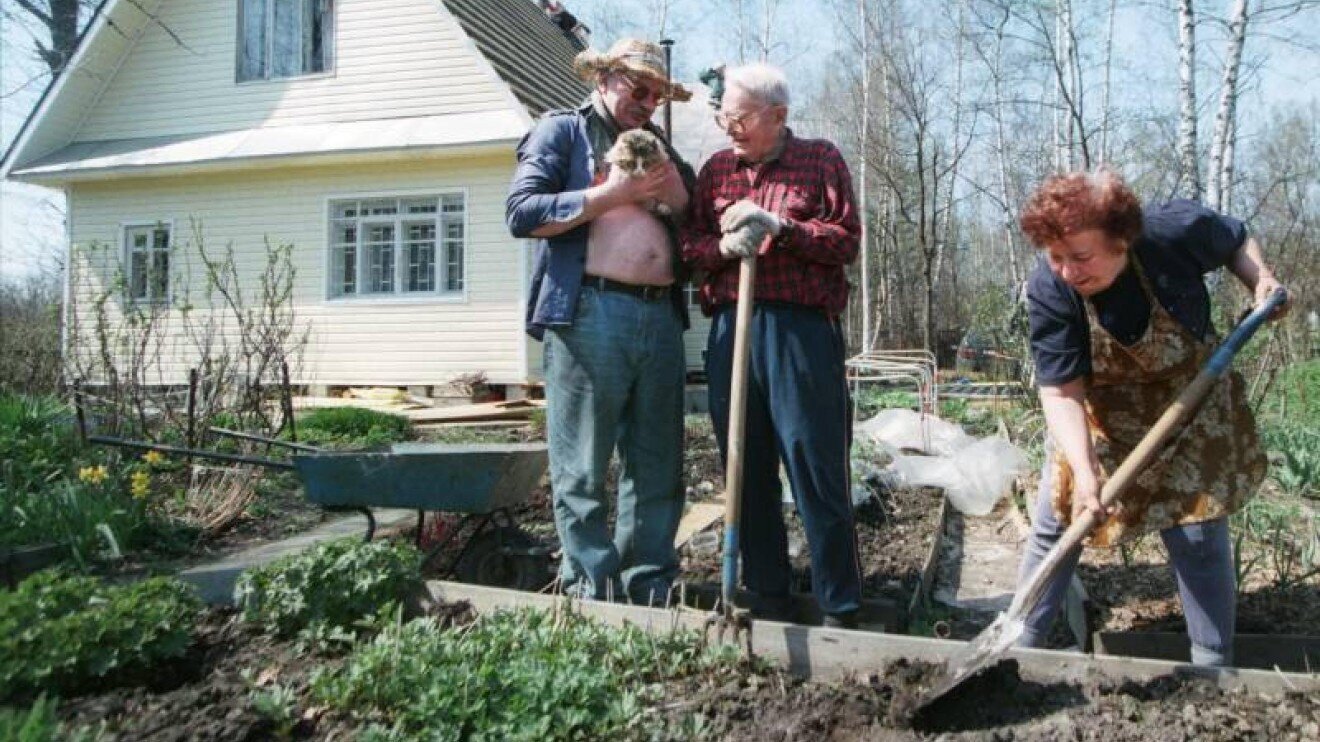
Three sotkas, six sotkas, eight sotkas — these figures were familiar to every Soviet person. Garden-and-vegetable plots became one of the defining phenomena of Soviet life, so distinctive that the word even entered the English language untranslated — "dacha." For millions of Soviet families, the dacha was not just a place to relax, but a source of food, a refuge from cramped city life, and the only accessible form of private property in a country where private property was formally not recognized.
Pre-revolutionary roots
The word "dacha" itself comes from the verb "davat'" ("to give") — the tsar would give plots of land to those who distinguished themselves in service. The first dachas in Russia appeared under Peter I. The ruler introduced the tradition of handing out land near St. Petersburg to officials, so that in summer they wouldn't scatter too far away, but stay "close at hand." But the practice became more widespread in the 19th century.
The country came to have many civil servants, professionals, and doctors who had no family estates of their own. But these people wanted to vacation outside the city, and had the money for such property. Some bought dachas, others rented them. Dacha life of that time was captured in the works of Chekhov, Gorky ("Summerfolk"), and Leonid Andreyev ("Petka at the Dacha").
Soviet Russia's inheritance
Soviet Russia inherited from pre-revolutionary Russia, among other things, a huge stock of country dacha houses and a tradition of dacha life. Both, however, were now folded into a socialist context: any free market in real estate was now out of the question.
The surviving "intelligentsia" strata, having lived to see the more relaxed times of the New Economic Policy (NEP), rediscovered their old, pleasant habits. The new class of Soviet officials followed their example. In 1927, the Council of People's Commissars and the All-Russian Central Executive Committee issued a joint decree, notable for the first official use of the term "dacha settlements." These were defined as "populated areas located outside city limits, whose primary purpose is to serve cities as sanatorium sites or places of summer rest."
Nomenklatura privilege in the 1930s
In the 1930s, dachas were allotted only to the "nomenklatura." Officials and writers built themselves enormous dachas at state expense. Construction was on such a scale that in February 1938 the Politburo adopted a resolution "On the Dachas of Responsible Workers," setting a maximum number of rooms for officials' dachas: up to 8 rooms for those with families, and up to 5 for those without.
In the first decades of Soviet power, dachas were the preserve of a narrow layer of the nomenklatura. Both Vladimir Lenin, the founder of the proletarian state, and his successors lived at state dachas. These dachas became a tool for binding the ruling elite together, since they were not private property — they were allotted for use only while an official remained useful to the state and displayed loyalty. Upon retiring, an official could count on a less prestigious, but still state-owned, dacha — again, on condition of "proper behavior."
From rest to farming: the transformation of the 1930s
In 1932, the government and the All-Russian Central Executive Committee decreed that land, including with existing structures, be allotted to cooperatives, state institutions, and enterprises, which would then distribute it among citizens. Such plots were granted for indefinite use, on condition that the cost of planned construction work would exceed the assessed value of the existing structures.
The decree led to widespread dacha construction. Most of the little houses, however, were tiny. A classic example is the settlement of Nov' near Razdory, on the Rublyovo-Uspenskoye Highway, where a two-room structure just over 15 square meters was considered sufficient for a family of four to live in.
But already in the 1930s, a transformation began: country plots shifted from places of rest to places of intensive labor. The recreational component gave way to the economic one. The cause was the terrible famine tied to the consequences of collectivization, industrialization, and militarization.
Vegetable gardens as a response to famine
To ease the catastrophic food situation somewhat, the authorities, in December 1933, launched the allotment of 1.5 million vegetable-garden plots to workers (200,000 of these in Moscow Oblast alone), on land adjoining factory territories. These plots were meant to be cultivated by their gardeners "in time free from work at the plant."
Plot sizes ranged from 12.5 to 25 sotkas. They were to remain in use by worker families for five to seven years. It was assumed that the land tracts set aside for gardening would, over time, become dacha settlements.
Postwar revival: 1949
The dacha question was revisited after the war. In the aftermath of the Great Patriotic War, the country faced food shortages. The government decided to give people the chance to grow their own fruit and vegetables. For this purpose, vacant plots in cities and towns, and territory not used by state farms and enterprises, were handed over.
The February 1949 resolution of the USSR Council of Ministers, "On Collective and Individual Vegetable Gardening and Horticulture for Workers and Employees," marked the start of collective and household gardening. In 1949, the USSR Council of Ministers ordered that workers who did not yet have a garden plot be given 6 sotkas within city limits, or 12 sotkas outside them.
The allotment scheme
The same scheme as before was used: "City and settlement executive committees allot land plots for workers' and employees' gardens to enterprises, institutions, and organizations, which in turn assign plots to their workers and employees." The period of use for a plot was limited to five years.
The principle in force was: one family, one plot. People received the land for indefinite use. Plots were managed by city and settlement executive committees. They "carved up" the territory and distributed it among enterprises, institutions, and organizations. Management then assigned plots to employees.
The best sotkas, located near the city or town, went to the families of fallen soldiers and disabled veterans of the Great Patriotic War.
Conditions and obligations
The recipient of land was obligated to work at the enterprise for five years. In addition, owners were given three years to develop the site. At minimum, they had to plant a garden and cultivate the land for vegetables. And no weeds allowed — a neglected plot meant immediate confiscation.
Churchill is credited with the pointed aphorism: "In the Soviet Union, almost nothing is permitted. And what is permitted is compulsory." When it came to vegetable and garden plots, this rule held fully. Point eight of the resolution states directly: "Workers and employees are obligated, within the first three years, to fully develop, through their own labor or that of family members, the land plots allotted to them for gardens, and to plant fruit trees and berry bushes."
The USSR Council of Ministers did not spare its time in spelling out, separately, a provision on planting currant and gooseberry bushes. The number of bushes was determined not by workers' personal preferences, but by the directives of city and settlement executive committees.
State assistance and restrictions
The state helped with development. Seeds, seedlings, fertilizer, and tools were not in short supply, and there was no need to travel far for them. If a family moved to another city, the land was taken back. But in that case, the new owner compensated for the costs incurred. The sum was set by local authorities.
If a worker moved to another region, he lost the right to use the plot, but was reimbursed for the expenses he had incurred.
The scientific basis for the six sotkas
Why did precisely six sotkas become the canonical size of the Soviet garden plot? Behind this lay not bureaucratic whim, but scientific calculation.
The vegetable-growing scientist Vitaly Edelstein began studying everything related to gardening back in pre-revolutionary times. His experience and findings helped the USSR fight famine during the war years. In 1944, he published the book "The Individual Vegetable Garden." The scientist not only laid out all the principles of gardening in detail, but spelled them out in figures.
Edelstein defined a list of crops that should be grown in every vegetable garden. This became the foundation for every Soviet gardener. He also calculated the annual vegetable-consumption norm for one adult — 500 kilograms. He then determined that 124.5 square meters were needed to produce such a yield.
This area was multiplied by the number of people in an average Soviet family. To the resulting figure, Edelstein added space for an orchard. That is how the scientist arrived at the famous six sotkas, or 600 square meters.
In practice, not everyone got such an area. Some families made do with 3-4 sotkas. In Siberia and the Far East, 8 sotkas were given, in view of harsher climate conditions.
The 1950s: the rise of gardening cooperatives
In the 1950s, the concept of "dacha-construction cooperatives" appeared. These organizations, formed under local executive committees at the petition of enterprises and institutions, served as owners and a kind of "management company" for dacha settlements.
From the mid-1950s, employees of one or several enterprises would band together to form a gardening cooperative. Colleagues then became dacha neighbors, and trade unions made sure the land was used as intended. Cooperatives were formed not only by employees, but by residents of a building, or members of a single social group, such as pensioners.
Accordingly, ordinary citizens could only get a plot as a shareholder of such a cooperative. Plots, of course, were not chosen at will by the gardeners, but distributed at a general meeting.
It was specifically stipulated that garden houses must be built according to standard designs, and construction "to individually approved designs" was permitted only as an exception.
The ban on individual construction: the Khrushchev-era crackdown
The Soviet leadership had an ambivalent attitude toward dachas. They corrected, of course, the shortcomings of the socialist economy, but on the other hand, they discredited it too. The nomenklatura turned dachas into country residences, while dacha-owners from worker families began showing "petty-bourgeois" and "possessive" instincts, seemingly wiped out entirely by the revolution.
Nikita Khrushchev grew so angry that, in 1960, the Council of Ministers decreed an end to allotting land for individual dacha construction and to selling dacha buildings to citizens. A resolution of the USSR Council of Ministers, No. 1346, dated December 30, 1960, "On Individual Dacha Construction," delivered an unpleasant New Year's surprise to the public.
The document carried a stern warning: citizens who rent out dacha buildings, trade in plots, or use hired labor would not only lose the right to use the land, but would face "prosecution as established by law."
The Brezhnev-era dacha boom
The way out of the situation was sought in further developing collective gardening. Only under Brezhnev did gardening cooperatives receive official permission to build a "summer garden house," and dacha construction spread on a mass scale across the entire Soviet Union.
The 1966 resolution — the birthday of the mass dacha
On March 18, 1966, the Council of Ministers of the RSFSR and the All-Union Central Council of Trade Unions decreed that enterprises, institutions, and organizations be allotted land tracts divided into plots of 6 sotkas (8 sotkas in Siberia and the Far East). This date can, in fact, be considered the birthday of the classic Soviet dacha, and of one of the main symbols of Soviet reality.
The foundation of the land fund was made up of land from the state land fund, the state forest fund, subsidiary rural farms, and "low-productivity land of state and collective farms." Dacha-owners gained the right to build "summer-type garden houses" with a usable area of 12 to 25 square meters. Terraces of up to 10 square meters per family were also permitted. Building houses of 30 square meters, however, was not allowed. Why not? Because we have socialism, that's why.
The dacha boom in the Union happened precisely in the 1960s, when cooperatives were allowed to build "summer-type garden houses." Now people not only worked in the garden here, but spent their leisure time, resting from the bustle of the city. From then on, people began building dachas en masse, many of which still stand today, or became the foundation for a full-fledged country house.
The scale of the dacha movement
Under the RSFSR Council of Ministers resolution of April 12, 1965, "On Collective Vegetable Gardening for Workers and Employees," the allotment and assignment of land plots for these purposes was carried out "to enterprises, institutions, and organizations for a term of up to five years."
By June 1986, more than 6.6 million working people had developed 426,000 hectares of land, creating 44,000 gardens. Every year, more than 20 million workers and their family members spent their vacation time, weekends, or summers at collective gardens.
The Perestroika period marked the start of dacha construction's flourishing. The country had 44,000 collective gardens, where 20 million working people spent their weekends and vacations. By various estimates, 25% to 35% of Soviet families had acquired garden plots.
Strict regulation
The USSR had strict restrictions on the size of a dacha and its plot, which only began to be lifted gradually in the late 1980s. Building second floors and basements was categorically forbidden.
The fight against violations
But the dacha life of many Soviet citizens did not match their leadership's high expectations, and was full of many sins. In the text of a December 29, 1984 resolution, the government complains that "the construction of summer garden houses is often carried out to designs not approved through established procedure," that "under the guise of summer garden houses, dacha-type mansions with garages and bathhouses are being built," and that "unspecialized construction organizations are being brought in" to do the work.
All of this "leads to serious departures from the moral and ethical norms of the Soviet way of life."
Shadow economy and shortages
Owning a greenhouse was not formally forbidden, but the Criminal Code contained articles on "Parasitism" and "Illegal Enterprise." This meant that if a person grew something in a greenhouse and sold it at the market to make a living, working nowhere else, they were required to license this activity and pay high taxes on it.
Understandably, few wanted to do that. As a result, people would take jobs, say, as paramilitary security guards at some factory, working a "one-day-on, three-days-off" schedule, working their greenhouses on their days off, while elderly pensioner women, whom market inspectors didn't bother much, sold the greenhouse produce. In the southern regions of the USSR, this system was well established, and greenhouse owners had serious income, especially from early vegetables and berries.
Some cunning citizens managed to earn money reselling dachas or renting them out, which was forbidden. The most harmless practice was selling surplus produce. The law allowed growing produce only for personal use, no commerce.
The building-materials problem
All this deeply irritated a population that also suffered from being unable to obtain basic materials for construction. Because of the total shortage, building "dacha houses" happened entirely in the shadow economy. Hiring workers or a truck for hauling — everything was a problem.
Building and repairing both dachas and greenhouses required building materials, plastic film, glass, and fuel. All of this had to be "obtained," each person scheming as best they could, since enormous demand for all of it exceeded state retail's modest supply by dozens of times.
It's no accident that KGB chairman Vladimir Semichastny forbade employees of his agency from acquiring or building dachas, fearing that otherwise they would be corrupted by the need to deal with the black market.
The everyday life of the Soviet dacha-owner
The dacha life of the ordinary Soviet citizen was extremely modest. Water was drawn from wells and boreholes; for sewage there was a cesspit with a homemade "birdhouse" outhouse on top. Old, sagging sofas, out-of-fashion étagères and chests of drawers were all sent off to the dacha. Basically, all sorts of junk got hauled out there, since anything might come in handy around the place.
The dacha community
Dacha life encouraged closer, more intimate contact with neighbors, as in the old communal apartments. Families became friends there, shared canning recipes, swapped seeds, cuttings, and gardening literature. Many still recall the dacha life of those times with nostalgia, for its warmth and simple sociability.
Back then, there weren't solid tall fences everywhere — it wouldn't have occurred to anyone to build them. And even if they'd wanted to — what would they have built them out of?
Why did people work so hard at their dachas?
Heading out to the dacha every weekend, from spring to autumn, became a tradition. One need only recall the film "Moscow Does Not Believe in Tears," which showed the very start of the garden-plot movement. Soviet sociologists were quite preoccupied with a question: why did people work themselves to exhaustion on their plots, and call it "rest"?
Getting to the dacha meant first an hour, sometimes two, on a commuter train, then on foot or by bus, then working non-stop on your six sotkas, and then — the trip home again. What for?
Economic necessity
The main reason the state made this concession was self-supply of fruit and vegetables, since establishing reliable retail trade in them simply wasn't working. Dachas became the salvation of tens of millions of people from a total shortage of food.
Besides dachas, where people grew vegetables and fruit, people also got plots from their workplaces for growing potatoes. Basically, they rested from their main job right there in the garden beds. Potatoes, tomatoes, and strawberries from the garden plots became an important supplement to a diet the state could otherwise only provide through ration coupons.
A psychological outlet
Only through indirect questioning did sociologists manage to uncover the main psychological reason driving people to work so intensely. In the heavily regulated Soviet world, with its standardized housing, the dacha offered the chance for a creative approach — building and arranging a plot however one saw fit — even within the prescribed size limits.
Homo sovieticus felt like a full-fledged owner there, creating his own world. Besides, garden plots were seen as a means of healthy recreation, and perhaps also as an outlet for unspent energy — which might otherwise flow into channels the authorities would not welcome.
Ambivalence and paradoxes
Soviet law and Communist ideology did not recognize private property, though in reality it existed. Formally, dacha plots belonged to enterprises and cooperatives; in fact, they belonged to citizens, and were passed down by inheritance.
The ambiguity of this arrangement bred confusion in views and assessments, which sometimes led to the silliest incidents. In 1959, for instance, "Ogonyok" magazine ran two pieces in the same issue — one ("For Myself, My Children, and My Grandchildren") spoke positively of a worker at the "Serp i Molot" factory and passionate amateur dacha-gardener, while the other (the satirical piece "Spiders") exposed the accursed private-property zealots earning "unearned" income from their dachas.
At the same time, individual dacha construction was banned — to build a dacha, one had to join a gardening cooperative or dacha cooperative.
Gorbachev-era liberalization
Gorbachev lifted many dacha restrictions in 1987. A resolution of the Central Committee and Council of Ministers, No. 1079, dated September 19, 1987, "On Additional Measures to Develop Citizens' Personal Subsidiary Farms and Collective Gardening and Vegetable-Growing," established:
"Members of gardening cooperatives have the right to build, on the land plots allotted to them, heated garden houses with a footprint of up to 50 square meters, not counting the area of a terrace (veranda) or attic, as well as outbuildings (freestanding or attached) for keeping poultry and rabbits, storing tools, and other needs. Greenhouses and other insulated-ground structures for growing crops may be built on the plot. A basement under the house or outbuilding is permitted. The previously existing restrictions on developing garden plots are hereby abolished."
Nomenklatura dachas: a different reality
Dacha problems in the USSR did not touch those in power. The authorities looked with suspicion on the revival of possessive instincts among ordinary dacha-owners, but the nomenklatura itself turned dachas into country residences.
Writers' and officials' estates
The party-favored playwright Alexander Korneichuk — Hero of Socialist Labor, Central Committee member, deputy, and laureate — built himself a residence in Plyuty, near Kyiv. There he erected, to an individual design (the architect, incidentally, was Vladimir Zabolotny, designer of the Verkhovna Rada building), a handsome two-story cottage with a garden. He also had an asphalt road built to his dacha from the Obukhiv highway.
Generals' and marshals' residences
Since Stalin's time, magnificent dachas for high-ranking figures had been built outside Moscow, in the settlements of Dannaya Polyana, Barvikha, and Gorki-6. Here is one general's dacha: 341 square meters, 9 rooms, marble and granite. A plot over 2 hectares, with a pond. The cost of this dacha came to 343,000 rubles.
Marshals had even roomier dachas, and larger plots. Marshal Akhromeyev lived at a dacha over 1,000 square meters in area, with a plot of 2.6 hectares. His colleague Marshal Sokolov had a 1,432-square-meter dacha on a plot of more than 5 hectares. Central Committee secretary Mikhail Suslov was allotted, in 1953, a 7-hectare plot with 400 fir trees, 30 maples, and a two-story building with an area of 2,400 square meters.
Soldiers' letters to the Central Committee
On how the generals' and marshals' dachas in the Moscow-region town of Arkhangelskoye were being built, soldier-builders working on these sites wrote to the CPSU Central Committee in 1957:
"We ask you to forgive us, Comrade Khrushchev, for taking you away from important state affairs. But we believe that if we stay silent, it will harm our forward movement, the building of socialism in our country. The matter is this: We, the soldier-builders of the Arkhangelskoye construction site at the military sanatorium 'Arkhangelskoye' in Krasnogorsk District, Moscow Oblast, are currently building dachas for Marshals Vasilevsky and Grechko, and Colonel-Generals Zheltov, Smirnov, Nedelin, and others. In total, about twenty dachas are planned in the area of the 'Arkhangelskoye' sanatorium. In addition, dachas for Marshals Konev, Meretskov, Timoshenko, and others — about ten dachas — have already been built earlier. The dachas are all large, two-story, made of stone. The plots allotted are large, 2-3 hectares of land. They are fenced with high walls, with German shepherd guard dogs behind them. The surrounding population — collective farmers and workers — say: there used to be just one estate here, that of Prince Yusupov, and now look how many little 'Yusupovlets,' Soviet landlords, there are. We believe such a concentration of dachas should not be allowed. Tour groups come here, and they see everything — they see the former Yusupov estate, now a museum, and they see dozens of newly built and under-construction estates for marshals and generals, with servants' quarters, garages, poultry houses, and other outbuildings, and large gardens. And there are also many ministers' dachas here, built earlier..."
The paradox of the Soviet dacha
By the 1980s, large Soviet cities were surrounded by a ring of garden plots. Dacha-life traditions took shape there, somewhat reminiscent of the pre-revolutionary ones known from works like Chekhov's or Gorky's "Summerfolk," or Leonid Andreyev's story "Petka at the Dacha."
The authorities looked with suspicion on the revival of possessive instincts, but could do nothing about it any longer. A paradoxical situation thus arose — a country poor by Western standards was populated by people who effectively had two dwellings. This was one of the puzzling oddities of the system, incomprehensible to an outside observer: poor people, yet owners of a dacha.
The six sotkas became not simply the area of a plot, but a fragment of the Soviet person's consumer ideal. Every USSR resident dreamed of owning an apartment, a car, and a dacha. Those who possessed this set were considered well-off by Soviet standards. A savings book, jewelry, an annual vacation in the south were mere additions to this high status.
But the "Soviet dream" often remained unattainable for most. Even those six sotkas weren't so easy to come by. In elementary school, a teacher might ask, "Class, who has a dacha?" — and for those who couldn't raise a hand, this became a source of awkwardness and shame.
The dacha as salvation
For families of engineers at Ural research institutes, for factory workers, for teachers and doctors, the three, four, or six sotkas of a garden plot became a vitally important lifeline. When meat and butter were rationed by coupon, the only other treats left were potatoes, tomatoes, and strawberries from the garden plots.
This was not a luxury, but a necessity. Dachas staved off hunger, provided vitamins, and made it possible to put up preserves for winter. Jars of cucumbers, tomatoes, compotes, jam made from berries — all of this was the fruit of exhausting labor on those dacha sotkas.
The social significance of the dacha
The dacha in the USSR served many functions:
- Economic — supplying the family with vegetables, fruit, and berries under conditions of shortage
- Psychological — the chance to feel like an owner, a creator of one's own world
- Social — a place for socializing, forming dacha communities
- Recreational — a rest from the city, even if in the form of hard physical labor
- Ideological — an "outlet" for energy into a safe channel
Legacy
Such an arrangement could only exist under "developed socialism," with its minimal property taxes and cheap electricity. Since dacha land plots were held exclusively as usage rights, no title documents were ever issued for them.
In 1990, a lengthy land reform began, one that could not bypass the dacha sector. On December 24, the right to private ownership of land was restored. In December 1992, Boris Yeltsin signed a law under which citizens of the Russian Federation gained the right to sell to other Russian citizens "land plots for personal subsidiary and dacha farming, gardening, and individual housing construction."
According to historians' calculations, the number of dacha-owners doubled between 1990 and 1996. It was precisely during this period that most of the modern stock of country houses and plots took shape.
Conclusion
Garden-and-vegetable plots became one of the most characteristic phenomena of Soviet life. They embodied the system's paradoxes: formally forbidden private property that in fact existed; exhausting labor called rest; a luxury not available to all, yet a necessity for survival.
Three sotkas, six sotkas, eight sotkas — these figures were familiar to everyone. On these plots, people grew potatoes, tomatoes, strawberries. This is what the children of engineers at Ural research institutes grew up on — on potatoes and bread, with potatoes, tomatoes, and strawberries as a vitamin supplement. Skinny and gawky, but knowing from childhood the value of labor on the land, and the taste of vegetables grown with their own hands.
The dacha became a symbol of the Soviet era — so significant that the word "dacha" entered the English language untranslated. And though the era itself has ended, the legacy of those six sotkas lives on in millions of plots across Russia, in the tradition of heading out of the city on weekends, in the skill of growing vegetables and putting up preserves for winter.