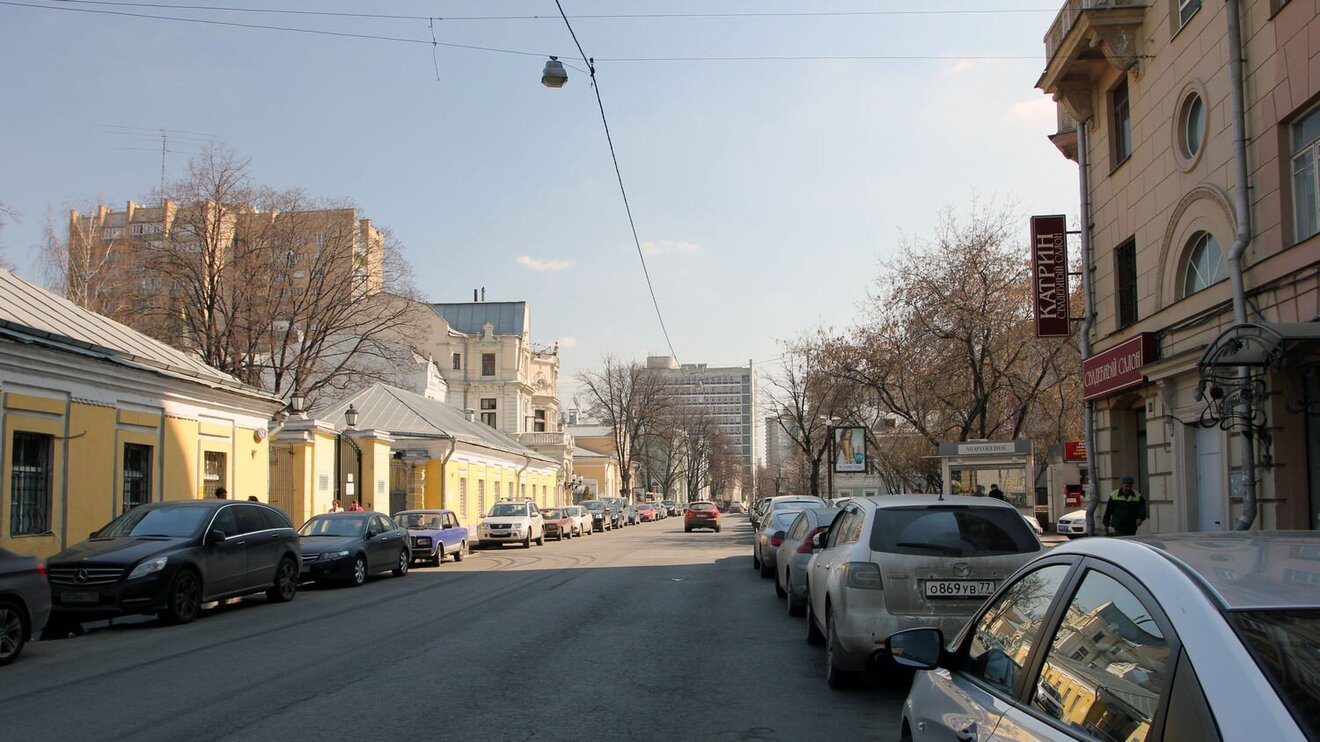
Povarskaya Street is one of the most prestigious streets in central Moscow, and its mention in the context of buying a six-room apartment in 1993 vividly captures the character's financial standing. At the time, owning property on Povarskaya was a symbol of belonging to the new Russian elite — successful businessmen, bankers, and "New Russians," who had amassed fortunes during the economic reforms of the early 1990s.
Historical significance and architectural value
Povarskaya Street took its name from the Povarskaya Sloboda ("Cooks' Quarter"), where in the 16th–17th centuries cooks who served the tsar's court had lived. The street runs from Bolshaya Nikitskaya to Novy Arbat, forming part of Moscow's historic center. By the mid-1990s, Povarskaya had preserved its distinctive architectural character — noble mansions from the 18th and 19th centuries lined the street, many of them federally protected architectural landmarks.
The street's architectural ensemble took shape over centuries. Empire- and Neoclassical-style mansions stood alongside early-20th-century apartment buildings. This historical development made Povarskaya one of the capital's most picturesque streets.
Povarskaya in the Soviet period
During the Soviet era, many of Povarskaya's mansions were nationalized and converted into communal apartments, or handed over to various state institutions. Embassies, representative offices of the Union republics, and research institutes were housed here. Building No. 44, for instance, held the representative office of the Kazakh SSR, while building No. 42 housed the Institute of Philosophy of the USSR Academy of Sciences.
Despite the crowding of its housing stock, Povarskaya retained its status as a prestigious neighborhood. Well-known figures from Soviet culture, science, and the party apparatus lived here. Its proximity to the center of power — the Kremlin and government buildings — made the area especially attractive to the nomenklatura.
Real estate on Povarskaya in the 1990s
With the start of economic reform and privatization, real estate on Povarskaya became a target of intense interest from Russia's newly rich. The privatization of housing, which began in 1991, made it possible to buy out communal apartments and merge them into spacious residences. A six-room apartment on Povarskaya in 1993 could cost anywhere from tens of thousands to hundreds of thousands of US dollars — enormous sums for the time.
A defining feature of the mid-1990s real estate market was its lack of transparency and its ties to the criminal world. Many deals were carried out through front men, often using strong-arm methods to "clear" living space of its previous occupants. Buying expensive real estate in central Moscow required not just significant financial resources, but a reliable "roof" — the protection of influential figures or criminal groups.
Social context and symbolism
By 1993, Povarskaya Street had become one of the symbols of the new Russia — home to bankers, entrepreneurs, and traders who had grown rich off the privatization of state property. Owning an apartment on Povarskaya displayed not just financial well-being but a certain social status. It was a way of declaring one's membership in the new elite that had replaced the Soviet nomenklatura.
The neighborhood's infrastructure matched its residents' status. Expensive restaurants, boutiques, and private clinics were nearby. Povarskaya was within walking distance of the Kremlin, the Arbat, theaters, and museums, making life there especially comfortable for the wealthy.
Cultural life and famous residents
Historically, Povarskaya was tied to Moscow's cultural life. At various times, composer Nikolai Rimsky-Korsakov, writer Ivan Turgenev, and painter Vasily Polenov all lived here. In the 1990s, this tradition continued — well-known figures from the arts, who could now afford prestigious housing, settled on the street.
Building No. 11 housed the N.A. Rimsky-Korsakov House-Museum, which continued operating throughout the 1990s. The street's cultural aura attracted not only businessmen, but members of the creative intelligentsia who had managed to adapt to the new economic conditions.
Architectural features of the residential buildings
The residential buildings on Povarskaya were known for their spacious apartments, with high ceilings, large windows, and enfilade layouts characteristic of noble mansions. A six-room apartment might include a living room, a study, several bedrooms, and a dining room — sheer luxury by the standards of standard Soviet housing.
Many apartments retained elements of their historical finishes — molding, parquet floors, tiled stoves. In the 1990s, new owners often carried out expensive renovations, installing imported plumbing fixtures, modern appliances, and air conditioning systems.
Security
Owning expensive real estate in central Moscow in the 1990s required serious security measures. Many buildings on Povarskaya were fitted with security systems, video surveillance, and metal doors. Some of the new owners hired personal bodyguards, or operated under the protection of influential criminal groups.
Povarskaya Street itself was patrolled by police more intensively than other neighborhoods, owing to its residents' high social status and its proximity to the center of power. Even so, the crime rate in mid-1990s Moscow made life unsafe even in prestigious neighborhoods.