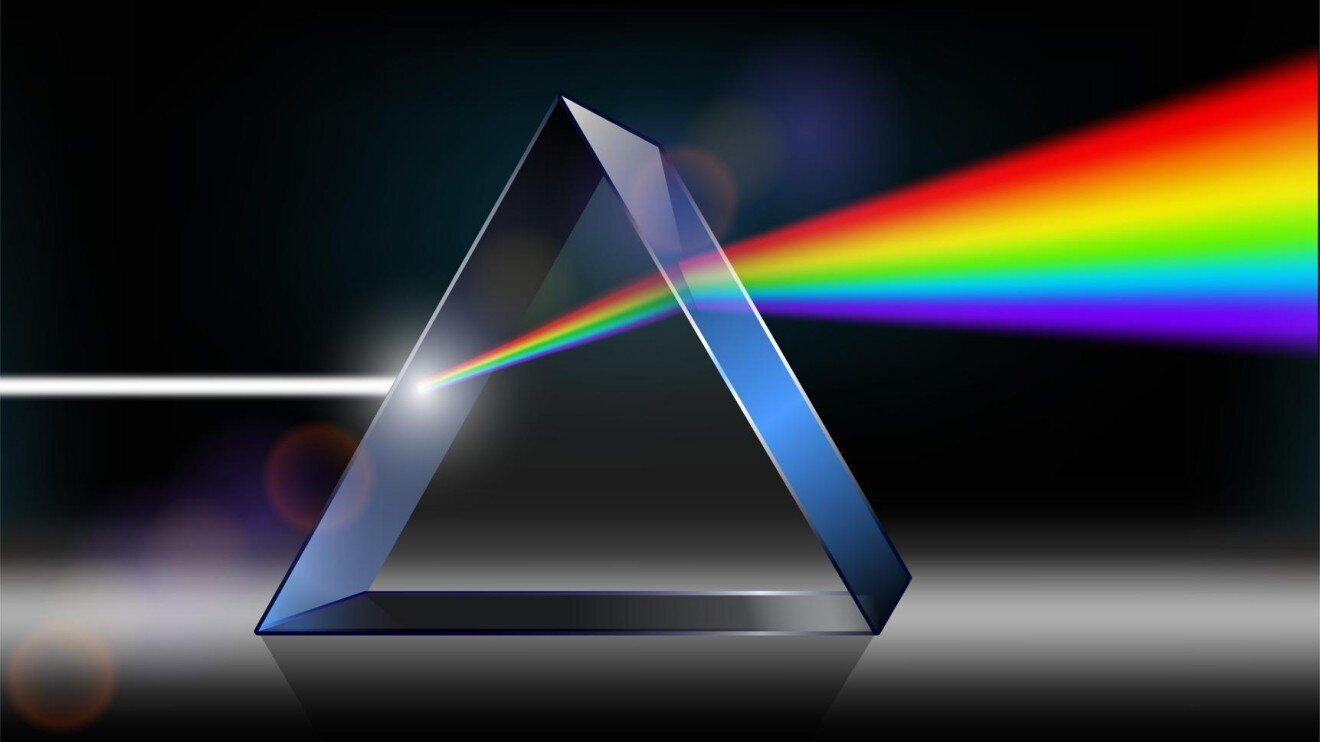
Refraction is an optical phenomenon in which light rays change direction as they pass from one medium into another.
In physical optics, the term «refraction» (from the Latin refractio, «breaking») describes the change in direction of a propagating wave, including light, as it crosses the boundary between two media with different optical properties.
The Physics of the Phenomenon
Refraction results from the change in the speed of light as it moves through different media. According to Snell’s law, the ratio of the sines of the angle of incidence and the angle of refraction equals the ratio of the media’s refractive indices:
sin α / sin β = n₂ / n₁
where α is the angle of incidence, β is the angle of refraction, and n₁ and n₂ are the refractive indices of the two media
This law explains why objects in water appear shifted or bent, and it underlies the operation of lenses, prisms, and other optical devices.
Types of Refraction
- Astronomical refraction — the distortion of the apparent position of celestial bodies caused by light bending through Earth’s atmosphere
- Atmospheric refraction — the change in the direction of light rays within a non-uniform atmosphere of varying density and temperature
- Terrestrial refraction — the bending of light rays near Earth’s surface, which affects surveying measurements
- Negative refraction — a special phenomenon in metamaterials, where light bends in the opposite direction from usual
Optical Effects of Refraction
The refraction of light in the atmosphere and other media produces a range of striking optical phenomena:
- Mirages — optical illusions arising from atmospheric refraction under significant air-temperature gradients
- Halos — rings of light around the Sun or Moon, formed as light refracts through ice crystals in the atmosphere
- Distortion of underwater objects — objects underwater appear closer and larger due to light refracting at the water-air boundary
- Dispersion of light — the splitting of white light into its spectral components, since the refractive index depends on wavelength
Interesting fact: Refraction lets us watch the sun set even after it has geometrically dropped below the horizon. Thanks to light bending through the atmosphere, we see the Sun roughly 0.5° higher than its true position, adding 2-3 extra minutes of daylight.
Practical Applications
Understanding the laws of refraction is used across many fields:
- Optical instruments (lenses, prisms, microscopes, telescopes)
- Eyeglasses and contact lenses for vision correction
- Fiber optics and telecommunications
- Astronomical observation and calculation
- Surveying and navigation
- Photography (correcting distortion)
Refractive Indices
Some typical refractive index values:
| Medium | Index |
|---|---|
| Vacuum | 1.0 |
| Air | 1.0003 |
| Water | 1.33 |
| Glass | 1.5-1.9 |
| Diamond | 2.42 |
It’s exactly these differences in refractive index that produce the picturesque glints on water and reflections in glass that can sometimes be so hard to make sense of at first glance.