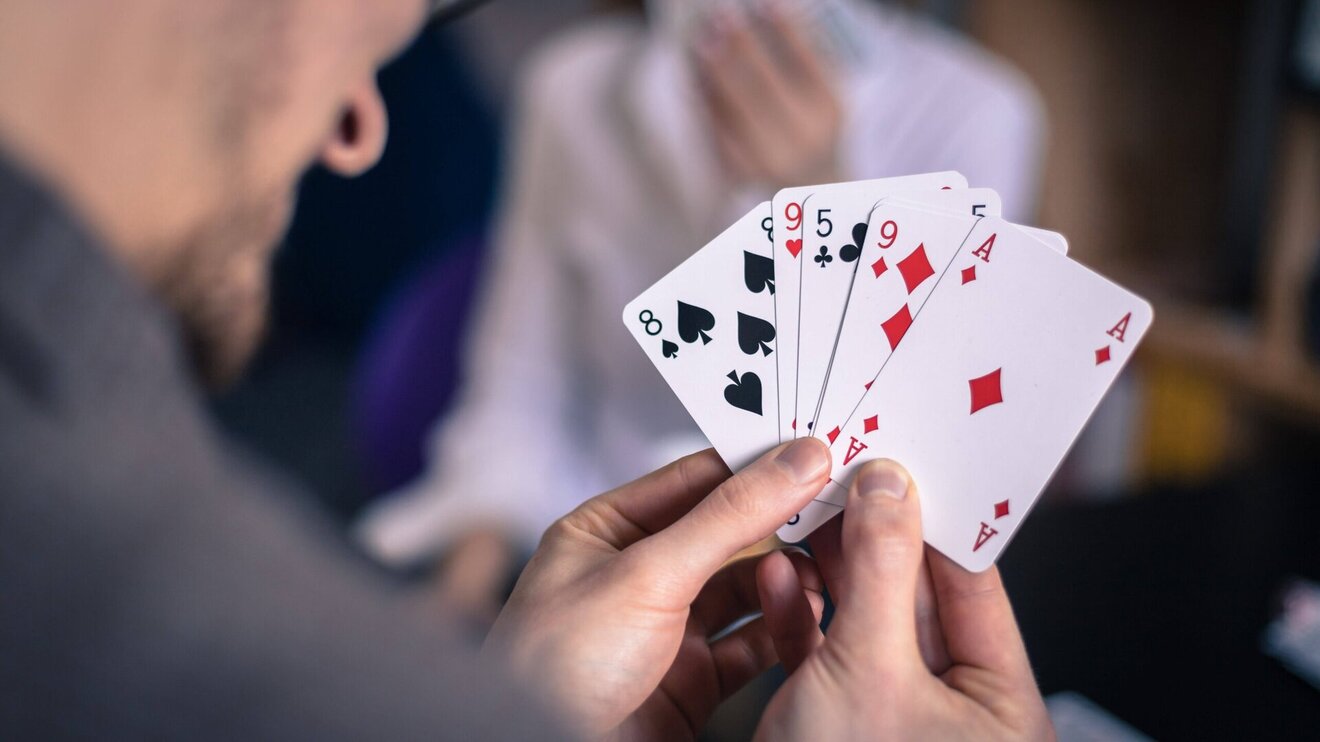
“Scoring the pulka” is a set phrase describing the process of playing preferans. The pulka is a specially ruled sheet of paper for recording game results, and the phrase “to score a pulka” became synonymous with playing this card game.
What the Pulka Is in Preferans
The pulka is a special form for recording preferans results — a sheet of paper with three areas for each player:
- The Pool — the main area for recording points earned in games for tricks, and bonuses for zero tricks in a distribution round. Each point in the pool equals +10 or +20 whists (depending on convention).
- The Mountain — the area for recording penalty points for a remise (failing to make the declared number of tricks) and for tricks taken during a distribution round. Each point in the mountain equals −10 whists.
- Whists — the area for recording points for tricks taken while defending. Each point equals 1 whist.
The History and Origins of Preferans
Preferans (from the French préférence, “preference,” “advantage”) is a trick-taking card game that spread widely in Russia in the mid-19th century. The English game whist is considered its predecessor.
The game quickly won popularity among educated segments of Russian society and became an integral part of the intelligentsia’s culture. In Soviet times preferans continued to exist despite the official disapproval of gambling.
Basic Rules of Play
Preferans is a commercial game — that is, a game played for money — where over a long game the outcome is determined more by the player’s skill than by luck. The game uses a 32-card deck (from seven to ace).
Players and the Object of the Game
The game is played by three or four (when playing with four, one player sits out each deal in turn, “sitting on the widow”). The goal is to accumulate the maximum number of points over the course of the match.
Types of Games in Preferans
There are three possible types of games in preferans:
- A trick-taking game — one participant (the declarer) commits to taking a declared number of tricks, while the others (the defenders) try to prevent this.
- Misère — one participant commits to taking no tricks at all, while the others try to force them to take at least one.
- Distribution (raspasy) — all participants try to take as few tricks as possible.
The Process of “Scoring the Pulka”
Bidding
After the cards are dealt, players bid to determine the type of game. Bids are made strictly in turn, clockwise. A player may say “pass” (declining to play) or make a meaningful bid — declaring a game of a certain level.
Bid Rankings
Trick-taking games are ranked in ascending order:
- 6 spades — 6 clubs — 6 diamonds — 6 hearts — 6 no-trump
- 7 spades — 7 clubs — 7 diamonds — 7 hearts — 7 no-trump
- And so on up to 10 no-trump
Play and Recording Results
After the type of game is determined, play proceeds — the sequential playing out of ten tricks. Once play concludes, the results are recorded in the corresponding areas of the pulka:
The Scoring System
| Game | Points for success | Points for shortfall (per trick) |
|---|---|---|
| 6 tricks | 2 points to the pool | 2 points to the mountain |
| 7 tricks | 4 points to the pool | 4 points to the mountain |
| 8 tricks | 6 points to the pool | 6 points to the mountain |
| 9 tricks | 8 points to the pool | 8 points to the mountain |
| 10 tricks / Misère | 10 points to the pool | 10 points to the mountain |
The Main Varieties of Preferans
Sochi Rules
Characterized by a strict, “stingy” style of defense. Since defending is made difficult, the “Sochi” variant is considered a “game against the defenders.”
Leningrad (Piter) Rules
Defense is semi-strict and “gentlemanly.” This variant is regarded as a “defenders’ game,” a “game against the declarer.” The mountain and whists are doubled, and the game can be time-limited.
Rostov Rules
In distribution rounds, the widow is not revealed. Whoever takes the fewest tricks records a set number of whists against their partners. Considered a game for masters of the distribution round.
Preferans Terminology
Basic Terms
- Whist
- The smallest unit for recording results in preferans; a partner’s declaration to play against the main declarer.
- Remise (a “plant”)
- Failing to fulfill one’s obligations while playing out a contract.
- Distribution round (raspasy)
- Play aimed at taking as few tricks as possible, when all players have declared “pass.”
- The widow (prikup)
- Two cards set aside separately during the deal, taken by whoever wins the bidding.
- The discard (snos)
- The two cards a player discards after taking the widow.
- A marriage (mar’yazh)
- A King and Queen of the same suit.
- The wheel (koleso)
- The symbol Ø, denoting 100 points.
The Cultural Significance of Preferans
Preferans holds a special place in Russian culture. The game became a symbol of intellectual leisure, a way for educated people to socialize. The expression “to score a pulka” entered everyday speech as a synonym for an unhurried, thoughtful way of passing the time.
Preferans in Literature and Film
The game is often mentioned in works of fiction and film. Characters in Yulian Semyonov’s novels about Stirlitz play preferans, as do characters in many Soviet and Russian films. The game became part of the image of the educated, cultured person.
The Etiquette of the Game
Preferans has a strict code of table etiquette. The game demands not just mathematical ability but psychological composure, the ability to read one’s opponents, and the capacity to make decisions with incomplete information.
Preferans as a Commercial Game
It’s important to understand that preferans is a commercial game, not a gambling one. That means the outcome, over the long run, is determined by the player’s skill rather than luck. A successful preferans player must:
- Be able to correctly assess the strength of their hand
- Understand the probabilities of various card distributions
- Master bidding tactics
- Know the fundamentals of playing out different types of games
- Be able to read their opponents’ play
The Game Today
Preferans remains a popular game. Tournaments exist at various levels, from club to international. The game has been adapted for computers and mobile devices, making it possible to play online against opponents from around the world.
Many well-known people are fans of preferans: chess player Anatoly Karpov, TV host Leonid Yakubovich, and many other figures from the creative intelligentsia.
Conclusion
“Scoring the pulka” is not just a card game — it’s an entire culture, demanding deep knowledge of the rules, tactical skill, and psychological preparation. Preferans remains one of the most intellectually demanding card games, one where a player’s skill shows through fully.
For students of the Soviet era, an evening of preferans wasn’t just entertainment, but a form of intellectual exchange, a way of trading ideas and forming friendships that often lasted a lifetime.