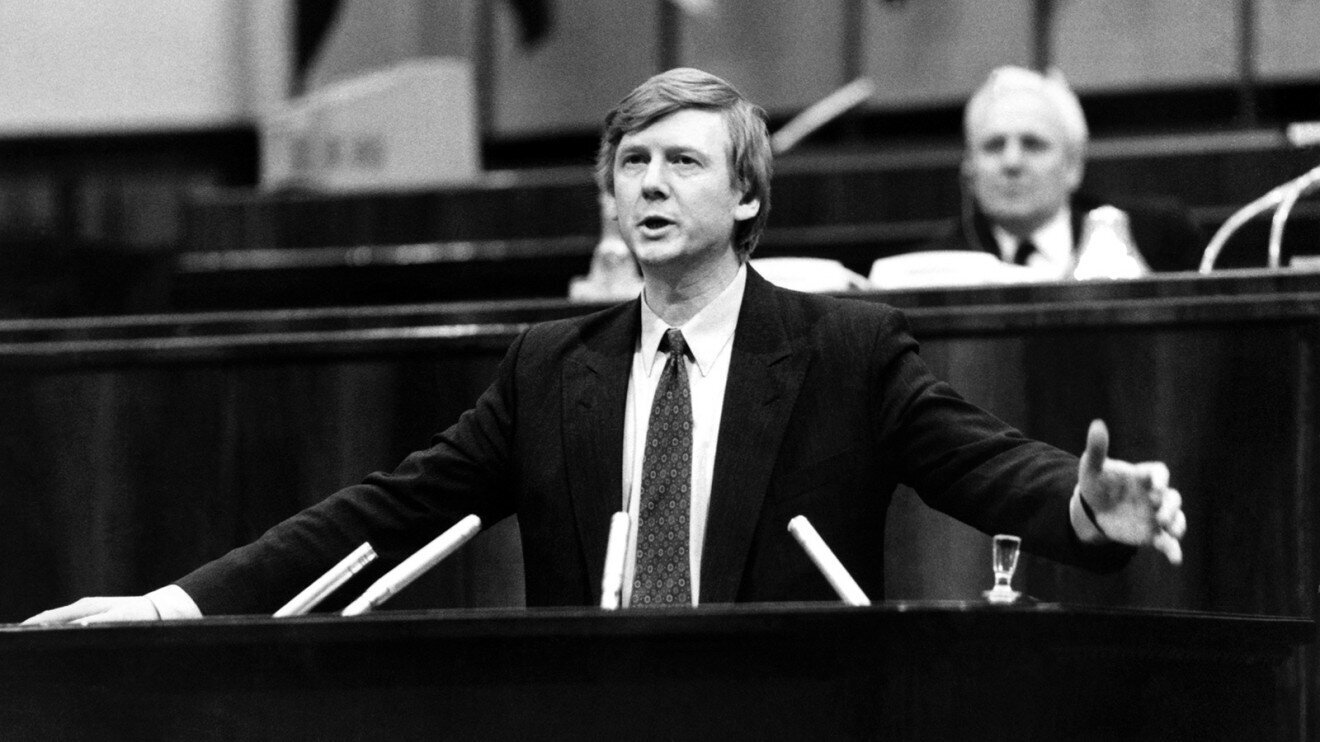
By the mid-1990s the name Anatoly Chubais was familiar to every Russian. The red-haired economist who headed the State Committee for the Management of State Property became the embodiment of economic reform – a savior to some, a wrecker to others. The public called him various things: «the redhead,» «the scoundrel,» and later the nickname «Cagliostro with a circuit breaker» would be added. But above all, his name was inseparable from privatization – the process that permanently transformed the country’s economy.
Who Anatoly Chubais is
Anatoly Borisovich Chubais was born on June 16, 1955, in Borisov, Minsk Oblast, in the Byelorussian SSR. His father, Boris Matveyevich, was a military man, a tank officer, and a veteran of the Great Patriotic War. The family moved frequently because of the father’s military career – they lived in Hungary, Germany, Central Asia, Belarus, and Ukraine.
In 1967 the family moved to Leningrad. Chubais finished school in 1972, and by his own account he «hated his school,» which was marked by «advanced military-patriotic upbringing.» In 1977 he graduated with honors from the Mechanical Engineering Faculty of the Leningrad Engineering-Economics Institute (LIEI), majoring in the «Economics and Organization of Mechanical Engineering Production.» In 1983 he defended his candidate’s dissertation in economics.
The circle of market economists
Already during his student years, Chubais had begun to grasp the depth of the economic problems facing the USSR. In 1979, together with colleagues at LIEI, he organized a circle of market-minded economists. Its members set themselves the task of learning the real – rather than the textbook – history of the Soviet economy and identifying possible paths for reforming it.
«We saw very clearly that the Soviet economy was heading toward collapse, that official economic science was looking the other way, and all of this troubled us enormously,» Chubais recalled. By his own account, he was responsible «for the circle’s security from the KGB» and for making sure «none of us ended up in prison.»
In 1982 the circle grew close to a group of young Moscow economists led by Yegor Gaidar. Thanks to Gaidar, the «Leningraders» were drawn into the work of a Politburo commission on improving the management of the national economy, created in 1984.
Arrival in power
After the local Soviet elections of March 1990, Chubais was appointed deputy chairman of the Leningrad City Executive Committee. In that post he worked on creating the Leningrad Free Economic Zone.
On November 10, 1991, as the USSR lived out its final weeks, 36-year-old Anatoly Chubais was appointed chairman of the RSFSR State Committee for the Management of State Property. Thus began a career in power that would last many years and make him one of the most controversial figures in modern Russian history.
Privatization: design and implementation
Under Chubais’s leadership, a privatization program was developed – the transfer of state property into private hands. The law «On the Privatization of State and Municipal Enterprises in the RSFSR» had already been adopted on July 3, 1991, but practical privatization work had not begun: as of January 1, 1992, only 107 shops, 58 cafeterias, and 56 consumer-service businesses had been privatized in Russia.
At the same time, amid the collapse of state authority, a spontaneous privatization was under way – in effect the plundering of state property: enterprise assets were leased out to front companies with the right to a subsequent buyout at an artificially deflated residual value.
Vouchers – privatization checks
On December 27, 1991, the «Basic Provisions of the Privatization Program in the Russian Federation for 1992» were adopted. Chubais, like Gaidar, favored privatization for cash, since it allowed enterprises to be handed to efficient owners more quickly and helped reduce the state budget deficit.
«Small privatization» was carried out for cash, mainly through open auctions, starting in mid-1992. Within a year, 50,000 private enterprises appeared: shops, cafes, tailor shops, hair salons.
But carrying out «large privatization» for cash right away proved impossible: the population had no money to buy up state property. So a voucher mechanism was introduced – privatization checks issued free of charge to every citizen of the Russian Federation.
Vouchers were introduced by a presidential decree dated August 14, 1992. From October 1992 to February 1993, 144 million vouchers were issued, reaching 97% of citizens. The voucher’s face value was set at 10,000 rubles.
The promise of two «Volgas»
It was widely believed that the 10,000-ruble figure had been arrived at by dividing the total value of enterprises to be privatized by the number of RF residents. Chubais was later frequently accused of deception – of deliberately inflating the voucher’s stated value.
In March 2002 the magazine Kommersant remarked ironically: «Chubais had the misfortune of declaring that ‘in a few years a voucher will be worth as much as two Volga cars.’ Although the privatization that began with the voucher forms the very foundation of the country’s economic system, the unfulfilled promise of two Volgas has made Chubais chiefly responsible for every misfortune occurring in the business world.»
Chubais himself later wrote: «Two Volgas for a voucher – that seems to have stuck to me for the rest of my life.» In fact the privatization check’s face value was purely nominal. As Gaidar put it, «the question of what face value to put on the check is essentially moot, since the check has only a socio-psychological significance.»
How the vouchers worked
Unlike registered privatization accounts, vouchers were freely transferable. They could be sold, given away, exchanged, bequeathed, or invested in mutual and check investment funds.
Fifty percent of voucher holders invested them in shares of the enterprises where they or their relatives worked, 25% sold them, and 25% invested them in check investment funds (ChIFs). By other estimates, 34% of vouchers were sold, 11% given away, 25% invested in ChIFs, and only 15% invested in shares.
Vouchers became a traded commodity. Their prices depended on market conditions and the political climate and fluctuated wildly, sometimes falling to the price of two bottles of vodka or a few loaves of bread.
At the same time, the targeted buying-up of vouchers and their use to acquire shares at check auctions allowed large fortunes to be built. The most successful voucher investment turned out to be shares in enterprises. In the Mari El Republic, for example, one voucher could be exchanged for 5,900 shares of Gazprom, and in Perm Oblast for 6,000 shares. By 2016 those shares were worth roughly 1 million rubles.
The failure of the check investment funds
The worst voucher investment turned out to be the ChIFs. By Chubais’s own admission, this project failed completely: «because of managers’ lack of professionalism and outright theft, all 40 million ChIF investors ended up defrauded.»
«Real oversight of the ChIFs would have required building a system comparable in complexity and clout to the banking-supervision system that only took shape in Russia by the late 1990s. Building such an oversight system in 1992–1993 was simply impossible,» Chubais wrote. The ChIFs’ failure had a negative effect on attitudes toward privatization as a whole.
Loans-for-shares auctions: the birth of the oligarchs
By mid-1994 free privatization had been completed. The stage of cash privatization began. But amid political instability and a high likelihood of a Communist return to power, potential investors were unwilling to take the risk. The pace of privatization dropped sharply.
In passing the 1995 budget law, the State Duma banned the sale of shares in highly profitable oil-and-gas enterprises. Yet privatization was the main source of funds for meeting social obligations and paying the wages of public-sector workers and pensions.
With the oil-producing enterprises off-limits for sale, loans-for-shares auctions became the way out. Private banks competitively offered the state loans secured by large blocks of shares. If the state failed to repay the loan, the shares would pass into the bank’s ownership.
In November–December 1995, 12 loans-for-shares auctions were held, generating 5.1 trillion rubles in revenue, which allowed the state to significantly reduce its debts to public-sector workers and pensioners. Loans-for-shares auctions accounted for 70.8% of the federal budget’s total privatization revenue.
During the auctions, shares were pledged at low prices, and as a result a handful of financial-industrial groups – above all ONEXIM, Menatep, and Alfa Group – gained control of major enterprises.
Criticism of Chubais: public anger
As a result of privatization, a segment of society settled into a negative view of it as «the greatest heist of the twentieth century» and the plundering of the people. According to opinion polls, in 2000–2007 some 77–83% of Russian citizens considered privatization unjust and favored a full or partial revision of its results.
Accusations of selling off the country
Chubais was accused of having handed vouchers to people with no understanding of economics, leaving them at the mercy of unscrupulous dealers and turning «people’s» privatization into «oligarchic» privatization. In connection with the loans-for-shares auctions, Chubais was frequently accused of selling off the nation’s wealth for a pittance and creating the Russian oligarchy.
Yegor Gaidar recalled that when, in the fall of 1991, he asked Chubais to head the State Property Committee – that is, «to take responsibility for designing and implementing the privatization program» – Chubais «sighed heavily and asked whether I understood that he would become a man accused for the rest of his life of selling off Russia.»
Polling data on his unpopularity
In the early 2000s Chubais consistently ranked among the three Russian politicians distrusted most by their fellow citizens. In a November 2000 FOM poll, only 4% said they didn’t know who he was. Fifty-five percent of Russians viewed the politician negatively, 29% were indifferent, and only 7% said they viewed him favorably.
People described Chubais as «the greatest crook of our time,» a man «without conscience,» «greedy,» «pushy,» and «callous,» a «thief,» «a man acting to Russia’s detriment,» and «a discreditor of reform.»
According to a December 2006 VTsIOM poll, 77% of Russians distrusted Chubais. In an August 1999 Romir poll, Chubais was named among those whose political and economic activity did the country the greatest harm.
«Chubais is to blame for everything!»
The popular meme «Chubais is to blame for everything» arose as the public’s sarcastic take on events in the country. It first appeared on television in the late 1990s, in the satirical puppet show Kukly on NTV.
On January 16, 1996, after the pro-government «Our Home Is Russia» movement did poorly in the State Duma elections, Chubais was dismissed as first deputy prime minister. On January 19 President Boris Yeltsin commented on the dismissal: «Chubais is to blame for the fact that only about 10% of voters cast their ballots for Our Home Is Russia in the parliamentary elections. Had it not been for the mistakes he made in conducting economic policy, the number of votes would have been no less than 20%.»
On Kukly these words were reworked. A puppet portraying Boris Yeltsin spoke from the cabin of a burned-out bus: «Chubais is to blame for everything. If it weren’t for Chubais, everything would be fine for us.» The phrase caught on and was embraced by the whole country.
«Chubais is to blame for everything!» became a universal answer to every misfortune and mishap. If someone’s car broke down, or the hot water got shut off, they could simply say: «Chubais is to blame for everything.» The meme was used in every kind of context, from discussions of political events to everyday annoyances.
Chubais’s responses to the criticism
Chubais acknowledged that in rolling out the vouchers, he and his colleagues had made «inflated estimates of the check’s value» and «overdid the propaganda, got swept up in euphoria,» resulting in «extremely severe negative consequences» and «popular hatred for the privatizers and the reforms.»
But he also maintained: «It wasn’t enough just to devise effective schemes and write good regulatory documents – we had to convince the Duma to pass those documents, and above all, to convince 150 million people to get up off the couch, leave their apartment, obtain a voucher, and then invest it sensibly on top of that! Of course the propaganda component was fantastically important.»
«Bandit capitalism or bandit communism»
In a November 2004 interview with the Financial Times, Chubais admitted that he had «underestimated the deep sense of injustice» that took root in people as a result of privatization, but insisted: «We couldn’t choose between ‘honest’ and ‘dishonest’ privatization, because honest privatization requires clear rules set by a strong state capable of enforcing the law. In the early 1990s we had neither a functioning state nor rule of law. We had to choose between bandit communism and bandit capitalism.»
The main task was to stop communism
In a 2004 interview for the documentary film The Oligarchs, Chubais declared: «Privatization in Russia before 1997 wasn’t really an economic process at all. Its main task was to stop communism. We accomplished that task.»
On the loans-for-shares auctions, Chubais said: «We had no choice. If we hadn’t carried out that kind of privatization, the Communists would have won the 1996 election, and that would have been the last free election in Russia, because those people don’t give up power that easily.»
The oligarchs’ position
One of the Russian oligarchs, Vladimir Potanin, told Forbes: «The auction wasn’t fraud, but it was a striking example of the exceptional power of lobbying. Like all of privatization, it was unjust and did, in fact, lead to social stratification. But what did the loans-for-shares auctions actually do? They created a class of major property owners in Russia.»
The reformers responded to the accusations by pointing out that the enterprises sold at the loans-for-shares auctions were in dire straits, carried heavy wage-arrears debts, and generated almost no income. Given the political risks of 1995, their share prices were negligible. At higher starting prices, the auctions would have found no buyers, and the state would have failed to replenish the budget.
Advisors from the CIA
On April 25, 2013, President Vladimir Putin, during a call-in program with Russian citizens, stated: «Among Anatoly Borisovich’s advisors, as it turns out, were career officers of the U.S. CIA. But upon returning to the United States they were put on trial for enriching themselves during privatization in the Russian Federation in violation of their own country’s laws – something they had no right to do as serving intelligence officers.»
This statement added a new dimension to the criticism of Chubais – now he was accused not only of incompetence or self-interest, but of collaborating with foreign intelligence services.
The attempt on Chubais’s life
In a November 2004 interview with the Financial Times, Chubais stated: «I know of at least three contracts taken out on my life. I know all the details, the names of those who were supposed to carry them out. The most recent such contract was taken out a year and a half ago. It had purely political motives: hatred over the fact that I ‘sold out Russia.’»
In March 2005 an attempt was made on Chubais’s life. Along the route his car was traveling, near the settlement of Zhavoronki in the Odintsovo district of Moscow Oblast, an explosive device with a yield of 3 to 12 kilograms of TNT equivalent was detonated, followed by automatic-weapons fire. Chubais and his companions were saved by the fact that the car was armored.
Charges over the attack were brought against retired GRU colonel Vladimir Kvachkov and three other men. Investigators concluded the crime had been committed out of extremist views and personal hostility toward Chubais.
However, a jury twice returned a not-guilty verdict for the defendants. On December 22, 2010, the Supreme Court rejected the Prosecutor General’s cassation appeal. The defendants were acquitted for good.
Vladimir Kvachkov, the officer accused of organizing the attempt on Chubais’s life, later ran for the State Duma and received 29% of the vote (44,000 people) in Moscow’s 199th electoral district.
Expert assessments of privatization
Experts note that in the course of privatization, the state did not take anything away – it only gave things out: «At worst it gave nothing – to those who hung their vouchers on the wall, sold them for a bottle of vodka, invested them badly, and so on. Not a single person was harmed by voucher privatization.»
The task of voucher privatization was not to distribute state property evenly, but to create private ownership and prepare the ground for the transition to cash privatization. That task was accomplished. Private property was revived in a country that had not known it since the late 1920s.
The overall results of privatization were reflected in a comparative analysis of state-owned and privatized enterprises for 1995, conducted by the International Center for Socio-Economic Research. Aggregate efficiency at privatized enterprises turned out to be significantly higher than in the state sector.
Daniel Treisman, a professor at the University of California, observed: «Companies run by oligarchs showed excellent performance – far better than many comparable enterprises run by the state or by its ‘red directors.’»
Chubais and the 1996 election
On March 18, 1996, in a personal meeting with Yeltsin, Chubais persuaded the president to abandon his intention to dissolve the Duma and postpone the presidential election by two years. On March 19, 1996, Chubais took charge of the Analytical Group within Yeltsin’s election campaign headquarters, effectively taking over management of the president’s reelection campaign.
Thanks to the Analytical Group’s work, Yeltsin’s approval rating began to climb. In the first round of voting, held on June 16, Yeltsin received 35.28% of the vote, Zyuganov 32.03%. In the runoff on July 3, 1996, Yeltsin won 53.82%.
Yeltsin’s daughter, Tatyana Dyachenko, later recalled that Chubais played a crucial role in securing Yeltsin’s second presidential term. Without Yeltsin’s 1996 victory, the reformers believed, privatization could have been reversed and the country could have returned to a command economy.
Later career
After Yeltsin’s victory in the runoff, Chubais became head of the Presidential Administration on July 16, 1996. Because Yeltsin soon underwent heart surgery and for a long time was unable to fully perform his duties, Chubais earned the nickname «the regent.»
On March 7, 1997, Chubais was appointed first deputy chairman of the Government of the Russian Federation, and on March 17, simultaneously, minister of finance. In that post he carried out a harsh program of financial stabilization. In 1997 inflation was significantly reduced – consumer prices rose by only 11% over the year. For the first time since the early 1990s, GDP growth of 1.4% was achieved.
But in November 1997 the «book affair» scandal broke out: Chubais and his associates were accused of receiving inflated royalties for a supposedly unwritten book on the history of privatization in Russia. On November 20, 1997, Chubais lost his post as finance minister but remained first deputy prime minister.
The 1998 default
On June 17, 1998, Chubais was appointed the president’s special representative for relations with international financial organizations. On July 20, 1998, Chubais managed to secure an agreement with the IMF Board for $11.2 billion in funding. The first tranche, disbursed immediately, was $4.8 billion.
But this did not save the Russian economy: the funds were quickly spent propping up the exchange rate and covering urgent expenses. On August 17, 1998, the Russian government declared insolvency – a default. The ruble’s exchange rate against the dollar collapsed almost threefold. Russians’ savings in the national currency were wiped out.
In the eyes of the public, Anatoly Chubais was one of the chief architects of what had happened. The 1998 crisis added new shades to his already grim image in the public mind.
Criticism from politicians and public figures
In 2008, opposition politician Garry Kasparov offered a critical assessment of Chubais. Kasparov declared: «the ‘liberal reformers’ didn’t build on perestroika’s achievements – they buried them,» and «on one point Chubais definitely isn’t being dishonest – he and his associates didn’t lose the country. The country lost.» He also said «the liberals of the ’90s don’t love their own people, and they’re afraid of them.» In Kasparov’s view, «the hardships of the early ’90s» had been for nothing.
In 2013, during President Vladimir Putin’s call-in show, a journalist from Perm, Sergei Malenko, asked about Chubais’s responsibility for the reforms he carried out and the possibility of criminal prosecution.
Public memory
By 1995, when the novel is set, Anatoly Chubais was already one of the most recognizable and reviled figures in the country. His name was inseparable from privatization, which most citizens regarded as plunder. «The ginger scoundrel» was just one of the many nicknames the public bestowed on the economist.
The line from the novel that «the money would just end up in Yolkin’s pocket, along with the ginger scoundrel’s» captures the mood of the era precisely. People widely believed that privatization was simply a way for those in power to enrich themselves, while ordinary people were left with nothing. And there was every reason for that belief: vouchers became worthless, the check investment funds went bankrupt, and the largest enterprises ended up in the hands of a narrow circle of oligarchs.
The plant directors referred to in the novel understood the situation perfectly well. They saw how privatization was unfolding, how some grew rich while others grew poor. The schemes for circumventing official procedures and «raking things in under oneself» were well understood by anyone close to production who had connections in power.
The Chubais paradox
Anatoly Chubais remains one of the most controversial figures in modern Russian history. On the one hand, he really was one of the architects of the economic reforms that dismantled the command economy and created a market economy. Capitalism could not have been built without privatization.
On the other hand, the way privatization was carried out led to mass impoverishment, the creation of oligarchic capitalism, and deep social stratification. The promise of two Volgas for a voucher became a symbol of the deception of the people. The loans-for-shares auctions turned state property into private property for a pittance.
Asked whether he takes offense at the phrase «Chubais is to blame for everything,» Chubais himself has said: «You have to understand that the 1990s were an extremely hard time for tens of millions of people. In that sense, a person needs someone to blame. We’re all built that way.»
The legacy of privatization
By the mid-1990s the results of privatization were plain to see. A class of owners emerged – oligarchs who controlled the country’s largest enterprises. A middle class of small and medium-sized entrepreneurs emerged as well. But the overwhelming majority of the population came out losers.
The situation described in the novel, in which a holding company offers a plant director a scheme for bypassing official privatization, was typical of the era. The «course toward the full privatization of Soviet industry» really had been set. «Private capital had free rein» – that, too, matched reality.
The line about how «in a year, if Gennady Andreyevich knocks Yolkin off his perch, we’ll revisit the matter» reflects the political uncertainty of 1995. At the time, many really did expect Communist Gennady Zyuganov to win the 1996 presidential election, with a possible revision of privatization’s outcomes to follow.
The understanding that «it all depends on what the laws turn out to be in a year’s time» was entirely accurate. Legislation kept changing, the rules of the game were unclear, and as a result gray schemes, corruption, and crime flourished.
Conclusion
Anatoly Chubais went down in history as the «father of Russian privatization,» the «architect of Russian capitalism,» and, at the same time, as a man millions of Russians consider chiefly responsible for their misfortunes. «The ginger scoundrel» is just one of many nicknames the public gave the economist.
The privatization of the 1990s truly was «the greatest redistribution of property» in Russian history. It dismantled the Soviet economic system and laid the foundations of a market economy. But the price of that transformation proved extremely high – the impoverishment of millions, social stratification, and a loss of trust in power and in reform itself.
Are the accusations against Chubais fair? Was he truly a «scoundrel» who knowingly deceived the people? Or was he a committed reformer who, amid chaos and a collapse of authority, tried to build capitalism at any cost? These questions remain a matter of debate to this day.
One thing is certain: the name Anatoly Chubais is forever bound up with the 1990s, with privatization, with the vouchers, with the loans-for-shares auctions. And for most Russians, that name will remain a symbol of injustice, deception, and the plundering of the country. «Chubais is to blame for everything» has outlived its era and become part of Russian folklore – a universal explanation for every misfortune and mishap.