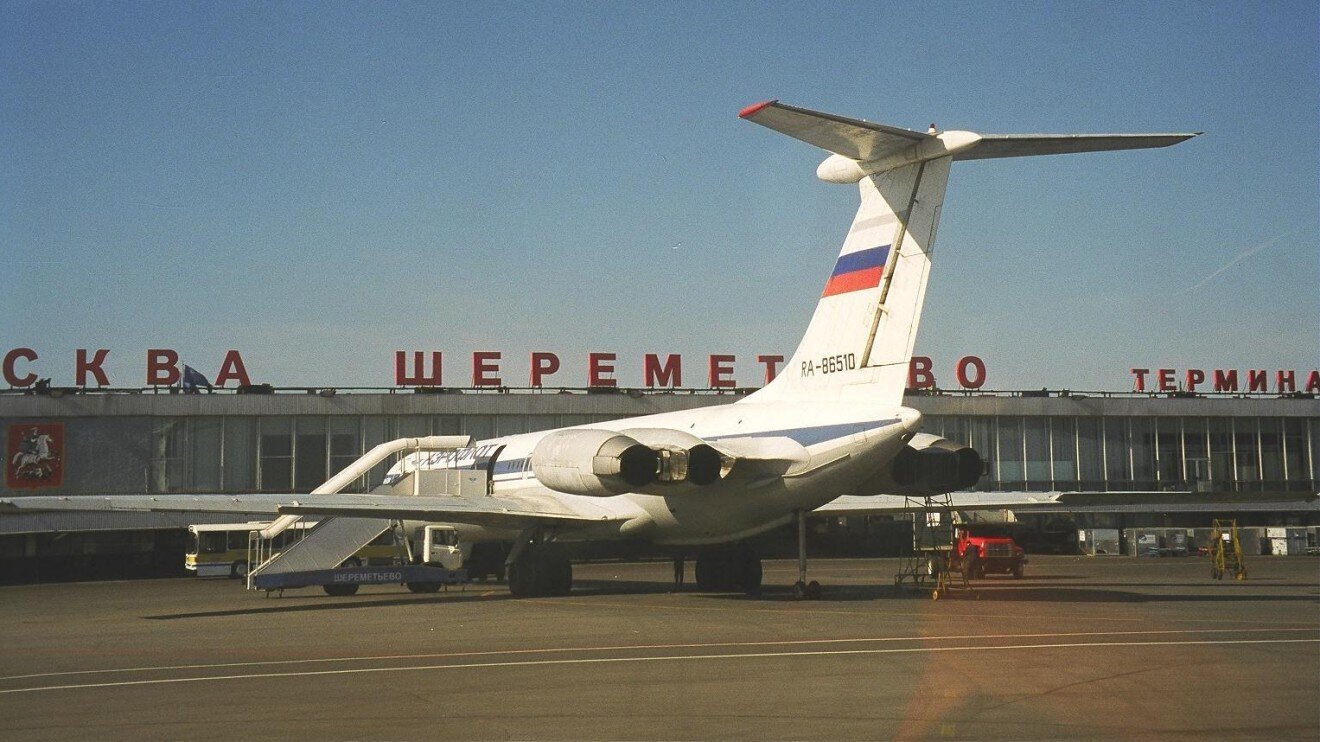
Sheremetyevo International Airport, named after Alexander Pushkin and affectionately nicknamed «Sharik» by the public, is one of Russia’s main air gateways and one of Moscow’s most important transport hubs. Located northwest of the capital, this airport has become a symbol of Soviet and Russian aviation.
Founding History
Sheremetyevo’s history began in the 1950s, when a decree of the USSR Council of Ministers, dated September 1, 1953, called for building a Central Air Force airfield near the settlement of Chashnikovo. The airfield was initially named «Sheremetyevsky,» after two nearby landmarks — the Sheremetyevsky residential settlement and the Sheremetyevskaya railway platform on the Savyolovsky line of the Moscow Railway.
In 1957, the runway, taxiways, aprons, and Central Control Point buildings were completed. But the airfield’s fate changed dramatically in 1959, when, on Nikita Khrushchev’s initiative, it was transferred from the USSR Ministry of Defense to civil aviation.
The Birth of a Civilian Airport
The official opening date of Sheremetyevo International Airport is considered to be August 11, 1959. On that day, ground crews handled their first airliner, a Tu-104, carrying passengers from Leningrad. The initiative for creating an international airport came from the head of the USSR himself, Nikita Khrushchev, who had been struck by the scale of London’s Heathrow Airport during a 1956 state visit to Britain.
According to contemporaries, Khrushchev, flying back into the USSR and stepping off the plane at the new Sheremetyevo military airfield, looked around at the empty ground and said: «It’s about time we built an airport like that ourselves.» These words were taken as a call to action, and on July 31, 1959, a government decree established a civilian airport called Sheremetyevo on the site of the former military airfield.
The Early Years of Operation
Sheremetyevo’s first air terminal was a small Central Control Point building, located near what is now Terminal B. On June 1, 1960, the airport handled its first international flight, from Moscow (Sheremetyevo) to Schönefeld, aboard an Il-18 operated by the Vnukovo air detachment.
In its first year of operation, the airport handled 50,000 passengers and 3,000 tons of mail and cargo. Operating Tu-104, Il-14, and Il-18 aircraft, Aeroflot flew from Sheremetyevo to 23 foreign countries. From 1961, flights departed from here to Cuba, the U.S., Canada, Argentina, and Australia.
The «Shot Glass» Terminal
On September 3, 1964, the Sheremetyevo-1 terminal complex received its first passengers. The terminal building was constructed in an architectural style considered cutting-edge by the standards of the late 1960s and became the finest example of this type of Soviet building. The architectural centerpiece was the arrivals building, which earned the popular nickname «The Shot Glass» for its distinctive shape.
A team of architects led by G. Yelkin, Y. Kryukov, and M. Gurevich worked on the terminal’s design. «The Shot Glass» remained a defining feature of Sheremetyevo International Airport for years, one of the most recognizable symbols of Soviet aviation.
Growth and Expansion
On November 20, 1967, the first flight from Sheremetyevo to New York took off. By 1970, the airport had become the largest in the USSR. Between 1972 and 1975, a second runway (Runway 2) was built, significantly increasing the airport’s capacity.
Ahead of the 1980 Moscow Olympics, the cornerstone of a new terminal, Sheremetyevo-2, was laid on November 17, 1977. The new terminal’s grand opening took place on May 6, 1980. During the Moscow Olympics, Sheremetyevo Airport handled more than 460,000 foreign passengers.
Geographic Location
The airport is located northwest of Moscow, in the Khimki urban district of Moscow Oblast, at roughly equal distance from the towns of Khimki, Lobnya, and Dolgoprudny. The distance from the Moscow Ring Road (MKAD), along the Leningradskoye Highway, to Terminal A is 13 kilometers; to Terminals D, E, and F, 9 kilometers.
This strategically important location makes Sheremetyevo one of the most convenient airports for residents of Moscow’s northern districts and Moscow Oblast. That’s exactly why many Muscovites living on the opposite side of the city prefer to spend the night in apartments closer to the airport before an early departure or after a late arrival.
Technical Equipment
Sheremetyevo is a Class A airfield, capable of accommodating every type of aircraft, both domestic and foreign-made. In 2002, the airport was awarded ICAO Category IIIA certification, allowing landings under vertical visibility of no less than 15 meters and runway visual range of no less than 175 meters.
The airport has two parallel runways: 06R/24L (Runway 2), 3,700 meters long, and 06C/24C (Runway 1), 3,550 meters long, with cement-concrete and reinforced-concrete surfaces. However, the insufficient distance between the runways (280 meters) prevents them from being used as two fully independent runways.
Terminal Structure
By the late 1990s, Sheremetyevo Airport consisted of several terminals, each serving specific functions:
Terminal A is dedicated to business aviation and private flights. It provides VIP service for high-ranking passengers and corporate clients.
Terminal B (formerly «Sheremetyevo-1») mainly serves domestic flights. Built in the 1960s, this terminal was for a long time the airport’s main international terminal.
Terminal C specializes in international flights and is part of the North Terminal Complex, along with Terminal B.
Terminal D serves both domestic and international flights. It’s one of the airport’s modern terminals, equipped with the latest technology.
Terminals E and F (formerly «Sheremetyevo-2») are dedicated to international flights. Terminal F, opened in 1980 for the Olympics, is the airport’s most recognizable terminal.
Transport Access
The airport can be reached several ways. The main driving routes run from the Leningradskoye Highway via the Mezhdunarodnoye or Sheremetyevskoye highways, or from the Dmitrovskoye Highway. Public transport is provided by buses running from the «Rechnoy Vokzal» and «Planernaya» metro stations.
For those who prefer to travel by their own car, more than 10 paid parking lots are set up around the airport, with a combined total of more than 6,000 parking spaces. Parking prices vary depending on location and the type of service.
Its Role in Russian Aviation
Sheremetyevo serves as the hub airport for Russia’s national carrier, Aeroflot. The company’s main international flights are based here, with service to every corner of the globe. By 1985, the airport was handling 3.5 million passengers a year, with scheduled flights to foreign countries along 172 routes to 122 destinations in 97 countries.
That same year, an international cargo terminal with a capacity of up to 150,000 tons was put into service, making Sheremetyevo an important logistics center not just for passengers but for freight as well.
Operational Features
One distinctive feature of Sheremetyevo is its shared use with federal agencies. The airport is classified as a civilian airport with co-basing rights for the FSB (Federal Security Service), which imposes certain operating restrictions and requires special security measures.
On November 11, 1991, Sheremetyevo International Airport received the legal status of a state enterprise, cementing its important role in the country’s transport system. This event took place at a turning point in Russian history and marked an important step in the development of domestic aviation.
Architectural Features
Sheremetyevo’s architecture reflects various eras in the development of Soviet and Russian aviation. Terminal B, with its famous «Shot Glass,» is an example of 1960s architecture, when Soviet architects strove to create buildings that were both functional and aesthetically appealing.
Terminal F (formerly «Sheremetyevo-2»), built for the 1980 Olympics, embodies the style of late-Soviet architecture, with its monumentality and its aim to impress foreign visitors. Its facade, with its characteristic elements, became one of the symbols of the Moscow skyline.
The Nickname «Sharik»
The airport’s popular nickname, «Sharik» («little ball»), arose among passengers and aviation professionals as a friendly shortening of «Sheremetyevo.» The name has firmly taken hold in Muscovites’ everyday vocabulary and become part of the city’s folklore. Many residents of the capital use the nickname in everyday speech, talking about flying «to Sharik» or «from Sharik.»
This informal name reflects Muscovites’ particular fondness for their main international airport — it’s perceived not as some bureaucratic institution, but as a familiar, understandable piece of city infrastructure, part of the daily life of millions of people.
Impact on City Life
Sheremetyevo’s location significantly affects the lives of Muscovites. Many city residents, especially frequent flyers, prefer to have an apartment or rent housing in the northwestern districts of the capital, to be closer to the airport. This is especially relevant for those who live on the opposite side of this enormous metropolis.
The phenomenon of «airport apartments» has become part of Moscow culture. Many businesspeople and frequent travelers keep a second home near the airport for convenience, letting them avoid hours-long trips across the entire city, especially given Moscow’s traffic.
Conclusion
Sheremetyevo International Airport, named after Alexander Pushkin, remains one of Russia’s most important transport hubs. From a 1950s military airfield, it grew into a modern aviation complex capable of serving millions of passengers a year. «Sharik,» as Muscovites lovingly call it, has become an inseparable part of the capital’s life, a symbol of Russia’s connection to the rest of the world.
The airport’s history is inextricably tied to the history of Russian aviation, reflecting every stage of its development — from the Soviet period to modern Russia. Sheremetyevo continues to grow, expand, and modernize, staying true to its core mission: to be the country’s reliable air gateway.