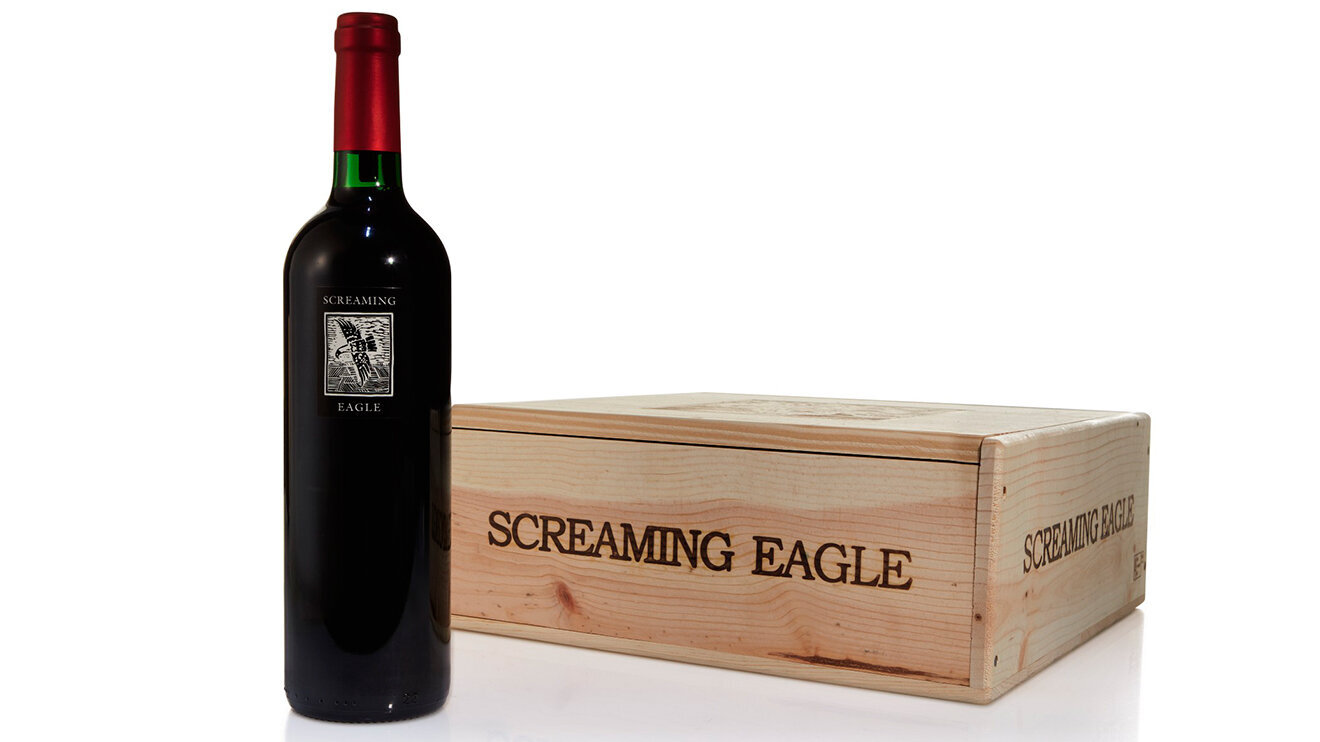
In 1997, a mention of the hero «nursing a Screaming Eagle» signaled entry into the elite world of American winemaking. By that point Screaming Eagle had already become a legend among connoisseurs, even though the winery’s history spanned only a few years.
The context of the era
By the mid-1990s Screaming Eagle represented a new kind of American wine – a «cult wine,» produced in microscopic quantities and sold at astronomical prices. It was a time when California wines had finally established themselves on the world stage as equals to France’s premium wines.
The birth of a legend: the story of Screaming Eagle
The story of Screaming Eagle began in 1986, when Jean Phillips, a former real estate agent, bought a 57-acre plot of land in Oakville, in the heart of the Napa Valley. Phillips wasn’t a professional winemaker – she simply fell in love with the property and decided to try her hand at making wine.
When Phillips bought the land, it was planted with a mix of grape varieties. She sold most of the harvest to other Napa Valley wineries, keeping only one acre for herself – roughly 80 Cabernet Sauvignon vines. It was from that tiny plot that the story of one of the most expensive wines in the world began.
Key dates
- 1986: Jean Phillips buys the property
- 1992: The first Screaming Eagle vintage
- 1995: The first vintage is released, and Robert Parker scores it 99 points
- 1995: The vineyard is fully replanted
Production
- Area: 48 acres
- Varieties: Cabernet Sauvignon, Merlot, Cabernet Franc
- Volume: 400–750 cases a year
- Bottles: 5,000–9,000 a year
A key moment in Screaming Eagle’s founding was Phillips’s meeting with Heidi Peterson Barrett, who became the estate’s first winemaker. Barrett was the daughter of the well-known consultant Richard Peterson, and it was she who helped craft the singular style that made Screaming Eagle famous.
The 1992 vintage: a cult is born
Screaming Eagle’s first commercial vintage was produced in 1992 and released for sale in 1995. That release proved a turning point not just for the winery but for the entire California wine industry.
A decisive role in turning Screaming Eagle into a cult wine was played by Robert Parker, the most influential wine critic of the era. Parker awarded the 1992 vintage 99 points out of a possible 100, calling it «nearly perfect.» That score instantly transformed an unknown wine into an object of desire for collectors and wine lovers worldwide.
«This wine displays extraordinary concentration, balance, and elegance. A rare combination of power and refinement makes it one of the greatest Cabernet Sauvignons ever produced in California.»
The combination of extremely limited production (just a few hundred bottles) and rapturous critical reviews sent Screaming Eagle’s prices soaring. A bottle that originally cost around $75 was going for several hundred dollars within just a few years.
The California wine revolution: the context of the era
To understand what Screaming Eagle meant in 1997, it helps to place it in the context of the California wine revolution, which began in the 1960s and peaked in the 1990s.
A long road to recognition
The history of California winemaking dates back to the eighteenth century, when Spanish missionaries planted the first vines to make sacramental wine. But the true history of quality winemaking began much later.
The Gold Rush of the mid-nineteenth century brought a flood of settlers to California, increasing demand for wine. It was during this period that the first commercial wineries were founded, including Buena Vista Winery (1857) in Sonoma and the earliest wineries in Napa County.
A blow to the industry
California winemaking’s development was interrupted twice by major catastrophes:
- Phylloxera (late nineteenth century): A grape-louse epidemic destroyed most vineyards
- Prohibition (1919–1933): Alcohol production was banned, and the number of wineries fell from 800 to 140
Revival after Prohibition
After Prohibition was repealed in 1933, California’s wine industry slowly recovered. By the 1960s, California was known mainly for sweet, port-style fortified wines and cheap table wines sold in large jugs.
The real renaissance began in the 1960s with a new generation of winemakers determined to produce world-class wines. Among the movement’s pioneers were Robert Mondavi, who founded his winery in 1966, and other visionaries such as Joe Heitz of Heitz Wine Cellars.
The 1976 Judgment of Paris: a turning point
A decisive moment in the history of California wine was the famous «Judgment of Paris» in 1976 – a blind tasting organized by British wine expert Steven Spurrier to mark America’s bicentennial.
The French experts taking part in the tasting didn’t know what they were drinking. The results shocked the wine world: California wines took first place in both the white category (Chateau Montelena’s 1973 Chardonnay) and the red category (Stag’s Leap Wine Cellars’ 1973 Cabernet Sauvignon).
Results of the 1976 Judgment of Paris
White wines (Chardonnay)
- Chateau Montelena 1973 (California)
- Meursault-Charmes 1973 (Burgundy)
- Chalone Vineyard 1974 (California)
Red wines (Cabernet Sauvignon)
- Stag’s Leap Wine Cellars 1973 (California)
- Château Mouton Rothschild 1970 (Bordeaux)
- Château Montrose 1970 (Bordeaux)
The result landed like a bombshell. France had always been considered the unquestioned authority on winemaking, and the idea that California wines could outdo the finest Bordeaux and Burgundy examples seemed impossible.
The cult-wine era: the 1980s and 1990s
After the 1976 triumph, California wines gained international recognition, but the real boom began in the 1980s. It was during this period that the phenomenon of «cult wines» took shape – small estates producing limited quantities of exceptional wine.
The traits of a cult wine
Cult wines shared several distinctive features:
- Microscopic production: Usually no more than 1,000–2,000 bottles a year
- The highest quality: Using the best grapes and the most advanced techniques
- Astronomical prices: $100 to $500 a bottle
- A cult of personality: Charismatic owners or winemakers
- Exclusivity: Distribution through waiting lists
Screaming Eagle became the quintessence of this phenomenon. By 1997, getting onto the buyer’s list was all but impossible for an ordinary consumer – bottles were allocated among select collectors and the finest restaurants.
The Napa Valley: terroir and prestige
Screaming Eagle’s location in Oakville, at the heart of the Napa Valley, was no accident. By the 1990s, the Napa Valley had already established itself as a premium wine region capable of competing with Bordeaux’s finest appellations.
Geography and terroir
The Napa Valley stretches roughly 50 kilometers and sits 100 kilometers north of San Francisco. The valley’s unique microclimate results from a combination of several factors:
Climate
A Mediterranean climate with a hot, dry summer and a mild, wet winter. Fog rolling in from San Francisco Bay cools the valley in the mornings.
Soils
Varied soils of volcanic origin, alluvial deposits, and sedimentary rock create a complex mosaic of terroirs.
Terrain
The valley is ringed by mountain ranges that shield the vineyards from extreme weather and create a variety of mesoclimates.
The Screaming Eagle plot in Oakville is considered one of the finest in the valley. Its soils consist of gravel, sand, and volcanic rock, providing excellent drainage and forcing the vines to root deep in search of water and nutrients.
The California Cabernet Sauvignon style
Screaming Eagle embodied the California style of Cabernet Sauvignon, which differed substantially from French examples. That style was shaped by the local terroir and the winemaking philosophy of the New World.
Style traits
| Trait | California style | Bordeaux style |
|---|---|---|
| Concentration | Very high, intense | More restrained, elegant |
| Alcohol | 13.5–15% and up | 12.5–13.5% |
| Fruit | Dominant, ripe fruit | More restrained, earthy tones |
| Oak | Prominent, often new oak | More integrated |
| Structure | Powerful, full-bodied | More tannic, built for aging |
California’s reliably warm climate let winemakers use very ripe grapes, producing a more fruit-forward style rather than an earthy or mineral one. It also pushed alcohol levels higher, with many California wines exceeding 13.5%.
The economics and culture of expensive wine
By 1997, Screaming Eagle had become more than a wine – it was an investment asset and a status symbol. On the secondary market, a bottle could fetch $1,000 or more, an extraordinary sum for the time.
Factors driving the price
Impact on the wine industry
Screaming Eagle’s success had an enormous impact on the entire California wine industry. It proved American wines could command the same prices as the most prestigious European examples.
A wave of imitators
Screaming Eagle’s success inspired many winemakers to launch their own cult projects. The 1990s saw dozens of new «garage» wineries appear, specializing in small quantities of premium wine:
- Harlan Estate: Founded in 1984, became one of Screaming Eagle’s chief rivals
- Colgin: Founded in 1992, specializes in Cabernet Sauvignon
- Dalla Valle: A family winery producing the cult wine Maya
- Grace Family Vineyards: One of the pioneers of the cult-wine movement
Production technique
Screaming Eagle’s quality came from combining an ideal terroir with flawless production technique. Every stage – from growing the grapes to bottling – was controlled with the utmost care.
In the vineyard
- • Hand pruning and thinning
- • Low yields (2–3 tons per acre)
- • Harvested into small bins
- • Repeated berry selection
In the winery
- • Berry sorting on a table
- • Fermentation in small tanks
- • Aged in new French oak barrels
- • Minimal filtration
The social side: wine as a status symbol
The mid-1990s saw an economic boom in the US that created a new class of wealthy people willing to spend big money on luxury goods. Expensive wine became one way to signal success and refined taste.
Screaming Eagle fit perfectly into this culture. Mentioning that someone drank this wine instantly signaled membership in the elite. Top-tier restaurants prided themselves on carrying it, and collectors were willing to pay any price for rare vintages.
«Screaming Eagle isn’t just a wine, it’s a statement. When you open a bottle at an important dinner, you’re showing that you know the best and can afford it.»
Criticism and debate
Despite the rapturous reviews, the cult-wine phenomenon, Screaming Eagle included, drew its share of criticism. Some experts argued that the prices for these wines didn’t match their quality and were the product of manufactured hype.
The critics’ main arguments
- Prices don’t match quality
- Artificially manufactured scarcity
- Turning wine into a speculative commodity
- A departure from traditional winemaking values
Supporters of cult wines, however, argued that the high prices were justified by the exceptional quality and microscopic production. Besides, they said, a free market has every right to set the price of any good based on supply and demand.
International recognition
By 1997, Screaming Eagle was recognized not just in the US but around the world. European collectors and restaurants actively sought the wine out, and international wine auctions regularly featured rare vintages.
That international recognition was the culmination of California wine’s long road to world status. If the 1976 win at the Judgment of Paris had been a sensation, by the mid-1990s American wines were already regarded as equals to the finest European examples.
Conclusion: a symbol of the era
In 1997 Screaming Eagle was the quintessence of the American dream in the wine industry – the story of how a former real estate agent built one of the most expensive and sought-after wines in the world, from just one acre of land.
For the novel’s hero, «nursing a Screaming Eagle» in 1997, the wine was more than a drink – it was a symbol of belonging to the elite world of connoisseurs. It was a time when…