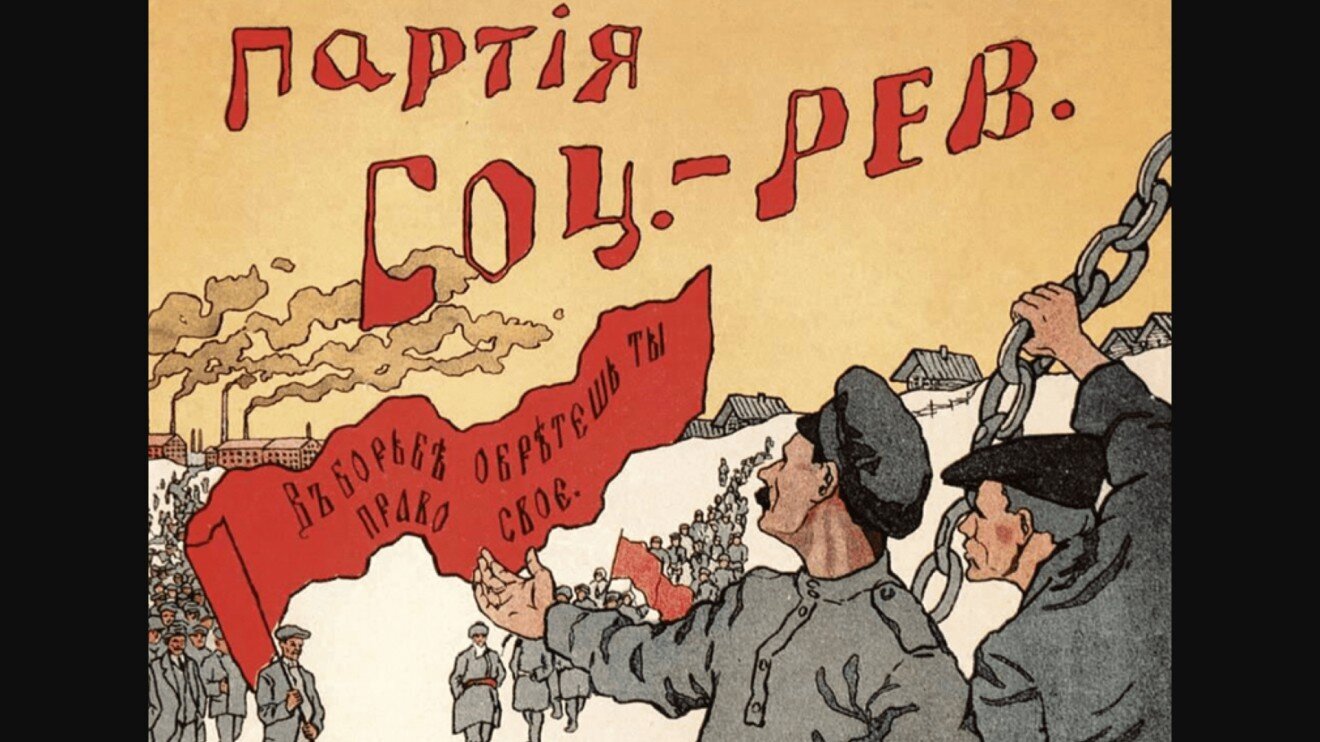
The Socialist Revolutionary Party (SR, or Esery in Russian) was the largest revolutionary political party in the early-20th-century Russian Empire, known for its terrorist activity and its Narodnik (agrarian-populist) ideology.
Origins and Ideology
The party was founded in January 1902 out of various Narodnik organizations. The SRs were the direct heirs of 19th-century Russian populism, and argued that Russia could move to socialism by a non-capitalist path, bypassing a stage of developed capitalism entirely.
The party's central idea was the "socialization of land" — abolishing private ownership of land and handing it over to peasant communes. Unlike the Marxist Social Democrats, the SRs considered the peasantry, not the proletariat, to be the main revolutionary force.
Terrorist Activity
The SRs became known above all for their terrorism. Their Combat Organization, active from 1902 to 1911, carried out a series of high-profile political assassinations:
- The murder of Interior Minister D. S. Sipyagin (1902)
- The murder of Grand Duke Sergei Alexandrovich (1905)
- In total, 233 terrorist attacks were carried out between 1902 and 1911
The Combat Organization's leader from 1903 to 1908 was Yevno Azef, who, as it later turned out, was simultaneously an agent of the tsarist secret police.
1917 — Triumph and Collapse
After the February Revolution of 1917, the SR party went through its high-water mark. By the summer of 1917 it had roughly a million members, making it the largest political party in Russia at the time.
Party members held key posts in the Provisional Government:
- Alexander Kerensky — Minister of Justice, later Minister of War and Prime Minister
- Viktor Chernov — Minister of Agriculture
- Nikolai Avksentyev — Minister of the Interior
In the November 1917 elections to the Constituent Assembly, the SRs won decisively, taking 374 of 766 seats (roughly 40% of the vote).
Standoff with the Bolsheviks
After the October Revolution, the SRs became one of the main opposition forces to Bolshevik rule. The party split: the Left SRs initially backed the Bolsheviks but later moved into opposition as well, while the Right SRs opposed Soviet power from the very start.
During the Civil War, the SRs stood up several anti-Bolshevik governments:
- The Committee of Members of the Constituent Assembly (Komuch) in Samara
- Participation in the Directorate in Omsk
- Support for various regional governments
The End of the Party
In 1922, a show trial of the SR party's leadership was held in Moscow, in which 12 party leaders were sentenced to death (later commuted to imprisonment). By 1923 the party had effectively ceased to exist within the USSR.
Some SRs emigrated and carried on political activity abroad, publishing journals such as Revolutionary Russia and Contemporary Notes. The last SR publications shut down in the mid-1940s.
Historical Significance
The Socialist Revolutionary Party played an important role in the Russian Revolution. As the largest non-Bolshevik party, it represented the interests of the peasantry — the overwhelming majority of Russia's population. But the SRs failed to offer an effective alternative to Bolshevik dictatorship, and were crushed during the Civil War.
In the context of the novel, the character's claim to have once been a "Socialist Revolutionary" points to involvement in the early-20th-century revolutionary movement — possibly including terrorist activity against the tsarist regime.