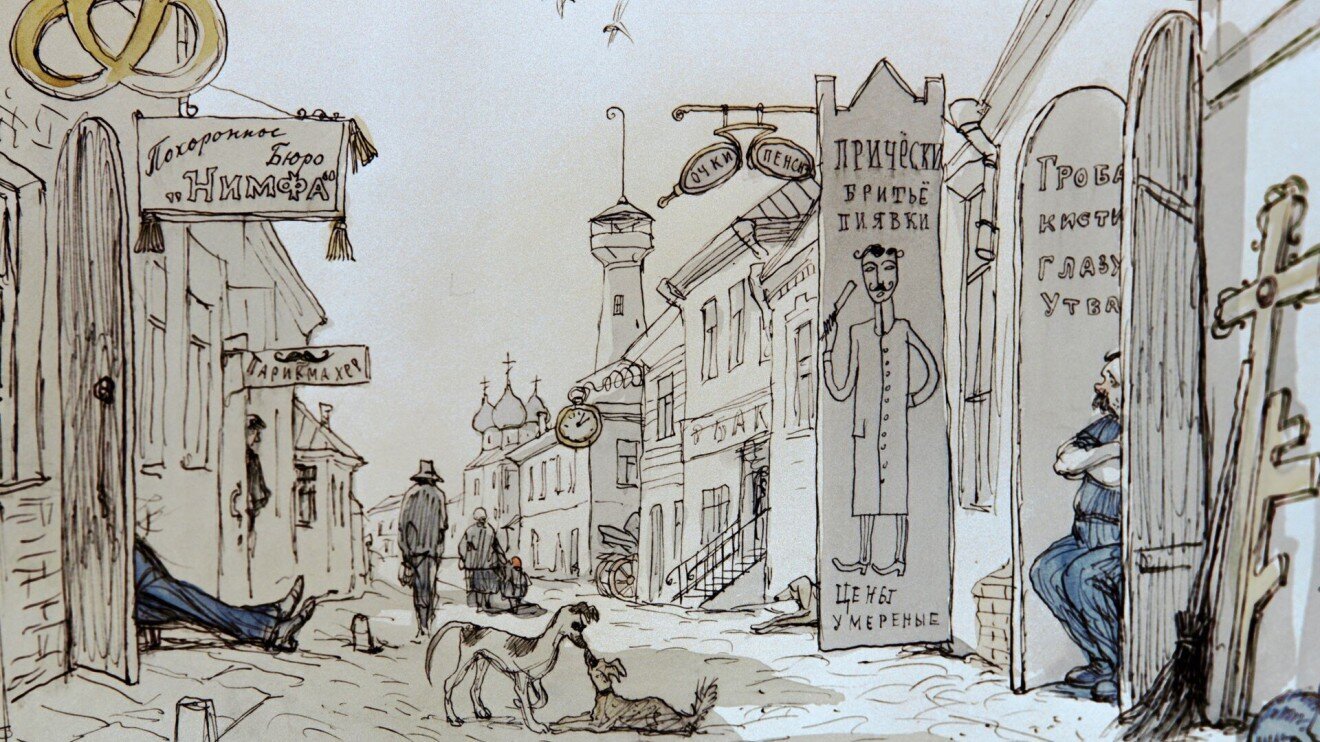
The mentioned passage nods to the classic satirical novel «The Twelve Chairs,» written by the Soviet authors Ilya Ilf (born Ilya Arnoldovich Faynzilberg, 1897-1937) and Yevgeni Petrov (born Yevgeni Petrovich Kataev, 1902-1942) in 1927. The novel was the pair's first joint work and the opening of a literary duology continued by «The Little Golden Calf» (1931).
The quoted passage sits right at the novel's opening, where the authors describe the provincial town of Stargorod (a fictional town whose name became shorthand for a typical backwater Russian town). Notably, the authors set the tone of the narrative immediately, flanking their hero with coffin workshops on both sides of the street — a fitting metaphor for a fading era.
The plot revolves around the search for diamonds hidden in one of twelve chairs from the drawing-room set belonging to Madame Petukhova, mother-in-law to the protagonist, Ippolit Matveyevich Vorobyaninov. The con man Ostap Bender, who joins the search, becomes the de facto leader of the «expedition» and leads the treasure hunt across the whole country, letting the authors paint a satirical panorama of late-1920s Soviet society.
«The Twelve Chairs» is a work with a rich cultural legacy. The novel's language, packed with sharp turns of phrase and witty lines, enriched Russian with a great many catchphrases and quotations, and the text itself became a model of satirical prose. The novel has been adapted for the screen many times, both in the USSR and abroad.
In the context of a novel about 1993 Russia, the nod to «The Twelve Chairs» can serve as a literary parallel between two pivotal eras — the NEP years of the 1920s and the post-Soviet period of the early 1990s, when old foundations were collapsing and new ones hadn't yet formed.