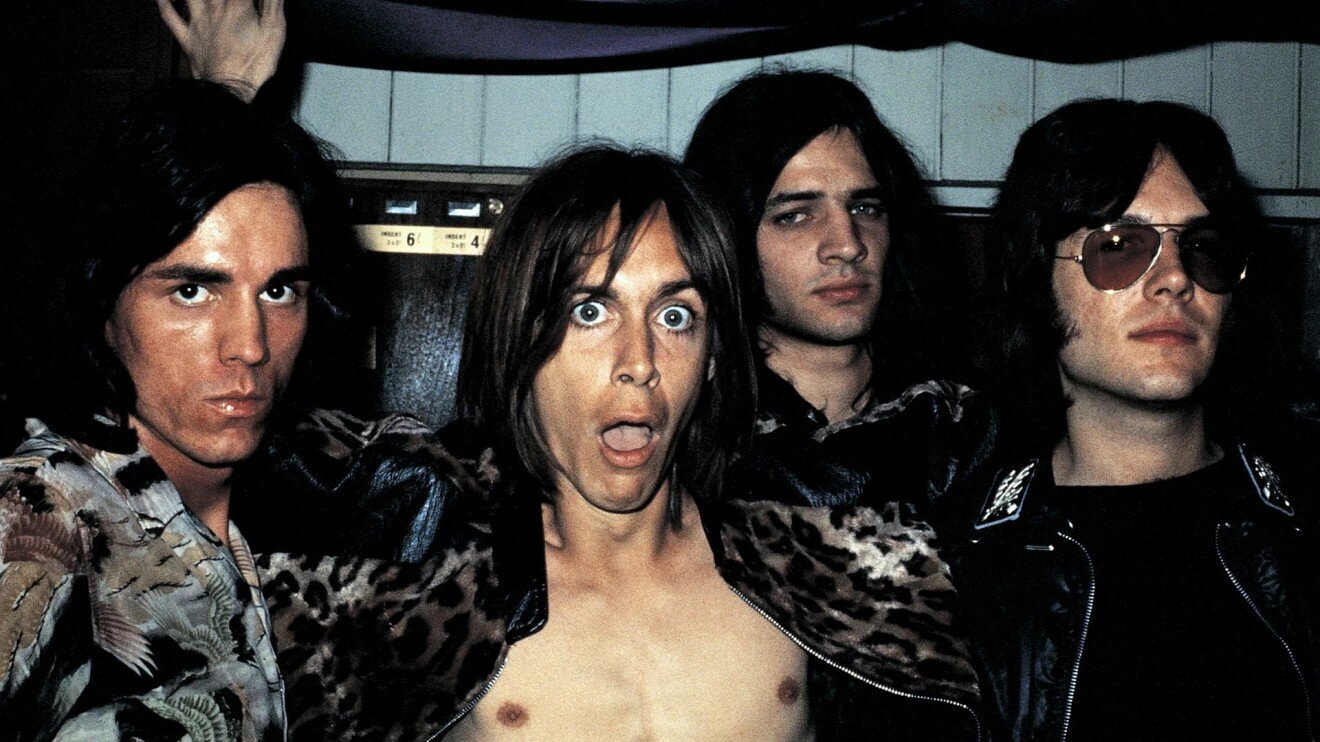
The Stooges were an American rock band that became one of the founders of punk rock and proto-punk. The band formed in 1967 in Michigan, led by frontman Iggy Pop (born James Osterberg) with the Asheton brothers — Ron (guitar) and Scott (drums) — and bassist Dave Alexander.
By 1994, when the novel is set, The Stooges had been defunct as an active band for twenty years. Their last concert was in 1974, after which the band broke up amid drug problems and internal conflict. Yet their influence on rock culture was undeniable by the early 1990s and continued to grow.
The Stooges' style has been described as garage rock, proto-punk, and glam rock. Their music was marked by an aggressive delivery, primitive but powerful riffs, and provocative lyrics. Iggy Pop's onstage antics stood out especially — he would cut himself with glass, roll around on stage, dive into the crowd — revolutionary for the late 1960s and early 1970s.
Over their brief career, the band released three studio albums: their self-titled debut "The Stooges" (1969), "Fun House" (1970), and "Raw Power" (1973). The latter became a cult classic and had an enormous influence on the development of punk rock. The song "Search and Destroy" from that album, mentioned in the novel's text, became an anthem of aggression and destruction.
In the context of 1990s Russia, the mention of The Stooges, and specifically "Search and Destroy," is quite symbolic. That track, with its refrain "I'm a street walking cheetah with a heart full of napalm," perfectly captured the spirit of ruthless competition and merciless struggle for survival amid the wild capitalism of the early 1990s.
By the mid-1990s, Russia had developed its own rock scene, and many young musicians and music fans were well-versed in the classics of Western rock, including The Stooges' work. Their records had circulated through underground channels even in Soviet times, and became more accessible once perestroika began.
The Stooges' philosophy — uncompromising, aggressive, dismissive of convention — resonated with the spirit of the times for many in the criminal and business worlds of the 1990s. "Search and Destroy" became a kind of soundtrack to an era when survival depended on being faster, harder, and more ruthless than the competition.
Interestingly, by 1994 Iggy Pop had already built a successful solo career, releasing several albums, including the famous "The Idiot" and "Lust for Life" (both 1977), made with David Bowie. Still, The Stooges' early work remained the most influential within underground culture.
The band's mention in the context of criminal dealings is no accident — The Stooges' music was always associated with rebellion, anarchy, and the destruction of the existing order. For the novel's characters, living amid lawlessness and constant threat, the band's aesthetic becomes not just a musical preference, but a philosophy of life.