In the early 1990s, amid Russia’s economic transformation and the lack of clear financial regulation, a host of organizations sprang up promising the public unbelievably high investment returns. Most turned out to be Ponzi schemes that ruined millions of citizens.
What a Financial Pyramid Scheme Is
A financial pyramid (or Ponzi scheme) is a system that pays returns to participants using funds continually drawn from new investors. Early participants are paid entirely out of money from later investors, while the true source of the «profit» is concealed or replaced with a fictional one.
Key Signs of a Financial Pyramid
- Promising returns several times higher than the market rate
- Guaranteeing profit with no real underlying assets
- Opaque investment mechanisms
- Heavy advertising emphasizing how easy the money is
- Paying new participants out of earlier investors’ money
Russia’s Biggest Financial Pyramids of the 1990s
MMM (1994–1996)
Russia’s most famous financial pyramid, created by Sergei Mavrodi. The company was registered in 1993 but didn’t launch active operations until February 1994. Thanks to an aggressive ad campaign featuring the fictional everyman «Lyonya Golubkov,» MMM drew in 10 to 15 million investors. At its peak, MMM shares cost 125,000 rubles apiece. The collapse came in July 1994, when the company stopped payments.
«Vlastilina» (1992–1994)
A financial pyramid run by Valentina Solovyova out of Podolsk. Its distinguishing feature was a high entry bar — the minimum investment was 50 million pre-denomination rubles. The company promised cars and apartments at half the market price. Investors included well-known performers: Alla Pugacheva, Filipp Kirkorov, Nadezhda Babkina, Alexander Rosenbaum. The pyramid collapsed in the fall of 1994; total damages ran to about 537 billion pre-denomination rubles.
«Khoper-Invest» (1993–1994)
A Volgograd company founded by the Konstantinov family. By the end of 1994 it had branches in 75 regions of Russia. Ad spots featuring popular performers made the company a household name. The slogan «Khoper-Invest — a great company. Unlike the others» became a catchphrase. After criticism from Anatoly Chubais, the company stopped payments in December 1994, owing about 500 billion rubles to four million investors.
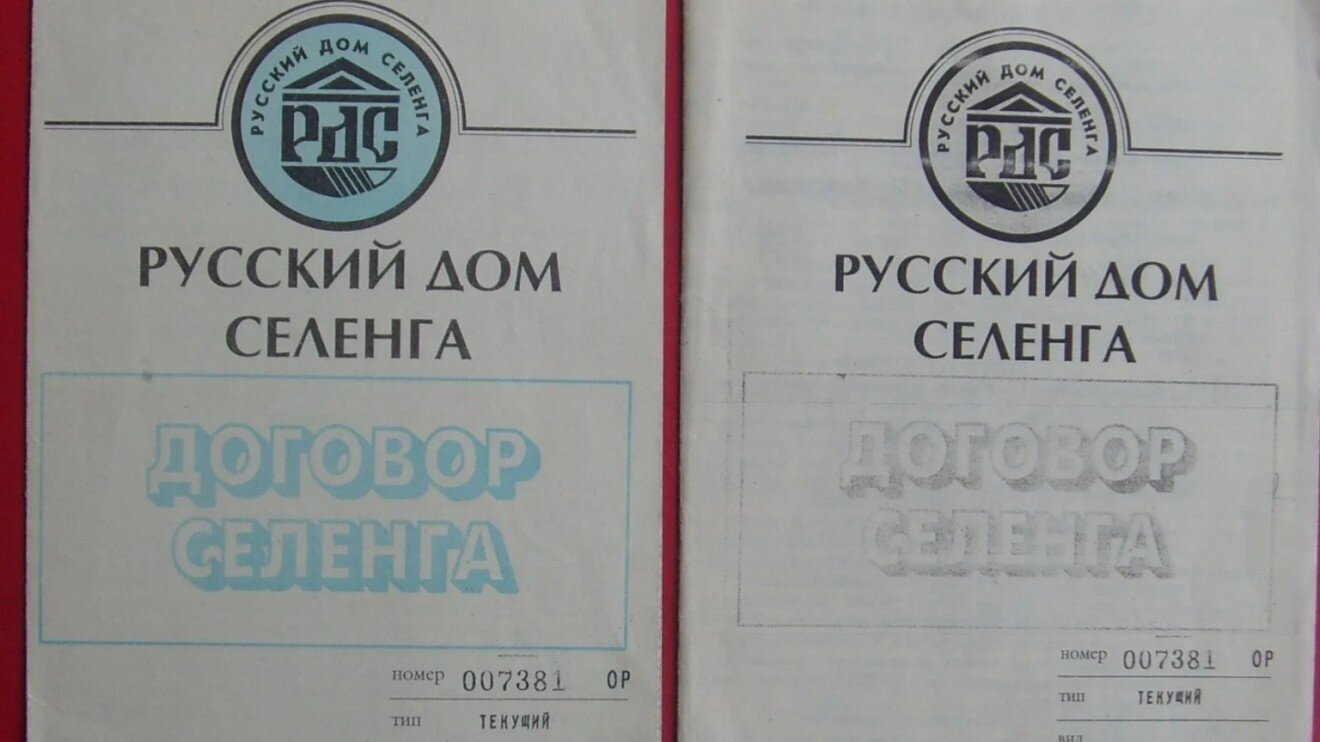
«Russky Dom Selenga» (1992–1997)
A Volgograd financial company founded by Alexander Salomadin and Sergei Gruzin. Its marketing hinged on a made-up term, «selenge» — supposedly leasing out material assets with no liability for the lessee. Over its existence, the company drew in around 2.5 million investors and nearly 3 trillion pre-denomination rubles. It was declared bankrupt in 1997.
«Tibet» / «Tandem» (1991–1994)
A group of companies founded by Vladimir Dryamov. He started out selling medicinal herbs in Dubna, then built a network of interlinked firms. From 1993, «Tandem» paid investors 30% a month. The pyramid collapsed in August 1994, affecting around 200,000 people for a total of more than 17 billion rubles.
«Chara» Bank (1992–1996)
Founded by Vladimir Rachuk and Marina Frantseva, the bank started as a family venture. From September 1993 it took deposits at high interest while quietly moving money abroad. Its depositors included many members of the creative intelligentsia. It stopped payments in October 1994 and lost its license in 1996. Its debt totaled 131 billion rubles.
Telemarket
The company «Telemarket,» mentioned in the novel, doesn’t appear among the major financial pyramids of the 1990s. It may refer to one of the era’s lesser-known financial outfits, or it may simply be the author’s invention.
Historical Context
The mass rise of financial pyramids in Russia was driven by several factors:
- Economic instability — high inflation was eroding citizens’ savings
- A lack of financial literacy — the public had no experience with investment instruments
- Weak legal regulation — no clear rules existed for financial organizations
- Public credulity — people believed in the possibility of getting rich quick
- Aggressive advertising — companies spent enormous sums attracting new customers
Consequences
The collapse of these financial pyramids inflicted colossal damage on the Russian economy and society. Millions of citizens lost their savings, undermining trust in financial institutions for years to come. The state was forced to adopt special laws regulating financial organizations.
In 2016, Article 172.2 was added to the Russian Criminal Code, providing for up to 6 years in prison for organizing a financial pyramid.
The «promised thousands of percent a year» mentioned in the novel isn’t an exaggeration. Real pyramids of the time really did promise incredible returns: MMM — up to 3,000% a year, «Tandem» — 360%, many others — anywhere from 200% to 1,000% a year.
The events described in the novel take place at the very height of Russia’s «pyramid boom,» when such companies were popping up practically every day, and their ads saturated every media outlet.