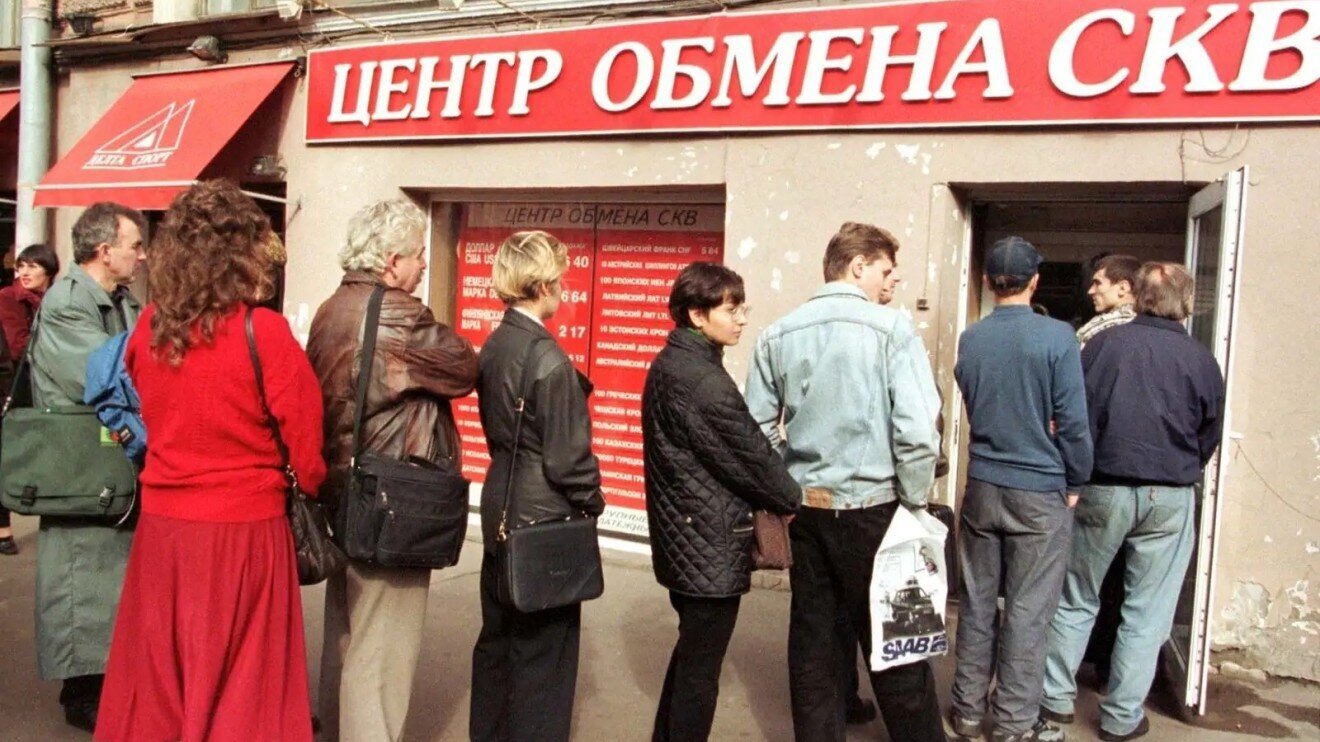
The novel mentions trading in hard currency (SKV) as a way of hedging against the swings of the ruble. The term carried a particular weight in the economic realities of Russia in 1993.
What SKV means
Freely convertible currency (SKV, from the Russian svobodno konvertiruyemaya valyuta) is a currency subject to no restrictions on foreign-exchange operations, whether for current payments or for transactions involving the movement of capital. The authorities impose no separate limitations on residents or non-residents dealing in such a currency.
By the start of the 1990s the principal freely convertible currencies were considered to be:
- The US dollar
- The German mark (the Bundesmark)
- The Japanese yen
- The British pound sterling
- The French franc
- The Swiss franc
Hard currency in the Russia of 1993
Amid the economic instability of the early 1990s the Russian ruble was not a freely convertible currency. More than that, it was living through a period of dramatic devaluation and high inflation.
Exchange rates for reference
As of July 20, 1993, the major currencies stood against the dollar as follows: the British pound at 0.6707–0.6711, the German mark at 1.7135–1.7145, the French franc at 5.835–5.840. The Russian ruble traded at 1,017 rubles to the dollar.
In 1993 the Russian economy was passing through one of its hardest stretches:
- The price liberalization begun in January 1992 was still running its course
- Inflation had reached catastrophic levels
- A currency reform was carried out between July 26 and August 7, 1993
- A banking crisis struck in October
Why business worked in hard currency
For Russian entrepreneurs in 1993, working in freely convertible currency was not a luxury but a survival necessity. Several factors explain it:
Protection from inflation
The Russian ruble was depreciating headlong. Ruble prices could shift within a matter of days, making business planning impossible.
Stable settlement
Dollars and German marks held their value comparatively steady, making long-term commercial relationships workable.
The currency reform of 1993
It was in 1993, when the novel is set, that the Russian authorities carried out a sweeping currency reform. Between July 26 and August 7 all banknotes of earlier issues were withdrawn from circulation, and the only legal tender became Bank of Russia notes of the 1993 series.
The reform was carried out to shield the economy from the flood of money coming in from the other post-Soviet states, and as an attempt to restrain inflation.
The practical side of trading in hard currency
As the example from the novel shows, many Russian entrepreneurs in 1993:
- Set prices exclusively in dollars or marks
- Kept their profit accounts in hard currency
- Avoided ruble settlement to hedge against currency risk
- Used the hard-currency rate as the basis for business planning
Historical context
In 1993 this practice was a forced measure. The Russian ruble had not yet found stability, and the country’s economy was in the middle of its transformation from a planned to a market system.
Consequences for the economy
The mass use of hard currency in settlements had two-sided consequences for the Russian economy:
| Positive effects | Negative effects |
|---|---|
| Protection of business from inflation | Erosion of confidence in the national currency |
| The possibility of long-term planning | Obstruction of the state’s monetary policy |
| Attraction of foreign investment | Deepening dependence on external factors |
The novel’s remark that «the dollar and the Bundesmark stood unshaken» captures the realities of the time precisely. For Russian entrepreneurs these currencies really did serve as an island of stability in the sea of economic uncertainty of the early 1990s.