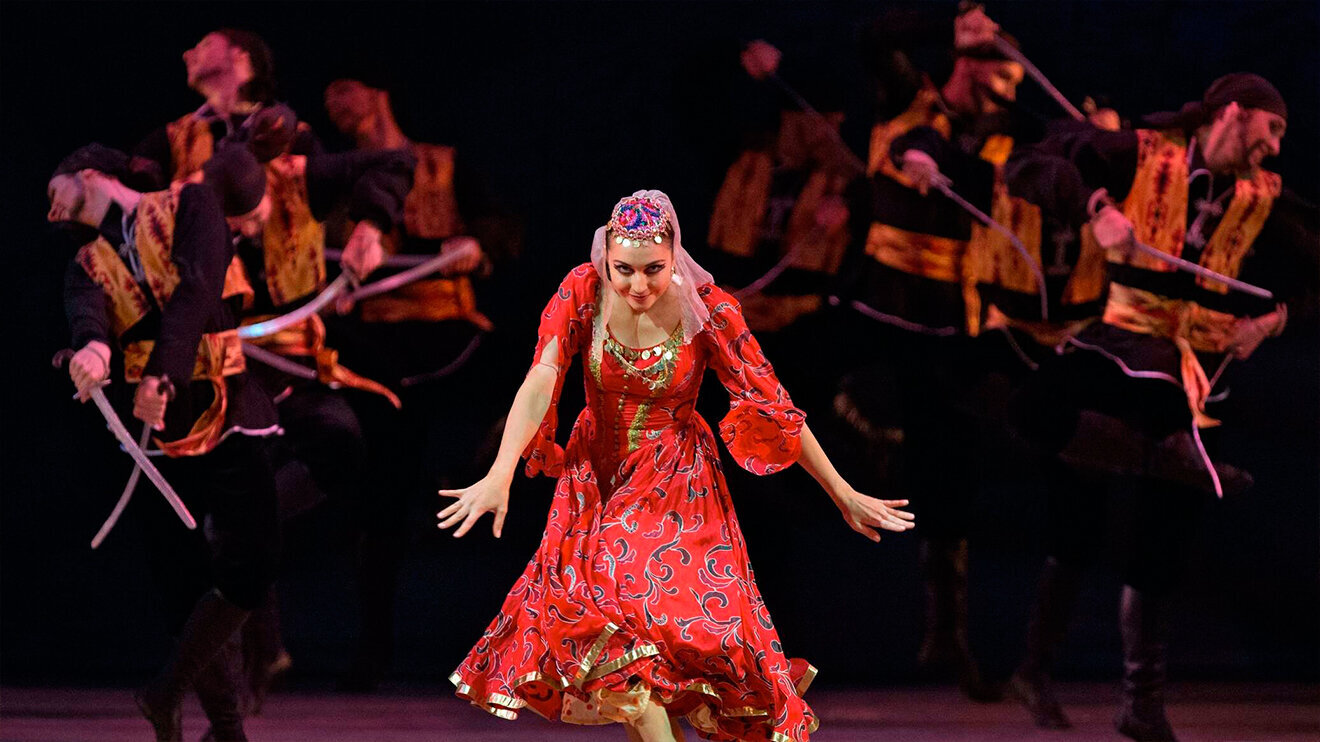
"Sabre Dance"
"Sabre Dance" is a famous musical excerpt from the ballet "Gayane," created by Soviet composer Aram Khachaturian in 1942. It comes from the fourth act of the ballet, where a traditional Armenian sabre dance is performed, marked by a breakneck tempo, vivid orchestral colors, and furious energy.
The ballet "Gayane" tells the story of a young Armenian woman's life on a collective farm. Its premiere took place in December 1942 in Perm (then called Molotov), where the Kirov Leningrad Opera and Ballet Theatre had been evacuated. "Sabre Dance" quickly gained popularity and began to be performed as a stand-alone concert piece, becoming one of the most recognizable pieces of music of the 20th century.
Aram Khachaturian (1903-1978)
Aram Ilyich Khachaturian was an outstanding Soviet composer of Armenian descent, a conductor, teacher, and public figure in music. He was born on June 6, 1903, in Tiflis (now Tbilisi), into an Armenian family. He began studying music quite late — entering the Gnessin Musical College in Moscow at age 19.
In 1934 he graduated from the Moscow Conservatory, having studied composition under Nikolai Myaskovsky. His graduation piece was his First Symphony, in which the defining traits of his style were already vividly on display: a fusion of classical forms with Armenian national color.
Among Khachaturian's best-known works, besides the ballet "Gayane," are the ballet "Spartacus" (1954), the Violin Concerto (1940), three symphonies, and music for numerous plays and films. Khachaturian forged a musical language all his own, uniting the traditions of Armenian folk music with the achievements of European classical music.
Aram Khachaturian received numerous honors, including the title of People's Artist of the USSR (1954), the Lenin Prize (1959), and several Stalin Prizes. He died on May 1, 1978, in Moscow.
"Flight of the Bumblebee"
"Flight of the Bumblebee" is an orchestral interlude written by Nikolai Andreyevich Rimsky-Korsakov for the opera "The Tale of Tsar Saltan" (1899–1900). The piece is heard in the third act of the opera, when Prince Gvidon transforms into a bumblebee in order to visit his father unnoticed.
The piece became famous for its virtuosity and the technical difficulty of performing it. The music captures the insect's rapid flight with astonishing precision, through fast chromatic runs. "Flight of the Bumblebee" is often performed as a stand-alone concert piece and exists in countless arrangements for different instruments. It is considered one of the most technically demanding pieces in the repertoire and often serves as a way for musicians to show off their virtuosity.
Nikolai Rimsky-Korsakov (1844-1908)
Nikolai Andreyevich Rimsky-Korsakov was a Russian composer, teacher, conductor, public figure, and music critic. He was born on March 18, 1844, in Tikhvin, into a noble family. He began studying music from early childhood, but initially chose a naval career, graduating from the Naval Cadet Corps in St. Petersburg.
In 1861 he met Mily Balakirev and joined the creative circle of composers known as "The Mighty Handful" (or the "Balakirev Circle"), becoming one of its most brilliant representatives. The group sought to create a distinctly Russian classical music, rooted in folk art.
Rimsky-Korsakov is the author of 15 operas, three symphonies, and numerous orchestral works, among which "Scheherazade," "Capriccio Espagnol," and "Russian Easter Festival Overture" are especially well known. Most of his operas are based on Russian fairy tales and legends, including "The Snow Maiden," "Sadko," "Kashchei the Immortal," and "The Golden Cockerel."
Rimsky-Korsakov's teaching at the St. Petersburg Conservatory was of enormous importance, where he trained an entire generation of outstanding composers, including Alexander Glazunov, Anatoly Lyadov, and Igor Stravinsky. He was also known as a brilliant orchestrator, who wrote a treatise on orchestration and completed a number of works left unfinished by his fellow members of "The Mighty Handful" after their deaths.
Nikolai Rimsky-Korsakov died on June 21, 1908, at his estate of Lyubensk, near Luga.