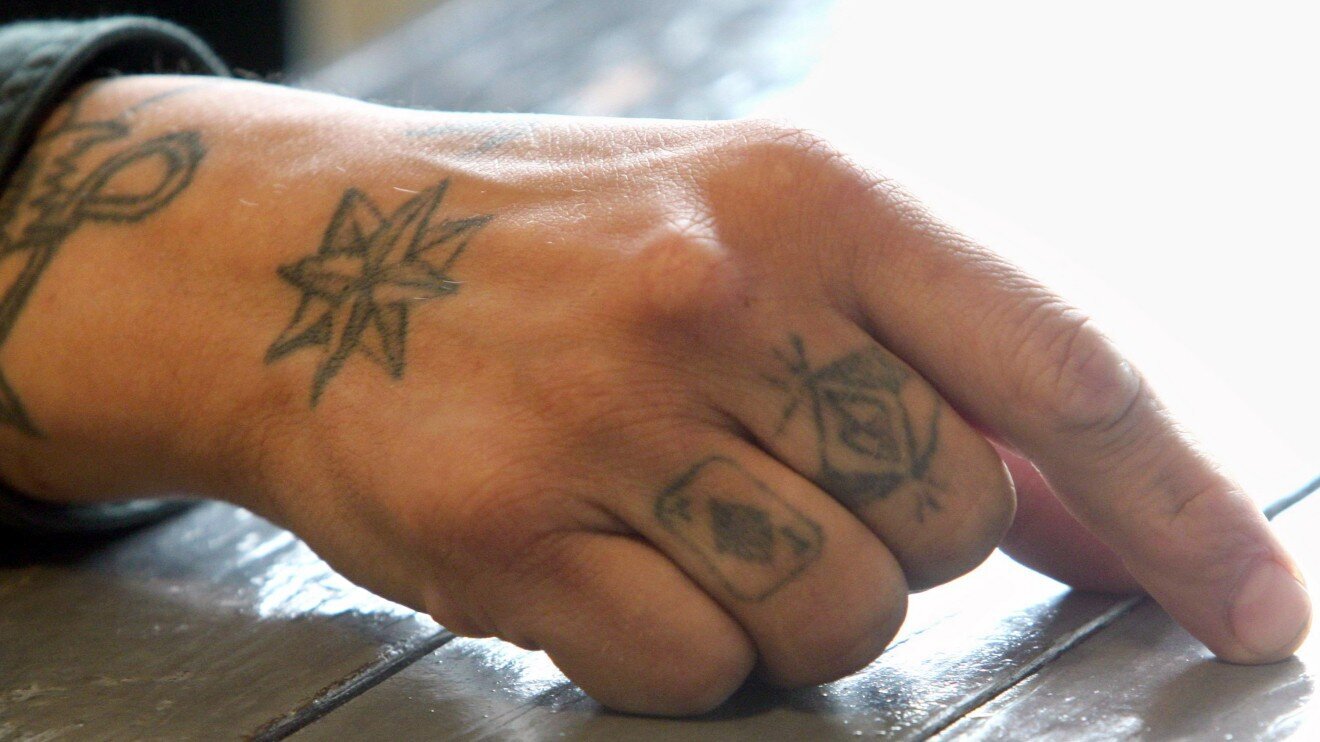
In 1993 Moscow, the phrase "So who are you, in life?" was a key element of criminal communication. This question was used to identify an interlocutor's social status within the informal hierarchy of the prison system and the criminal underworld.
The structure of the question and its function
The phrase "who, in life" was a set expression, borrowed from prison slang*. The question was not asked to learn about someone's profession or occupation in the ordinary sense. It demanded that the person being asked declare which caste* of the prison hierarchy, or which part of the criminal world, they belonged to.
A correct answer to this question required using specific terminology: "chelovek" ("a person"), "muzhik" ("a regular guy"), "patsan" ("a lad"), "brodyaga"* ("a wanderer"; see the article "The 'Brodyaga' in the Criminal Hierarchy"), "blatnoi"* ("a made man"), "arestant"* ("a prisoner"). Each of these designations carried a precise meaning within the criminal subculture, and determined the speaker's status, rights, and obligations.
The mechanics of the provocation
The question "So who are you, in life?" was used as a tool for sizing someone up. A person unfamiliar with the rules of criminal communication would commit one of the following errors:
- Answer in ordinary categories: "a student," "a businessman," "an employee"
- Try to dodge the question without using the correct verbal formulas
- Show confusion or fear
- Begin making excuses or explaining their status
Any of these reactions was taken as a sign of a "lokh"* ("a mark") — someone who did not belong to the criminal world and didn't know its rules. This gave grounds for further psychological pressure, demands for "tribute," physical violence, or humiliation.
The rules for answering
A correct answer to the question required knowledge of several principles. First, one had to establish, with a counter-question, the questioner's own right to ask: "Why do you want to know?", "Introduce yourself properly first," "And who are you yourself?"
This counterattack shifted the initiative to the person being questioned. Under the rules of criminal communication, whoever initiates a conversation is obligated to justify their interest. Refusing to justify it was classified as "bespredel"* ("lawlessness") — an improper act, violating criminal "ponyatiya"* ("codes").
Second, one had to avoid any form of excuse-making or explanation of one's actions. Phrases like "I don't want to answer," "that's my own business," or "I don't know you" were seen as weakness, and gave grounds to accuse the speaker of disrespecting the questioner.
Third, it was essential to stay calm and show a command of the rules of the game. Any display of fear, confusion, or aggression was used against the person answering.
Examples of correct responses
People who did not belong to the criminal world, but were familiar with its rules, used formulas such as:
- "Chelovek" ("A person")
- The most neutral answer, indicating non-membership in the criminal hierarchy while still demonstrating knowledge of the rules.
- "Chelovek poryadochny" ("A decent person")
- An expanded version of the previous answer, emphasizing adherence to certain moral standards.
- "Ya ne po zhizni, ya v zhizni" ("I'm not 'in life' [the criminal sense], I'm just living my life")
- A play on words, rejecting the very premise of the question and refusing to define oneself in the terms of the criminal hierarchy.
- "Kak zhizn' prozhivu, srazu skazhu" ("Once I've lived my life, I'll tell you right away")
- An evasive answer, showing an unwillingness to define one's status.
- "Chelovek bozhii, po zhizni prokhozhii" ("A child of God, just passing through life")
- A formula pointing to the temporary nature of one's presence in the criminal milieu, and non-involvement in its hierarchy.
Use of the question by small-time criminals
In 1993 Moscow, this question was actively exploited by young men from the far Moscow suburbs, mimicking criminal behavior. This category of people had no real ties to serious criminal authorities, but used elements of the criminal subculture to intimidate businessmen and extract illegal profit.
A typical scheme included the following elements:
- A group of three to five people showing up at a business
- Displaying markers of criminal affiliation: distinctive clothing (leather jackets, tracksuit pants with side stripes*, pump-style shoes*, white socks*), tattoos*, a particular manner
- Asking provocative questions: "Who's in charge here?", "So who are you, in life?"
- Psychological pressure through a display of readiness for physical violence
- Demanding "tribute," or control over the business
The scheme's effectiveness rested on victims' ignorance of the rules of criminal communication, and their fear of the criminal underworld's representatives.
Businessmen's defensive strategy
Commercial operations with connections to real criminal authorities developed a system for defending against such provocations. The key element of this system was redirecting the provocateurs to genuine representatives of the criminal hierarchy.
The phrase "poteret' za bazar s brodyagoi" ("hash it out with a brodyaga"; see the article "The 'Brodyaga' in the Criminal Hierarchy") was an offer for the provocateurs to justify their actions before someone with genuine authority in the criminal world. This offer immediately revealed the provocateurs' true status.
Serious criminals did not put such questions to businessmen operating under the "roof"* of other authorities. The criminal world had a well-developed system of communication, letting it avoid conflicts over spheres of influence. Using provocative questions like this one indicated non-membership in that system, and low status within the criminal hierarchy.
Gradations of response and their consequences
The answer given to "So who are you, in life?" determined how the situation would unfold. Several outcomes can be distinguished:
| Type of response | Consequences |
|---|---|
| Correct terminology, showing command of the rules | Pressure eases; possible respect from the questioners |
| A counter-question about the questioner's aims | Initiative shifts; the provocateurs' true intentions are exposed |
| Confusion, attempts to explain in ordinary terms | Classified as a "lokh"; pressure intensifies |
| Refusal to answer without the correct formulas | Accusation of disrespect; possible physical violence |
| An aggressive reaction with no knowledge of the rules | Escalation; physical violence |
The question as a tool of social control
Using the question "So who are you, in life?" went beyond simple provocation. This tool served to maintain the boundaries of the criminal subculture and its hierarchy. Through this question, a person's membership among "ours" or "outsiders" was established, their place in the social structure, and the acceptable ways of dealing with them.
During the social upheaval of the early 1990s, when the old institutions of social control had collapsed and new ones had not yet formed, the criminal subculture expanded its reach. Its rules and language seeped into everyday communication, becoming a tool for establishing hierarchical relationships beyond the confines of prison.
The question "So who are you, in life?" became a marker of this process — an indicator of an attempt to apply the criminal world's rules to ordinary citizens and commercial relationships.
The psychological basis for the question's effectiveness
The effectiveness of this provocation rested on several psychological mechanisms:
Uncertainty about the rules of the game. A person unfamiliar with the criminal subculture had no idea what the correct answer was, producing confusion and fear.
Fear of physical violence. The question was asked in a context that displayed a readiness for aggression, blocking the victim's rational thinking.
Social pressure. The question was often asked in front of other people, heightening the fear of public humiliation.
Imposing someone else's rules. The very act of asking the question forced the person answering to accept the questioner's frame of reference, giving the questioner the advantage.
How use of the question evolved
By the mid-1990s, knowledge of how to answer this question had spread among the urban population. Businessmen, entrepreneurs, and retail workers had developed defensive strategies. At the same time, criminal organizations were professionalizing — serious gangs moved toward more sophisticated forms of controlling businesses, no longer requiring such crude provocations.
The question "So who are you, in life?" remained in the arsenal of petty criminals and gopniks*, but lost its effectiveness as a tool for intimidating educated city dwellers.
Knowledge of the rules of criminal communication in early-1990s Moscow was a practical survival skill for anyone engaged in commerce. The question "So who are you, in life?" was a key element of this communication, demanding a specific form of response.