In the novel, set in 1993, the character Zhorik uses the word "zagogulistaya" ("zigzaggy," "twisty") to describe his own timeline. This creates an interesting anachronism, since the word "zagogulina" in its specific political-cultural sense wouldn't enter wide public circulation until five years after the events described here.
Etymology and Original Meaning
"Zagogulina" is a dialectal, colloquial Russian coinage. In folk speech it existed long before it acquired any political coloring. Originally the term denoted:
- A curved ornament, a flourish, a bent line in a drawing or in handwriting
- Something convoluted or tangled in form or construction
- A strange twist, an unexpected turn of events
- A trick, a ruse, a particular maneuver in some matter
The word's root is tied to the verb gnut', "to bend." The prefix za- and the suffixes -ul- and -in- together conjure an image of something bent and twisted over and over. Morphologically, it belongs to the expressive folk vocabulary that conveys the very essence of what it names through its sound.
The Term's Political Birth
The Historic Date
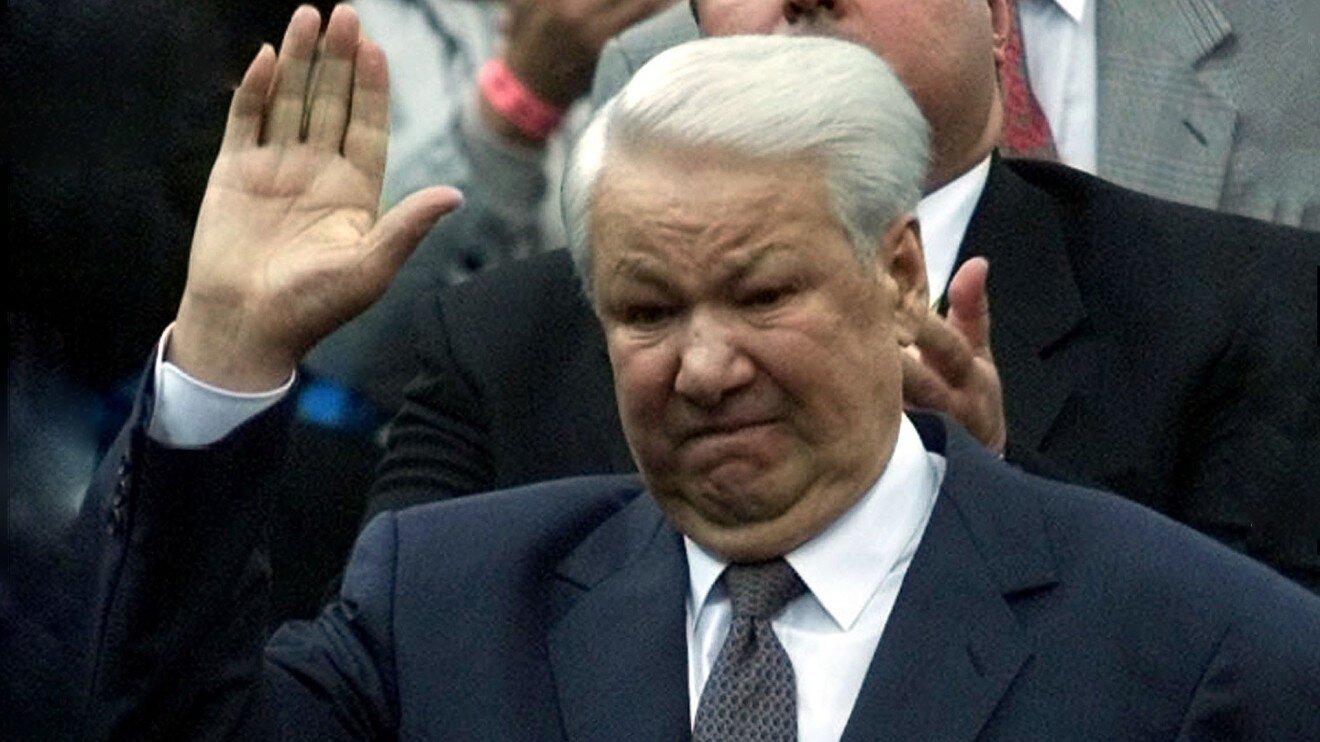
According to the Dictionary of the Russian Public Language of the Late 20th Century, the word "zagogulina," applied to Russia's political reality, was first uttered by Boris Nikolayevich Yeltsin on October 8, 1998. It happened at a ceremony introducing the armed forces' top officers, and the moment was caught on television, which ensured the expression spread immediately.
The full phrase went: "My support for you is a priority, but my demands of you are a priority too. So that's, you know, quite a zagogulina we've got here." Addressing the military, the president reached for a colloquial word to describe the mutual obligations binding the government and the army, creating an effect of unexpected candor and simplicity.
The Context Behind the Phrase
October 1998 was a difficult time for Russia. The country was reeling from the August default; Sergei Kiriyenko's government had just been dismissed, and Yevgeny Primakov had become prime minister. Amid the economic crisis, funding the security services was an especially sore point. Yeltsin was, in effect, admitting to the difficulty of the situation: the state was obligated to support the army, but its demands of that army remained high, unpaid debts notwithstanding.
In this context, "zagogulina" captured the paradoxical, contradictory nature of a situation where both sides were bound by mutual obligations that couldn't fully be met. It was an unvarnished admission of a difficult reality, expressed in a plain folk word.
Yeltsin's Continued Use of the Word
After its first public use, the word stuck in the vocabulary of Russia's first president. In his book Presidential Marathon (2000), Yeltsin used the term "zagogulina" to describe his own political tactics in appointing a prime minister in May 1999.
Describing the situation around Sergei Stepashin's candidacy, Yeltsin wrote: "But I like how I wrapped up the intrigue with Aksyonenko. Quite a zagogulina. The Duma people are expecting exactly him, getting ready for a fight. And right at that moment, I'll give them a different candidate." Here, "zagogulina" no longer means a contradictory situation, but a cunning maneuver, an unexpected move, a piece of political sleight of hand.
So, in Yeltsin's own usage, the word picked up two shades of meaning:
- A statement acknowledging a difficult, paradoxical situation full of internal contradictions
- A label for one's own unexpected political move, maneuver, or feint
Its Place in Dictionaries and Reference Works
In Dictionaries and Handbooks
The word "zagogulina," in its Yeltsin-era sense, was recorded by several lexicographic sources:
The Russian Wiktionary defines the expression "so that's, you know, quite a zagogulina we've got here" as "an acknowledgment of the seriousness, the contradictoriness, of a situation." That definition captures precisely the first, October usage of the term.
Oleg Yuryevich Maslov, in his work "Stabilitet and the Apologetarium" (Dictionary of Contemporary Russian Politics, Part 5), dated September 28, 2006, offers a broader gloss: "Zagogulina — a term denoting one of the chief features of Russian politics at the end of the 20th century. The term was coined by Russia's first president, B. N. Yeltsin."
The word also made it into K. V. Dushenko's Great Dictionary of Quotations and Catchphrases, confirming its status as a stable expression that has taken root in the language.
Its Place in Yeltsin's Idiolect
The linguist Kseniya Knorre-Dmitrieva, analyzing the speech of post-Soviet Russian politicians, notes: "Every one of our leaders had some speech quirk that ended up in jokes: say 'arch-important,' 'to begin' with the stress in the wrong place, 'Kuzka's mother,' or something with a Georgian accent or a lip-smack, and everyone instantly knows who you're talking about. In the '90s, Boris Yeltsin had 'you know,' 'zagogulina,' 'shta' [a slurred 'what']."
So "zagogulina" took its place alongside Yeltsin's other speech markers. The word became part of his media image, right along with his manner of pronunciation and his taste for informal vocabulary. This was the speech of a "Sverdlovsk regional Party committee secretary," as Knorre-Dmitrieva put it, but a less formal version, allowing room for colloquialisms and dialect.
Making Sense of the "Zagogulinas"
Zagogulina as a Principle of Political Biography
Dmitry Kamyshev, an editor on Kommersant's politics desk, proposed an interpretation under which "the entire political biography of Russia's first president was, in effect, made up of just such 'zagogulinas.'" By "zagogulinas" he meant decisions and actions that:
- Looked, at the time, like a tactical defeat or a mistake
- Contained internal contradictions
- Drew criticism and incomprehension
- But later turned into a strategic success, or created a new reality
A Catalog of Political "Zagogulinas"
Kamyshev put together a sort of catalog of Yeltsin's "zagogulinas," spanning the whole of the first president's political career:
The October 1987 Plenum
Yeltsin's speech at the October plenum of the CPSU Central Committee, sharply criticizing the Party leadership and Mikhail Gorbachev personally, led to his removal as First Secretary of the Moscow City Party Committee and effective political exile to the post of deputy chairman of Gosstroy. Yet that very stand laid the groundwork for his future popularity as a politician willing to openly confront the system. The October plenum became the foundation for his victories in the elections for USSR and RSFSR people's deputies, and later in the presidential election.
The 1992 Shock Therapy
The liberalization of prices under Yegor Gaidar's government in January 1992 sent prices spiraling, dealing a blow to ordinary citizens' well-being and to the authority of a president who had promised to "lie down on the rails" if things got worse. Yet the result was the end of chronic shortages and queues, and the shift to a market economy. Short-term pain turned into long-term systemic change.
The Events of October 1993
The use of force against the Supreme Soviet, and the shelling of the White House by tanks, damaged Russia's image as a democratic country. But the result was a new Constitution, establishing a presidential republic and, in the view of Yeltsin's supporters, laying the foundations of Western-style democracy. The harshness of the method stood in stark contrast to its stated goal — building a democratic state.
The 1995–1996 Loans-for-Shares Auctions
The scandalous privatization of the country's largest enterprises through loans-for-shares auctions failed to bring in the expected budget revenue, gave rise to the oligarchs, and helped inflate the GKO pyramid scheme that ended in the 1998 default. Yet those very auctions created a class of major private owners, many of whom turned money-losing Soviet enterprises into efficient companies. The oligarchs' political backing, in turn, helped Yeltsin win the 1996 election.
The Chechen Problem
The deployment of troops into Chechnya in December 1994 was the consequence of a paradoxical situation: Russia's leadership had first backed the "parade of sovereignties" in its struggle against the Union center, then tried to halt that same process within Russia itself — but in Chechnya, self-determination had gone too far. The first Chechen campaign ended in effective defeat and the Khasavyurt Accords, though the problem would return under a new leadership.
The Resignation of December 31, 1999
Yeltsin's early resignation and handover of power to Vladimir Putin was his final "zagogulina." The president announced he was handing power to a "new generation," under which Russia "would never go back to the past." Yet subsequent events showed a return to elements of the past was entirely possible: direct gubernatorial elections were abolished, State Duma election rules were tightened, and the media came under state control.
The Philosophy of Zagogulina
A Dialectic of Contradictions
The concept of "zagogulina" reflects a particular understanding of political action, in which:
- Contradiction isn't a flaw, but a driving force
- Short-term losses are justified by long-term gains
- Straightforwardness gives way to maneuvering and detours
- A tactical defeat can be a stepping stone to strategic victory
- The goal and the means of achieving it can appear to be in visible contradiction
Zagogulina as a Cultural Code
The choice of precisely this word to describe complex political situations is no accident. "Zagogulina" is:
A visual metaphor. The word conjures an image of a winding line, a curve, a loop. Yeltsin's political path really wasn't a straight one — it was full of unexpected turns, reversals, loops.
Folk language. Using a dialectal, colloquial word instead of a political term created an effect of closeness to ordinary people, of simplicity, of an absence of officialese — a deliberate contrast to the Soviet "wooden tongue" of the nomenklatura.
A humorous effect. The word sounds funny, almost childish. It deflates the gravity of a situation, letting one speak of serious contradictions with irony rather than a tragic tone.
An acknowledgment of complexity. "Zagogulina" is an honest admission that a situation is tangled, contradictory, without a simple solution — the opposite of the Soviet era's confident pronouncements about the "one true path."
The Temporal Paradox in the Novel
The character Zhorik's use of the word "zagogulistaya" in 1993 creates an interesting anachronism. In reality, the term "zagogulina" wouldn't take on its specific political-cultural meaning until 1998. In 1993, it would have been simply a dialect word, carrying no political connotations at all.
In the context of the novel, though, this anachronism can work in several ways:
Foreshadowing
If the novel's plot involves time travel or parallel realities (judging by the conversation about ten-dimensional spaces and timelines), then using a word that "hasn't been coined yet" may be a deliberate device. Zhorik, occupying the "most zagogulistaya" of all timelines, may well know something of the future, or draw his words from other temporal streams.
Metaphorical Precision
The word "zagogulistaya" is a perfect fit for describing nonlinear time, crossing timelines, and the complex trajectories of fate. A line with two punctures, where a person's essence meets itself from another time, is genuinely a "zagogulina" in its purest form. Zhorik reaches for a folk word to describe a complex physical-philosophical concept, following the tradition of explaining the complex through the simple.
Characterizing the Character
The choice of the word "zagogulistaya" characterizes Zhorik himself as someone drawn to folk speech and dialect, capable of expressing a complicated idea in plain, vivid language. It builds a particular social and cultural portrait of the character.
Zagogulina in the Context of the Novel's Theme of Time
In the characters' dialogue, the talk is of nonlinear time, crossing timelines, the projection of a multidimensional self onto a two-dimensional sheet of paper. In this context, "zagogulina" picks up additional layers of meaning:
The Geometry of Fate
If you picture a person's life as a line, then a "zagogulina" is the place where that line bends, crosses itself, forms a loop. Those are exactly the points Zhorik describes: places where a person meets themselves from another time. A zagogulina is a literal picture of just such a crossing.
Paradoxes of Causality
Yeltsin's political "zagogulinas" were marked by cause and effect trading places: defeat turned into victory, error into success. In a theory of nonlinear time, such causal paradoxes stop being a metaphor and become literal reality. An effect can precede its cause; an ending can shape a beginning.
Multiplicity of Paths
Zhorik's "most zagogulistaya" line implies the greatest possible number of crossings, turns, reversals — a trajectory that doesn't move straight from past to future, but loops, doubles back, crosses other lines. In the language of political biography, it's a path full of unexpected decisions, contradictory moves, paradoxical results.
The Term's Linguistic Staying Power
The word "zagogulina" has outlived its creator as a political term. It has entered active vocabulary to describe:
- Unpredictable political decisions
- Situations full of internal contradiction
- Cunning political maneuvers
- Paradoxical turns of history
The term keeps its relevance precisely because it's so compact and vivid. A single word replaces a lengthy description of a complicated situation, while adding an ironic edge that deflates the gravity of it all.
A note for readers of the novel: The character's use of the word "zagogulistaya" in 1993 is a deliberate anachronism on the author's part. In real history, the term "zagogulina," in its specific sense, wouldn't appear until 1998. But in the context of a work concerned with crossing timelines and the nonlinearity of time, this anachronism functions as a literary device, underscoring the relativity of chronology and the possibility of the future shaping the past.
Conclusion
"Zagogulina" is more than a piece of folk slang that slipped out of a politician's mouth and got picked up by journalists. It's a concept reflecting a particular logic of political action, where contradiction becomes the norm, the straight path gives way to the roundabout one, and defeat turns into victory.
In the context of a novel about nonlinear time and crossing fates, the word takes on an added dimension. A zagogulina is not just a political maneuver, but a geometry of time, a shape of fate, a life's trajectory that doesn't move in a straight line, but loops, doubles back, crosses itself.
Zhorik, occupying the "most zagogulistaya" of all timelines, is a character whose fate is maximally nonlinear, full of crossings and paradoxes. His path resembles Yeltsin's own: unpredictable, contradictory, but ultimately arriving at a result — even if not always the expected one.
The word "zagogulina" has become part of the Russian language, naming a phenomenon for which there was no adequate term before. It joins the folk current of the spoken language with political reflection, simplicity of form with complexity of content, humor with seriousness. In that sense, "zagogulina" itself is a kind of zagogulina: a simple word for a complicated phenomenon, a piece of dialect playing the role of a political term, an accident that became a rule.