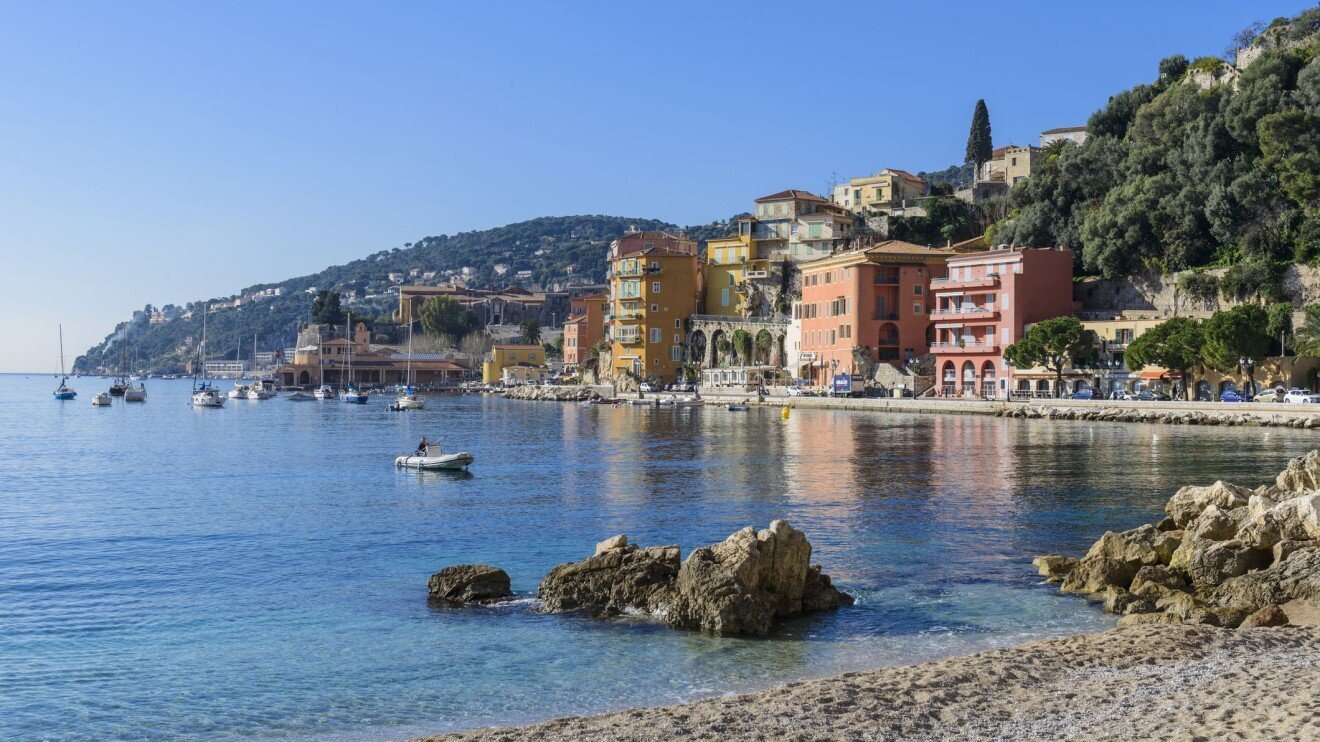
A resort town on the French Riviera, located in the Alpes-Maritimes department of the Provence-Alpes-Côte d’Azur region. Situated southwest of the Principality of Monaco, close to the border with Italy.
Geographic Location
Villefranche-sur-Mer (French pronunciation: [vilfʁɑ̃ʃ syʁ mɛʁ]; Occitan: Vilafranca de Mar; Italian: Villafranca Marittima) sits directly east of Nice, along the mountains of Mont Boron, Mont Alban, and Mont Vinaigrier, 10 kilometers southwest of Monaco.
Villefranche Bay is one of the deepest natural harbors of any port on the Mediterranean, providing safe anchorage for large ships against easterly winds. Reaching a depth of 98 meters between Cap de Nice and Cap Ferrat, it extends south into a 518-meter abyss known as the Villefranche submarine canyon, about 1.9 kilometers from shore.
The town’s boundaries extend up into the hills surrounding the bay, rising from sea level to 577 meters — the peak of Mont Leuze. The Basse Corniche passes through Villefranche, with the Moyenne Corniche above it, and the Haute Corniche higher still.
Historical Development
Antiquity and the Middle Ages
The territory of present-day Villefranche and the surrounding towns of Beaulieu-sur-Mer and Saint-Jean-Cap-Ferrat has been settled since prehistoric times. Celto-Ligurian tribes roamed the area and founded farming communities in the surrounding hills. The Greeks, and later the Romans, used the natural harbor as a waypoint en route to Greek settlements in the western Mediterranean.
After Julius Caesar’s conquest of Gaul, the Romans built an extension of the Via Aurelia, which passed through the settlement of Montolivo.
By the fall of the Carolingian Empire, the area was part of Lotharingia, and later part of the County of Provence. In 1295, Charles II, Duke of Anjou, then Count of Provence, prompted the residents of Montolivo and the surrounding area to resettle closer to the coastline, to protect the region from pirates. By charter, he established Villefranche as a «free port» (hence the name), granting tax privileges and port-fee rights that persisted until the 18th century.
The Savoy Period
In 1388, Eastern Provence became part of the Duchy of Savoy, following a disputed succession after the death of the childless Queen Joanna I of Naples. For the next 400 years, the territory, known as the County of Nice, was fought over bitterly between the Holy Roman Empire, allied with Savoy, and France.
In 1543, a combined Franco-Ottoman force sacked and occupied the town after besieging Nice, prompting Duke Emmanuel Philibert to secure the site by building an imposing citadel and fortress on nearby Mont Alban. In the late 17th century, the territory passed to the French, but was returned to Savoy after the Peace of Utrecht.
The 18th and 19th Centuries
In the 18th century, the town lost some of its maritime importance to the new port being built at Nice, but remained a naval base. In 1744, a combined Franco-Spanish army under the Prince of Conti routed the Piedmontese regiments of Charles Emmanuel III of Sardinia at Fort Mont Alban, on the heights above the town.
In 1793, the French returned to reoccupy Villefranche, and the County of Nice remained part of Napoleon’s empire until 1814. The Congress of Vienna returned it to the Kingdom of Sardinia.
In 1860, as a consequence of the Risorgimento, the territory was ceded to France by treaty, following a plebiscite.
Naval Significance
By the late 19th century, Villefranche had become an important base for the Imperial Russian Navy, and the Russians founded an oceanographic laboratory in the old naval hospital. The site also became a winter residence for royalty and wealthy visitors.
Villefranche Bay is notable for reaching considerable depth a short distance from shore. As a result, it became an important port over the years. From World War I onward, U.S. naval forces called here regularly, making Villefranche the home port of the U.S. Sixth Fleet from 1948 to February 1966, when French President Charles de Gaulle withdrew France from NATO and demanded American forces leave the country.
Shortly before 1966, the Sixth Fleet commander’s flagship rotated between USS Springfield and USS Little Rock. Since the 1980s, Villefranche has been used by cruise ships and is the most-visited cruise-ship port of call in France.
Architectural Landmarks
Religious Buildings
The Church of Saint-Michel, in the heart of the old town, was built in the 1750s in the Italian Baroque style on the site of a more modest early-14th-century church. It houses various works of art, notably a large painting of St. Michael above the marble high altar, a reclining sculpture of Christ (18th century) known as the «Christ of the Galleys,» and a polychrome wooden statue of San Rocco. Its organ, built by the Grinda brothers in 1790, is one of the oldest still in use in the County of Nice. The building was listed as a French historical monument in 1990.
The Chapel of Saint-Pierre dates to the 16th century. Used to store local fishermen’s nets and gear for most of the 19th and early 20th centuries, it was restored in 1957, with the addition of famous frescoes by Jean Cocteau depicting the life of the saint and local fishermen. The building was listed as a French historical monument in 1995.
Secular Buildings
The old harbor, La Darse, dates to the 17th century. Originally built for the Duke of Savoy’s galleys, it’s now a marina with a yacht yard. It’s also home to the Villefranche Oceanographic Observatory, run by Sorbonne University (Pierre and Marie Curie University) and France’s National Centre for Scientific Research, with 3 laboratories (oceanology, marine geology, and cell biology) and 150 staff. The buildings and structures surrounding the harbor have also been listed as French historical monuments since 1991.
The Citadel, built in 1557, now houses the town hall, a conference center, three museums, and an open-air theater.
Rue Obscure, or «Dark Street,» is a passage beneath the harbor houses dating back to 1260.
Villa Léopolda, in the surrounding hills, was once the residence of King Leopold II of Belgium and has been called «the most expensive house in the world.»
Beaches and Natural Beauty
Plage des Mariniers is the main beach, located on the north side of the bay. It stretches 700 meters beneath the railway line connecting Nice to Italy.
Plage de la Darse is a smaller pebble beach behind the main jetty of the La Darse harbor.
Cultural Significance
Film
The old town and bay have served for years as a natural backdrop for filmmakers. Among the many films shot here:
- «Captain Horatio Hornblower» by Raoul Walsh
- «Against All Flags» with Errol Flynn
- «To Catch a Thief» by Alfred Hitchcock
- «The Count of Monte Cristo» with Louis Jourdan
- «An Affair to Remember» by Leo McCarey, with Cary Grant and Deborah Kerr
- «The Madwoman of Chaillot» with Katharine Hepburn
- «Never Say Never Again» with Sean Connery
- «The Jewel of the Nile» with Michael Douglas
- «The Bourne Identity» with Richard Chamberlain
- «Killers» with Ashton Kutcher
- «Maximum Risk» with Jean-Claude Van Damme
- «Dirty Rotten Scoundrels» with Steve Martin and Michael Caine
- «Ronin» with Robert De Niro
- «Absolutely Fabulous: The Movie» with Jennifer Saunders and Joanna Lumley
The harbor building facades inspired the film sets for the «Moteurs... Action!» stunt show at the Walt Disney Studios Park in Disneyland Paris and Disney’s Hollywood Studios at Walt Disney World, Florida.
Music
It was in Villefranche-sur-Mer that the Rolling Stones recorded their 1972 album «Exile on Main St.» at a Belle Époque mansion called Néllcote.
Present Day
Villefranche is now part of the Nice Côte d’Azur metropolitan area and can be considered a suburb of greater Nice. Tourism remains its primary economic activity, with hotels and restaurants employing a significant share of the population.
Traditional activities like fishing have largely given way to maritime pursuits like sailing and deep-sea diving. Some shipyard activity remains at the La Darse harbor, but most of it has now moved to Antibes.
Villefranche continues to serve as a harbor for visiting naval forces, especially U.S. Navy ships. Since the 1980s, it has been actively used by cruise ships, becoming the most-visited cruise-ship port of call in France.
Scientific Significance
The town is home to the Villefranche Oceanographic Observatory (Observatoire Océanologique de Villefranche), a research center run jointly by Sorbonne University (Pierre and Marie Curie University) and France’s National Centre for Scientific Research. The observatory comprises three laboratories — oceanology, marine geology, and cell biology — employing 150 specialists.
The institution continues a research tradition dating back to the late 19th century, when the Russians founded an oceanographic laboratory here. Thanks to the bay’s unique location, with its exceptional depths so close to shore, Villefranche remains an important center for marine research.
Conclusion
Villefranche-sur-Mer represents a unique blend of natural beauty, rich history, and modern functionality. This small resort town on the French Riviera has managed to preserve its distinct character and historical heritage while remaining an important tourist center and a scientific outpost.
From its ancient Celto-Ligurian settlements to modern cruise liners, from medieval fortresses to oceanographic laboratories, Villefranche embodies centuries of Mediterranean history. Its strategic location, unique bay, and architectural gems make it one of the most appealing spots on the Côte d’Azur.